

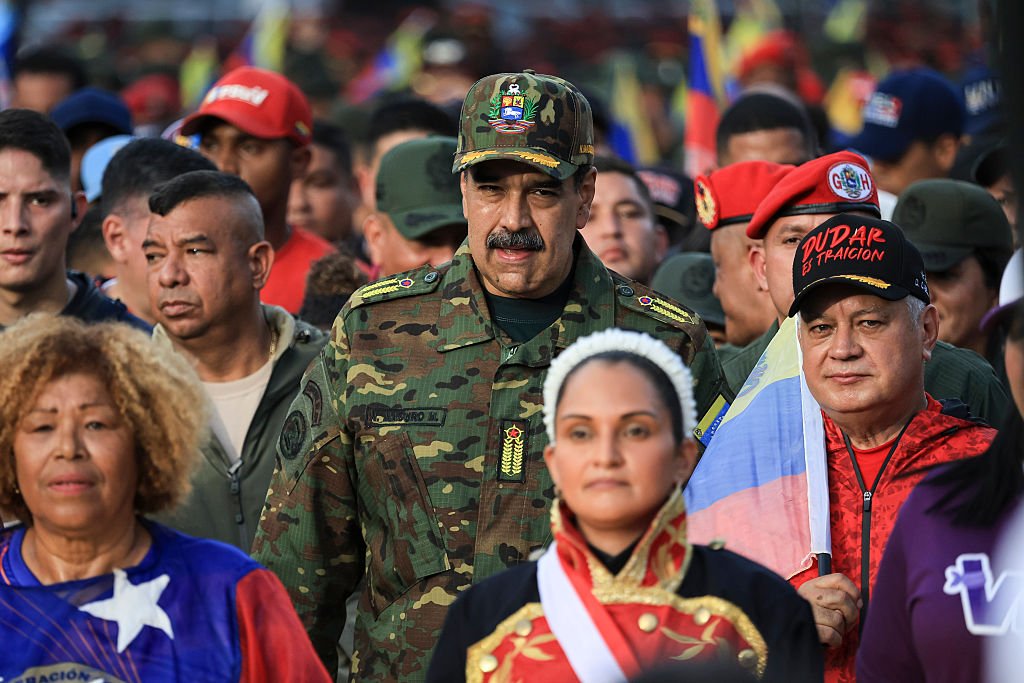
As former Venezuelan President Nicolás Maduro prepares to fight drug, weapon, and narco-terrorism charges in the United States after being arrested in Caracas, Venezuela, early Saturday morning by U.S. military forces, legal scholars and analysts are putting a spotlight on past Supreme Court rulings about presidential authority, extraterritorial arrests, and the rights of foreign leaders while debating the legality of the Trump administration’s actions.
The cases they’re revisiting principally relate to two aspects of Saturday’s operation and the criminal case against Maduro: 1) Whether President Donald Trump had the authority to send U.S. forces into Venezuela to arrest Maduro; and 2) Maduro’s likely defense in U.S. courts.
Supreme Court precedent has less to say about the first question than the second. As Steve Vladeck noted, the Justice Department contended in a 1989 DOJ Office of Legal Counsel memorandum that the president may order extraterritorial arrests, even if these are in contravention of international law. Additionally, in a prior memo, the DOJ asserted that the president has “inherent authority … to use troops to protect federal functions.”
In making these claims, the DOJ drew on the 1890 case of In re Neagle. This case arose after David Neagle, a deputy U.S. marshal assigned to protect Justice Stephen Field while he was in California, killed a man who assaulted Field. California officials charged Neagle with murder, contending that Neagle was not acting as a federal officer – and therefore did not have immunity from state law – because the U.S. attorney general did not have the authority to provide Field with a bodyguard.
In holding that the attorney general did have that authority, the Supreme Court emphasized that the president’s “general obligation” to execute the laws of the United States includes an obligation to protect the people charged with carrying out those laws. That holding is relevant to Saturday’s operation in Venezuela because the Trump administration has cited the need to protect those tasked with arresting Maduro as justification for using military force – although the court has not addressed the boundaries for the use of force and how, exactly, international law should be recognized here (if at all).
Supreme Court precedent is also playing a role in debates over how Maduro will fight the charges against him. In several past cases, the Supreme Court has addressed how U.S. courts should respond to potentially unlawful extraterritorial arrests, claims of immunity by foreign heads of state, and who determines whether someone who presents himself as a head of state is treated as such by the U.S. legal system.
Cases on the first issue work against Maduro, according to legal experts. Even if he could prove that his arrest in Caracas violated international law, it likely wouldn’t prevent U.S. courts from hearing the criminal case against him. As Vladeck explained, the Supreme Court has repeatedly held that “unlawful abductions of criminal suspects from foreign soil, even by the U.S. government, do[] not preclude their criminal prosecution in U.S. courts.”
Vladeck pointed to 1992’s United States v. Alvarez-Machain as one such ruling. In that case, the justices considered whether a criminal trial could proceed in the U.S. against a Mexican citizen, Humberto Alvarez-Machain, who was indicted for kidnapping and murdering a DEA agent and the agent’s pilot. Alvarez-Machain had been forcibly taken from his home at the direction of DEA agents and flown to Texas to stand trial. A U.S. district court and the U.S. Court of Appeals for the 9th Circuit sided with Alvarez-Machain, ruling that U.S. officials had violated an extradition treaty between the U.S. and Mexico and that, as a result, the U.S. did not have proper jurisdiction over the defendant.
Nevertheless, the Supreme Court ruled 6-3 in favor of the United States, holding that the abduction did not violate the treaty because “[t]he Treaty says nothing about the obligations of the United States and Mexico to refrain from forcible abductions of people from the territory of the other nation, or the consequences under the Treaty if such an abduction occurs.” In the absence of a treaty violation, Chief Justice William Rehnquist explained, the court was free to apply its preexisting doctrine on prosecution after a forcible abduction, which said that “forcible abduction is no sufficient reason why the party should not answer when brought within the jurisdiction of the court which has the right to try him.”
Maduro may fare better by drawing on cases on the unique legal status of heads of state. “It is a longstanding principle of international law that heads of state have immunity in foreign courts,” according to The New York Times, and the “Supreme Court has recognized that constraint dating back to an 1812 opinion that says ‘the person of the sovereign’ is exempt from arrest or detention within a foreign territory.”
In that 1812 case, Schooner Exchange v. McFaddon, for example, the court addressed whether U.S. courts had the authority to hear a dispute over control of a foreign vessel in a U.S. port. In explaining why they did not, Chief Justice John Marshall reflected more broadly on how granting immunity to certain foreign officials is a path toward peace. If a head of state enters a foreign territory “with the knowledge and license of its sovereign, that license, although containing no stipulation exempting his person from arrest, is universally understood to imply such stipulation,” Marshall wrote.
But such language may ultimately prove a thin reed for Maduro to rely on, as the Supreme Court has also held, as The New York Times noted, that “presidents have absolute authority to recognize foreign governments.” That conclusion came in a 2015 case called Zivotofsky v. Kerry, in which the court sided with the federal government in a dispute over the government’s refusal to list Israel as a U.S. passport applicant’s place of birth due to a policy stating that no country has sovereignty over Jerusalem. As SCOTUSblog reported at the time, the court held that the Constitution gives the president the exclusive power to recognize foreign sovereigns and their boundaries.
If Maduro argues, as expected, that he should be immune from prosecution as a head of state, the Trump administration could counter that neither Trump nor former President Joe Biden recognized him as such beginning in 2019.
Although it will likely be years before the Maduro case could make it to the Supreme Court, some legal scholars are already predicting that it will end up there. “I think the odds are good that it will be appealed to the Supreme Court by one or another party,” said Michael Gerhardt, a law professor at the University of North Carolina, to Newsweek. Of course, on what grounds and in what posture any appeal would occur is – at least at the moment – as unpredictable as everything else concerning the arrest of Maduro.
Posted in Court Analysis, Featured
Recommended Citation:
Kelsey Dallas,
Maduro’s arrest places these Supreme Court rulings in the spotlight,
SCOTUSblog (Jan. 6, 2026, 2:50 PM),
https://www.scotusblog.com/2026/01/maduros-arrest-places-these-supreme-court-rulings-in-the-spotlight/
