


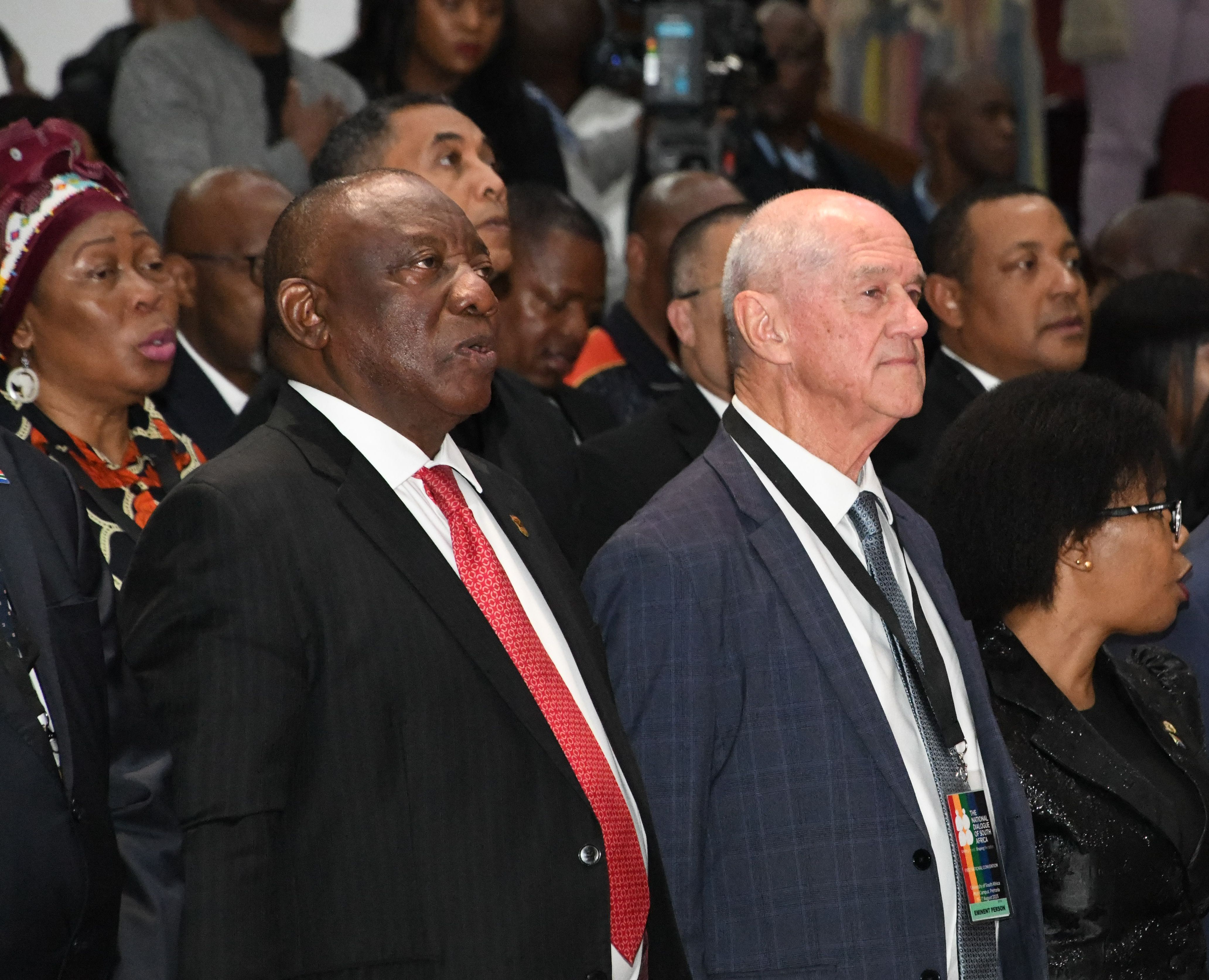
Months after Roelf Meyer was sent to repair relations with the US, he has failed, because his government is not prepared to do the simplest things to enable a new trade and investment pact with Washington.


South Africa’s ambassador to the United States (US), Roelf Meyer, was sent to Washington with a straightforward mission. He was expected to rebuild South Africa’s relationship with its most important Western economic partner and create the conditions for greater trade and investment. Instead of getting that right he was let down by Pretoria and now Washington has moved to sanction South African leaders.
US Secretary of State Marco Rubio announcedthe new policy this week. It provides for visa restrictions against foreign nationals responsible for, or complicit in, policies promoting race-based discrimination, inciting imminent violence against racial or ethnic minorities, or enabling expropriation without compensation.
Meyer was appointed in April and presented his credentials to President Donald Trump in May. President Cyril Ramaphosa selected him because he thought Meyer could buy time and head off any sanctions risk until the US midterm elections or a future presidential election changed the balance of power in Washington. The intent from the start was to delay and obfuscatehy, given Meyer’s Afrikaner roots
This is exactly what The Common Sensewarned of when Meyer was appointed.
For the five months after Meyer’s appointment, no sincere attempt was mounted to address America’s concerns and Washington has moved from criticising South African government policy to imposing direct consequences on people involved in making or implementing it.
It was always easy to prevent this and it remains easy to set it right.
American firms need to be granted exemption from black economic empowerment (BEE). South Africa’s government already does thatof foreign investors. South Africans support that for American firms too, as polls conducted by this newspaper and its polling partner, the Social Research Foundation, have shown
The chart below shows data from July on the explicit question of exempting US firms from BEE.
On expropriation, the relevant Act allows the seizure of any fixed or movable asset for less than its market value. The South African government, however, says that this will not be executed. No firm is going to commit much to South Africa under such circumstances, especially given that its government has already seized mineral and water rights for no compensation and is threatening to take land, medical insurance schemes, and pension funds too, and forcing a regime of prescribed assets.
On farm killings and murders, into which this newspaper has produced the most cutting-edge research, it would be a simple matter to placate the Americans
And Pretoria needs to back off on some of its nefarious foreign policy positions.
Pretoria is not, therefore, going to get anywhere by pursuing better public relations in Washington. It needs to move to take firm decisions on policy reforms, which will in turn open the way to a vast new trade and investment pact in the best interests of both countries and their governments.
Earlier this year, The Common Senseset out what a South African trade and investment offer to Washington could look like. Rather than concentrating narrowly on preserving access to the African Growth and Opportunity Act, which is a silly and small thing compared to what South Africa should be aiming for, or negotiating individual tariff concessions, the door is wide open to secure a much larger economic partnership involving minerals, energy, agriculture, technology, infrastructure, and investment.
To the degree that the American sanctions policy is framed as an Afrikaner issue The Common Sense has made its views plain on that. All South Africans insofar as they are victims of the parlous state of the economy, or violence, or are denied property rights suffer the consequences of their government’s counter-productive policies.
As thisnewspaper has made the case about March and March, and the uMkhonto weSizwe Party, and the loss of the African National Congress’s (ANC’s) parliamentary majority, that party and the government just flatly refused to entertain moderate advice on reform, reform that would have improved peoples’ lives, just as an American deal would have done, and now, as a consequence, the government and the ANC face hardliners on more and more fronts. Washington is just another of those and it could easily have been avoided – all of it.
What of the view that South Africa should stand its ground and not compromise on its “principles” and “sovereignty”?
South Africa needs capital desperately. Fixed investment remains far below the levels necessary to produce sustained economic growth. Low growth is the reason the unemployment rate is over 30%, and over 50% for young South Africans. That, in turn, is what is breaking the ANC apart, sinking the authority of the government in Pretoria, and putting the 1994 democracy on the line. Some “principles” those – that leave half of young people without work!
Why is the capital investment rate so low? Because all investors know what the Americans are unique in being prepared to state: that South Africa’s empowerment and expropriation policies make the country essentially uninvestable. The Americans are therefore right on what South Africa needs to do, not just to turn its economy around, but also to preserve its democracy.
To date, however, South Africa’s government has shown no inclination to consider even moderate domestic voices that have made the same point. The ANC has been so opposed to pragmatic reforms that it effectively conceded losing control of South Africa as the price of clinging to its counterproductive policies. And yesterday, the American ambassador warnedthat the initial sanctions may be only the start and that escalation will follow. The advice of cool, centrist, pragmatic voices that have South Africa’s best interests at heart, needs to be followed to ensure that this is avoided.


