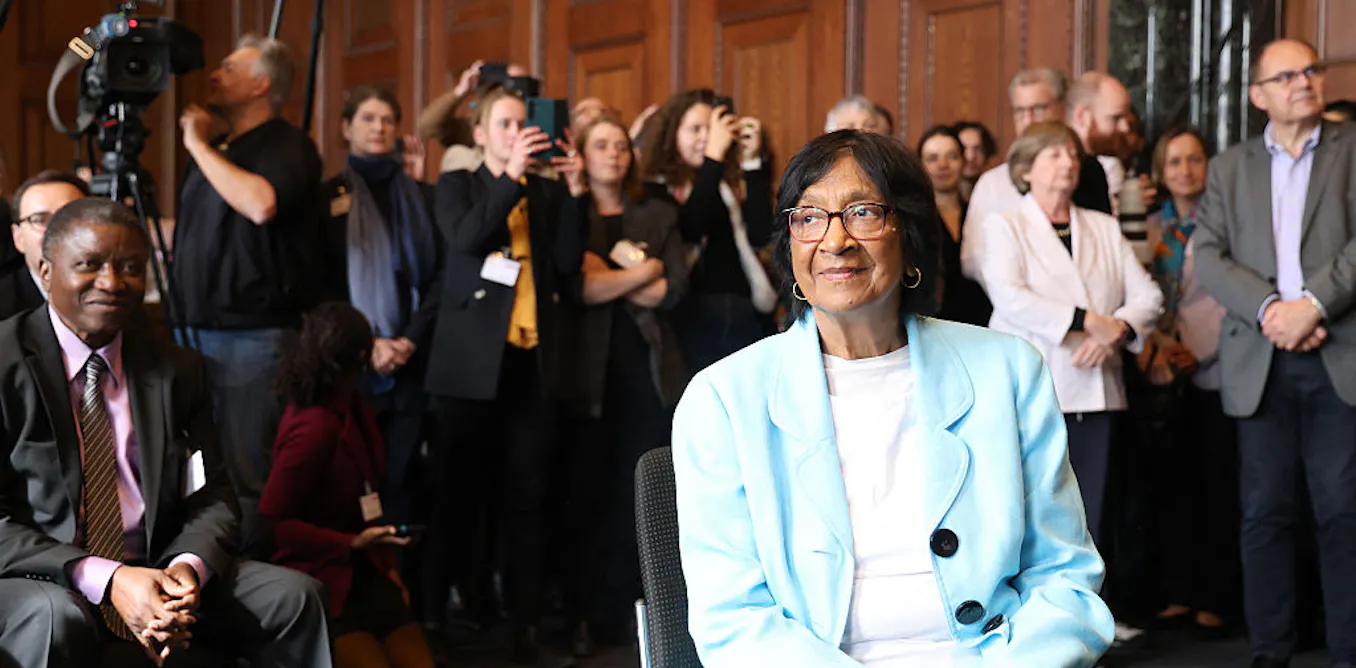
The awarding of the 2026 Nobel Peace Prize to distinguished <a href="https://absafricatv.com/how-a-south-african-billionaire-is-turning-a-corner-of-somerset-into-one-mans-estate/" title="How a South African billionaire is turning a corner of Somerset into ‘one man’s estate’”>South African jurist and international judge Navanethem “Navi” Pillay is about more than just the recognition of an exceptional individual in the global fight for justice.
It’s clear that the prize also speaks to a bigger context. It comes at a time of pressure on and the questioning of the international legal order.
Pillay’s recognition affirms the conviction that international law, however imperfectly applied, remains indispensable to a peaceful world.
Making history
It is a proud moment for South Africa. She becomes the fifth South African to receive this honour, following resistance leader Chief Albert Luthuli in 1960, religious leader and activist Archbishop Desmond Tutu in 1984, and former presidents Nelson Mandela and FW de Klerk in 1993.
She is the first South African woman to receive the peace award. Her prize is a further break with its historical tendency to mostly honour “highly educated white men from Europe and the US”.
Similar to her South African predecessors, the struggle against apartheid and white minority rule features as a crucial element of her contribution. However, there is an important difference. While Mandela became a global symbol of reconciliation, Pillay took the lessons of South Africa’s struggle into the international arena. There she became leader and institution builder in her own right.
She had the daunting task of being one of the very first international judges responsible for forging into being international institutions intended to ensure that those responsible for the gravest human rights violations are held accountable.
She was on the first bench of judges of both the International Criminal Tribunal for Rwanda, established by the United Nations (UN) following the 1994 genocide in Rwanda, and the International Criminal Court (ICC) from 2003 to 2008.
Her personality and drive endowed these fledgling institutions with gravitas and legitimacy. Through her pioneering contributions, she has come to personify the global quest for accountability.
The Navi Pillay I know
As a scholar of international human rights law, I first met Pillay when she was president of the Rwanda tribunal in Arusha, Tanzania. She struck me then, and over time continued to impress me, as someone remarkably approachable. Humble, unassuming and generous with her time, she is also often described as courageous, principled, and unwavering.
I smiled when, in her characteristically down-to-earth reply to the Nobel committee praising her courage, she insisted she was merely applying her independent legal mind to the stark principles of justice.
When I first met her, I was with a group of human rights students from the University of Pretoria visiting Tanzania to observe proceedings. Judge Pillay’s demanding schedule prevented her from spending much time with us during the day. Yet she offered to meet us at her hotel that evening. To our surprise, she arrived driving herself, without a chauffeur or an entourage. She spent many hours answering questions and discussing the work of the tribunal.
Similar encounters continued over subsequent years. To me, these moments revealed her understanding of human rights institutions not as remote structures, but as belonging to people. This included young Africans who she hoped would one day help shape their future.
From apartheid to global justice
Pillay’s story is held together by a central belief, whether in response to apartheid in South Africa, genocide in Rwanda or the occupation of Palestinian territory: that law can restrain abusive power, protect victims and hold the powerful to account. She simply applied it on a bigger stage each time.
Born in 1941 in Durban, to a family of Indian Tamil origin, Pillay experienced racial and gender discrimination first-hand. Despite this, she built a legal career. In 1967 she became the first woman of colour to establish a legal practice in her province.
Like many lawyers opposed to apartheid, she sought to use the very legal system that sustained injustice to challenge its abuses. She represented political activists, exposed torture and challenged the treatment of political prisoners.
She was also involved in the Women’s National Coalition, which helped shape the equality provisions of South Africa’s democratic constitution. These prohibit discrimination on grounds including race, sex and sexual orientation. After apartheid ended, Mandela in 1995 appointed her as a High Court judge.
Rape as a crime against humanity
Later that year she took up office in Tanzania, where one of her most enduring global contributions came in the Rwanda tribunal’s landmark 1998 judgement.
During the trial of Jean-Paul Akayesu, accused of the slaughter of thousands, Pillay and another judge questioned witnesses about sexual violence. They helped bring these experiences into the open and contributed to the amendment of the indictment to include rape.
The result was a judgment that recognised rape as a crime against humanity. It established that rape and sexual violence could also constitute acts of genocide.
The decision constituted the first conviction for genocide by an international criminal tribunal and the first conviction of an individual for rape as a crime against humanity by such a tribunal. This opened the way for greater accountability for crimes committed disproportionately against women and girls.
From time immemorial, rape has been regarded as spoils of war. Now it will be considered a war crime.
Human rights within the UN
From 2008 to 2014, Pillay served as UN High Commissioner for Human Rights, the first woman from the global south to hold this position.
It required a different form of leadership. Rather than deciding cases as a judge, she had to engage governments, confront violations and persuade states to honour their international obligations. During her tenure, she managed to steer the UN’s human rights work through turbulent times, including the aftermath of the global financial crisis, the Arab Spring, and civil war in Syria. Her voice was a steadfast pillar of clarity: human rights could not be sacrificed to economic expediency, national sovereignty or political convenience.
Her tenure coincided with significant advances within the UN. She was a consistent advocate for the rights of equality based on sexual orientation and gender identity, anti-discrimination laws, and proper recording of hate crimes.
In 2001, her home city, Durban, hosted the UN’s World Conference against Racism, Racial Discrimination, Xenophobia and Related Intolerance. The Durban Declaration set an international agenda against racism and xenophobia. It also acknowledged slavery as a crime against humanity.
Although she had no official role in the 2001 conference, as UN high commissioner she was closely involved in the subsequent review process. She defended the declaration against misrepresentation. She emphasised its condemnation of antisemitism, remembrance of the Holocaust and recognition of Israel’s right to security.
Despite boycotts by several western states, including the US, she helped steer the 2009 Durban Review Conference towards a consensus reaffirming the declaration, supported by 182 states. Her role exemplified her determination to overcome division and backlash without compromising fundamental human rights principles.
Pillay’s term was also characterised by a distinctive contribution to women’s rights by championing the recognition of preventable maternal deaths as a human rights issue, rather than merely a public health concern. Under her leadership, the UN Human Rights Office developed groundbreaking guidance in 2012 requiring governments to address discrimination, maternal healthcare and accountability for avoidable deaths.
Palestine and genocide
More recently, she took up her last official UN duty as chair of the Independent International Commission of Inquiry on the Occupied Palestinian Territory and Israel. The commission’s investigations and findings, including on the war in Gaza, have generated considerable controversy and strong criticism, particularly from Israel and the US.
Her dedication to this task illustrates an essential feature of her work: the application of legal principles becomes most difficult, and most necessary, when politically powerful actors reject scrutiny.
A time when hope is needed
The timing of this award is therefore particularly telling. It comes as, only days earlier, US president Donald Trump had called the ICC “evil” and urged all its members to resign. Responding to the prize, the US imposed sanctions on the ICC.
The award also comes amid Israel’s growing international isolation. Pillay and her team concluded in 2025 that Israel was committing genocide in Gaza.
The commission’s findings do not constitute a binding judicial determination. But they do represent a significant contribution to documenting alleged atrocities and advancing the pursuit of accountability, despite intense political opposition.
Even as Pillay recently celebrated her 85th birthday, she may soon have another word on genocide. Since 2019, she has been sitting as an ad hoc judge at the International Court of Justice in the case brought by The Gambia against Myanmar concerning alleged genocide against the Rohingya. Following a public hearing in January 2026, a judgment in this case is expected later this year, or in early 2027.
Her Nobel Prize does not suggest that international justice has triumphed. But it reminds us that the structures built to advance it remain worth defending. Recognising Pillay is an affirmation of what has been achieved, but also about what must not be lost.