



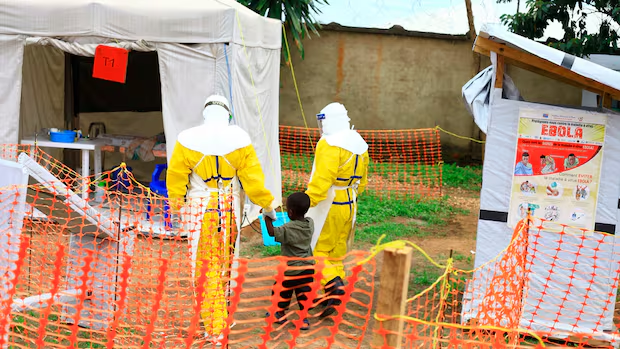
Africa’s top public health body on Friday confirmed a new Ebola outbreak in Congo’s remote Ituri province, with 246 suspected cases and 65 deaths recorded so far.
The deaths and suspected cases have been recorded mainly in the Mongwalu and Rwampara health zones, the Africa Centres for Disease Control and Prevention said in a statement. A case has now also been confirmed by Uganda’s health ministry, who said a Congolese man died in Kampala.
The Ebola virus is highly contagious and can be contracted through bodily fluids such as vomit, blood or semen. The disease it causes is rare, but severe and often fatal.
“Four deaths have been reported among laboratory-confirmed cases. Suspected cases have also been reported in Bunia, pending confirmation,” the agency said, referring to the capital of Ituri province, near the border with Uganda.
It said preliminary laboratory results had detected the Ebola virus in 13 of 20 samples. The results suggest a non-Ebola Zaire strain of the virus with sequencing ongoing to further characterize the strain, the agency said. The Ebola Zaire strain has been prominent in Congo’s past outbreaks.
“I think the big news is that this obviously is not Ebola Zaire, which is what we normally are accustomed to in DRC [Democratic Republic of the Congo],” said Jason Kindrachuk, an associate professor in medical microbiology and infectious diseases at the University of Manitoba.
“That changes the calculus a little bit, right? Because we don’t have the ability to just get in and start vaccinating everybody with the Ervebo vaccine.”


WHO director-general Tedros Adhanom Ghebreyesus says the global health agency is supporting officials in Congo as they investigate following the confirmation of Ebola cases in Ituri province. Congo has a strong track record in Ebola response, said Tedros, who offered WHO emergency funding and technical support.
The World Health Organization said last year that Congo has a stockpile of treatments and some 2,000 doses of the Ervebo Ebola vaccine. However, the vaccine is only effective against the Ebola Zaire strain, it said.
The Africa CDC said results confirming the strain in the new outbreak are expected within 24 hours.
The agency also said it is convening an urgent co-ordination meeting Friday with health authorities from Congo, Uganda and South Sudan, together with key partners, including other countries, UN agencies and the Public Health Agency of Canada.
“The meeting will focus on immediate response priorities, cross-border co-ordination, surveillance, laboratory support, infection prevention and control, risk communication, safe and dignified burials, and resource mobilization,” it said.
Dr. Tedros Adhanom Ghebreyesus, World Health Organization director-general, told reporters Friday that the WHO last week sent a team to help Congo investigate the outbreak and collect samples. While initial results did not confirm Ebola, a new analysis on Thursday did, he said.
Congo has “a strong track record in Ebola response and control,” Tedros said, adding that the WHO is releasing $500,000 to aid Congo’s response.
In a media call, acting director of the Centres for Disease Control and Prevention, Dr. Jay Bhattacharya, said the agency is working closely with DRC’s ministry of health.
“This morning we also heard from the Government of Uganda confirming an Ebola outbreak there, and we are also co-ordinating with our country office in Uganda and our colleagues there to track and help with the outbreak there,” Bhattacharya told reporters.
Asked about cuts to U.S. foreign aid across Africa, Bhattacharya said the CDC country offices in both nations were well-staffed and equipped to help with the outbreak, and that the agency will mobilize them as needed.
Affected areas are close to Uganda, South Sudan borders
The latest outbreak comes around five months after Congo’s last Ebola outbreak that killed 43 was declared over.
“This is not their first game with Ebola,” said Kindrachuk in Manitoba. “They’ve gone through this, they are the world’s experts in terms of response.”
But, he says trying to manage an unknown strain, in an area dealing with violence, will add complications.

“When we talk about people being sick, they are very, very sick,” Kindrachuk said.
“And trying to provide them supportive care in areas where there aren’t resources for proper supportive care, like we would see [in Canada] or in Europe, it makes things very, very complex.”
Ituri is in a remote eastern part of Congo characterized by poor road networks, more than 1,000 kilometres from the nation’s capital of Kinshasa.
Africa CDC said it is concerned about the risk of further spread due to intense population movement, mining-related mobility in Mongwalu, insecurity in affected areas, gaps in contact listing and control challenges.
The proximity of affected areas to Uganda and South Sudan also raises concerns, it said.
Congo has seen more than a dozen Ebola outbreaks
This is the 17th outbreak in Congo since the disease first emerged in the country in 1976. An Ebola outbreak from 2018 to 2020 in eastern Congo killed more than 1,000 people. The WHO said that outbreak was characterized by the Ebola Zaire strain.
The World Health Organization has deemed the Ebola outbreak in Congo a public health emergency of international concern.
An earlier outbreak that swept across West Africa from 2014 to 2016 also killed more than 11,000 people.
The new outbreak will create more worry for the Central African country, which has been battling various armed groups in the east, including the M23 rebel group, which launched a rapid assault in January last year and has since occupied key cities.
Ituri in particular is also battling violence from the Allied Democratic Force, an Islamic State-linked militant group which has killed dozens there and in other parts of the east.
“This is a conflict-ridden area which is only going to exacerbate things,” said Kindrachuk.
“This is making a bad situation … even worse now.”
Congo, Africa’s second-largest country by land area, often faces logistical challenges in responding to disease outbreaks. During last year’s outbreak, which lasted three months, the World Health Organization initially faced significant challenges in delivering vaccines due to limited access and scarce funds.
Dr. Gabriel Nsakala, a professor of public health who has been involved in past Ebola outbreak responses in Congo, said the country and health workers on the ground have a high level of experience, in addition to existing infrastructure such as laboratories.
“In terms of training, people already know what they can do. Now, the expertise and equipment need to be delivered quickly,” Nsakala added.





