

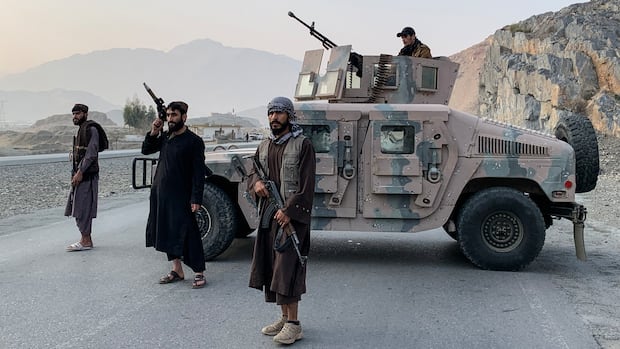
The Pakistan defence minister’s declaration of “open war” between his country and Afghanistan seemed both unexpected and inevitable.
It’s unexpected because Pakistan and the Taliban were once close allies. Pakistan is one of only three countries to recognize the first Taliban government that seized power in Afghanistan in 1996, and Pakistan welcomed its return in 2021.
And it’s inevitable because the two Islamic neighbours share a complicated history that has deteriorated rapidly over the last five years, leading to military strikes in early October of last year and an unsteady ceasefire that has now collapsed completely.
Here’s a quick overview of why the two Islamic neighbours are fighting and what might happen next.
What’s happening?
In an escalation of an already violent tit-for-tat between the countries, Pakistan early on Friday bombed Taliban government forces in major Afghan cities, including the capital Kabul and the Taliban’s headquarters, Kandahar. Pakistan called it Operation Righteous Fury.
It was the first time Islamabad has attacked Taliban military facilities rather than militants it says are backed by the group, a stark rupture in ties between the neighbouring countries.

Pakistan said it had targeted and killed dozens of militants in airstrikes on Sunday. Afghanistan said only civilians were killed and launched a cross-border attack in six provinces in retaliation.
After Pakistan’s Friday attack, border fighting resumed and is ongoing.
Why are they fighting?
Both sides blame the other for a surge in terrorist attacks in each country since the Taliban returned to power.
Pakistan, which has suffered suicide bombings and assaults on security forces, blames the Pakistani Taliban, or TTP, for many of the attacks, and says the group (which is distinct from the Afghan Taliban) receives safe haven inside Afghanistan.
The TTP was created almost 20 years ago when militants banded together to fight Pakistan and to support the Afghan Taliban’s fight against the U.S. and NATO. It has attacked markets, mosques, airports, military bases and police stations, and it has also gained territory — mostly along the border with Afghanistan.
Pakistan says armed insurgents seeking independence for the southwestern Pakistani province of Balochistan also shelter in Afghanistan.

The Afghan Taliban, meanwhile, says Pakistan harbours ISIS members. ISIS, the Islamic State in Iraq and Syria, has carried out numerous attacks, including suicide bombings, since the Taliban’s return to power, despite the Taliban’s promise to restore security in the country.
Each side denies they give safe haven to terrorists.
What are some of the deeper issues?
A disputed border: Afghanistan and Pakistan’s relationship has been complicated since Pakistan was founded in 1947. The rugged and porous 2,600-kilometre border between the countries is known as the Durand Line, named after Sir Henry Mortimer Durand and decided upon in 1893 as the dividing line between Afghanistan and what was then the British Indian Empire. Pakistan inherited the border when the country was founded, but Afghanistan has never recognized it.
A refugee crisis: Millions of Afghan nationals have made their home in Pakistan over the decades, fleeing war, poverty and oppression. The International Crisis Group, a non-government organization that works to resolve deadly conflicts, says Pakistan has hardened its stance toward Afghan nationals living in Pakistan, expelling hundreds of thousands of refugees “including the most vulnerable — women and girls, journalists and rights defenders.”
“It now requires that any Afghan wishing to remain in the country — even someone with UN refugee status — obtain a visa,” the NGO said, in a recent report.

India complicates things: Pakistan helped give birth to the Taliban in the early 1990s as a way to give “strategic depth” to its rivalry with India. Now, Pakistan accuses Afghanistan of cozying up to its rivals. In his tweet declaring “open war,” Defence Minister Khawaja Mohammad Asif also said the Taliban had turned Afghanistan “into a colony of India.” India’s ties with Afghanistan have improved recently, with offers of enhanced trade, to the annoyance of Islamabad.
What next?
If the sides move toward negotiation, the two countries will have plenty of support from outside countries concerned that a prolonged conflict would be a boon for ISIS and other militant groups that operate in the region. Russia, China, Turkey and Saudi Arabia are all trying to mediate in the conflict, diplomats and news reports said.
“While conflict between Afghanistan and Pakistan poses a far lower escalation risk [than] between nuclear-armed Pakistan and India, the regional instability created by the Pakistan-Taliban conflict provides international terrorist groups … room to operate and increases the global terrorist threat,” the D.C.-based Center for Strategic and International Studies said in a report earlier this month.
If the sides opt for an ongoing war, it will not be a symmetrical conflict. Nuclear-armed Pakistan has 600,000 active personnel, more than 6,000 armoured vehicles and hundreds of combat aircraft. The Taliban has fewer than 200,000 personnel and few aircraft. It does, however, have a reputation for guerilla warfare.
The potential for a large conflict has people on both sides concerned.
In Pakistan, the population is worried about militant attacks in large cities. In impoverished Afghanistan, ordinary people have memories of many past conflicts, including the two-decade insurgency against the U.S.-backed government.
“Misery has started again,” Yalda, 35, told Reuters.
