


Listen to this article
Estimated 5 minutes
The audio version of this article is generated by AI-based technology. Mispronunciations can occur. We are working with our partners to continually review and improve the results.
Gaza’s Rafah border crossing with Egypt reopened on Monday for limited traffic, a key step in the Israeli-Hamas ceasefire but a mostly symbolic development on the ground, as few people will be allowed to travel in either direction and no goods will be going into the war-torn territory.
Within the first couple of hours of the opening, no one was actually seen crossing in or out of Gaza. Nevertheless, the reopening is seen as a key step as the U.S.-brokered ceasefire agreement that took effect on Oct. 10 moves into its second phase.
The truce halted more than two years of war between Israel and Hamas, which began with the Hamas-led attack on southern Israel on Oct. 7, 2023. Its first phase called for the exchange of all hostages held in Gaza for hundreds of Palestinians held by Israel, an increase in badly needed humanitarian aid and a partial pullback of Israeli troops.
Israeli troops seized the Rafah crossing in May 2024, calling it part of efforts to combat arms-smuggling for the militant Hamas group. The crossing was briefly opened for the evacuation of medical patients during a ceasefire in early 2025. Israel had resisted reopening the Rafah crossing, but the recovery of the remains of the last hostage in Gaza cleared the way to move forward.
About 20,000 Palestinian children and adults needing medical care hope to leave devastated Gaza via the crossing, according to Gaza health officials. Thousands of other Palestinians outside the territory hope to enter and return home.
State-run Egyptian media and an Israeli security official also confirmed the reopening. The officials spoke to The Associated Press on condition of anonymity to discuss the issue.
Egypt prepares to receive war-wounded
Before the war, Rafah was the main crossing for people moving in and out of Gaza. The territory’s handful of other crossings are all shared with Israel. Under the terms of the ceasefire, Israel’s military controls the area between the Rafah crossing and the zone where most Palestinians live.
About 150 hospitals across Egypt are ready to receive Palestinian patients evacuated from Gaza through Rafah, authorities said. Also, the Egyptian Red Crescent said it has readied “safe spaces” on the Egyptian side of the crossing to support those evacuated from the Gaza Strip.

The Rafah border crossing from Gaza to Egypt is set to reopen and though only 150 people are expected to be allowed through each day, it’s providing a sliver of hope after years of war.
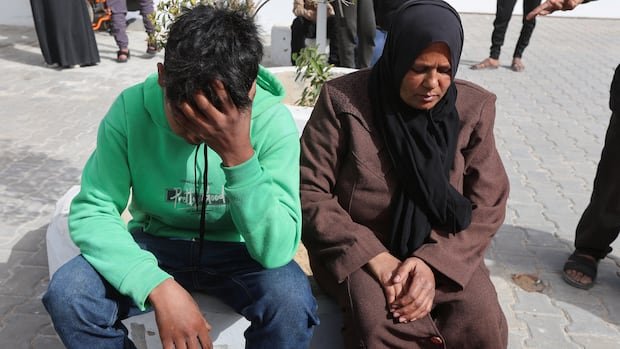
On Monday, Rajaa Abu Mustafa stood outside a Gaza hospital where her 17-year-old son Mohamed was awaiting evacuation. He was blinded by a shot to the eye last year as he joined desperate Palestinians seeking food from aid trucks east of the city of Khan Younis.
“We have been waiting for the crossing to open,” she said. “Now it’s opened and the health ministry called and told us that we will travel to Egypt for [his] treatment.”
Israel has banned sending patients to hospitals in the Israeli-occupied West Bank and East Jerusalem since the war began — a move that cut off what was previously the main outlet for Palestinians needing medical treatment unavailable in Gaza.
Israel has said it and Egypt will vet people for exit and entry through the Rafah crossing, which will be supervised by European Union border patrol agents with a small Palestinian presence. The numbers of travellers are expected to increase over time, if the system is successful.
Fearing that Israel could use the crossing to push Palestinians out of the enclave, Egypt has repeatedly said it must be open for them to enter and exit Gaza. Historically, Israel and Egypt have vetted Palestinians applying to cross.
Palestinian toddler killed by Israeli fire
Violence continued across the coastal territory on Monday, and Gaza hospital officials said an Israeli navy ship had fired on a tent camp sheltering displaced people on the coast of Gaza’s southern city of Khan Younis, killing a three-year-old Palestinian boy. Israel’s military said it was looking into the incident.
According to the Nasser hospital, which received the body, the attack happened in Muwasi, a tent camp area on the Gaza Strip’s coast.

More than 520 Palestinians have been killed by Israeli fire since the Oct. 10 ceasefire, according to the strip’s health ministry. The casualties since the ceasefire, which UNICEF said include more than 100 children, are among the over 71,700 Palestinians killed since the start of Israel’s offensive in October 2023, according to the Gaza health ministry, which does not say how many were fighters or civilians.
The second phase of the ceasefire deal is more complicated. It calls for installing the new Palestinian committee to govern Gaza, deploying an international security force, disarming Hamas and taking steps to begin rebuilding.
