

AFP via Getty Images
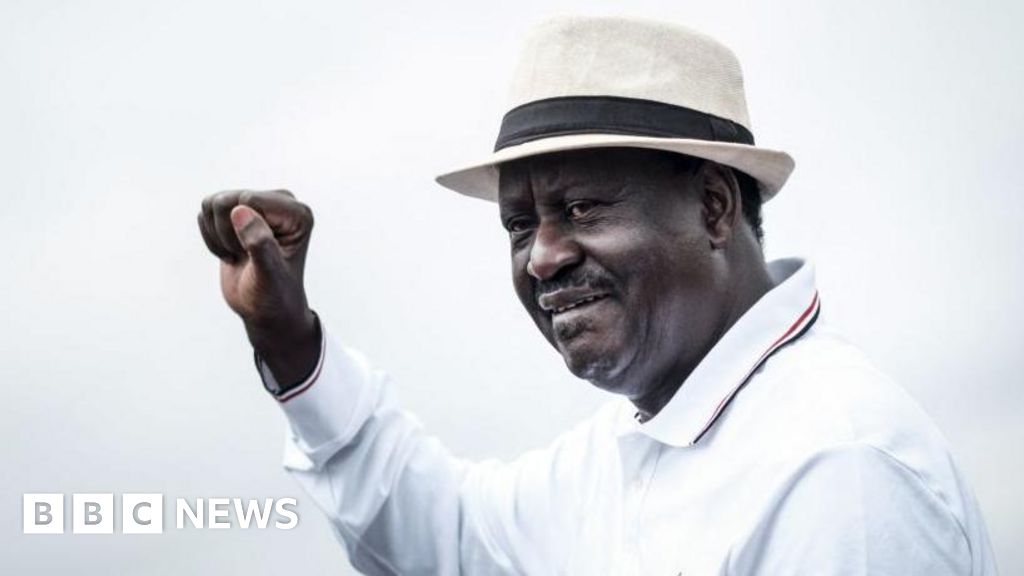
Raila Odinga was one of Kenya’s most influential and enduring political figures despite five unsuccessful presidential bids
For years, the firebrand politician emerged as a staunch campaigner and defender of multi-party democracy – adored by near-fanatical supporters and vilified by a threatened political elite
Fondly known as “Baba”, meaning father, the veteran opposition leader died on Wednesday morning at the age of 80 in India, where he had been receiving treatment for an undisclosed illness
His death not only marks the end of an era for a towering pan-Africanist, but also leaves a significant void in Kenya’s opposition as the country heads towards the 2027 elections
Although Odinga came from a famous Kenyan family, the political crown eluded him throughout his decades-long career – just as it eluded his father, who served as vice-president after independence from the UK
In 2022, Odinga made his fifth attempt at the presidency, having come closest to the top job in 2008 when he was appointed prime minister in a coalition government
In February, he lost the race to lead the African Union Commission to Djibouti’s foreign affairs minister
Despite his political misfortunes, Odinga remained a political force so influential that successive Kenyan presidents struggled to govern easily without his support
Last year, President William Ruto reached out to Odinga for a political deal that saw opposition leaders appointed in the cabinet
Four members of Odinga’s ODM party joined what is now known as a “broad-based” government
The move was seen by many as Ruto’s attempt to solidify his hold on power amid increasing discontent with his administration over its perceived failure to improve the lives of poor people, while raising taxes heavily
Odinga faced heavy criticism, especially from the young people behind last year’s anti-government protests, who accused him of betrayal. He insisted that he only “donated” experts to help the president “save” the country
An avid football fan and supporter of English premier league club Arsenal, Odinga came from the Luo ethnic group – the fourth largest in Kenya
He had a passionate following, and his adoring fans has nicknames for him like “Agwambo” (Act of God) and “Tinga” (Tractor) – drawn from his party symbol in the 1997 election
His signature slow-motion dance to reggae tunes at rallies – popularly known as “The Raila Dance” – became widely imitated by many in social gatherings
In the 2022 presidential election, Odinga chose former Justice Minister Martha Karua as his running mate. This was widely welcomed, as it was the first time a presidential front-runner had chosen a female deputy
Odinga was seen as the political heir to his father, Jaramogi Odinga, who was Kenya’s first vice-president after independence, but walked out of the government in 1966 after falling out with then-leader Jomo Kenyatta, whose son, Uhuru, went on to become president after the advent of multi-party democracy in the East African nation
Jaramogi Odinga favoured closer ties with the Soviet Union and China, while Jomo Kenyatta preferred an alliance with the US and other Western powers
Their differences worsened, with Jaramogi Odinga imprisoned for 18 months until he was released in 1971
Raila Odinga was also a former political prisoner, and holds the record for being Kenya’s longest-serving detainee
His struggle against one-party dictatorship saw him detained twice (from 1982 to 1988 and 1989 to 1991) during the rule of Jomo Kenyatta’s successor, Daniel arap Moi
He was initially imprisoned for trying to stage a coup in 1982, which propelled him on to the national stage
After multi-party democracy was introduced a decade later, Odinga repeatedly failed in his attempt to win power, often saying he had been cheated of victory
This led to one of the biggest political crises in Kenya’s history, when about 1,200 people died and thousands fled their homes after Odinga was convinced that then-President Mwai Kibaki stole the 2007 election
After mediation talks led by former UN chief Kofi Annan, Odinga took the post of prime minister in a coalition government, but his relationship with Kibaki was marred by what he called “supremacy wars”
In the 2017 election, he lost to Uhuru Kenyatta at the ballot box, but won in the Supreme Court, which nullified the result because of the widespread irregularities he had highlighted
Odinga, however, boycotted the re-run, saying a level playing field had not been created
This paved the way for the re-election of Kenyatta, while Odinga – reputed to be a master strategist and mass mobiliser – declared himself “the people’s president” at a huge rally in the capital, Nairobi
His supporters heeded his call to boycott the large number of businesses owned by the Kenyatta family to show their anger at the president’s re-election
The long-standing rivalry between Odinga and Kenyatta ended with a famous handshake in 2018. It culminated with Kenyatta backing Odinga’s final bid for the presidency in 2022
Odinga was described as a dedicated pan-Africanist who criticised what he called neo-colonialism. He championed African unity, self-reliance and integration through the building of infrastructure like roads, serving as the African Union High Representative for Infrastructure Development from 2018 to 2023
He was also appointed by the African Union (AU) to mediate in the 2010-2011 political crisis that broke out in Ivory Coast after then-President Laurent Gbagbo refused to give up power after losing to Alassane Ouattara in elections
However, his efforts failed to resolve the stand-off, as Gbagbo rejected him as a mediator, accusing him of being biased towards Ouattara
In his spare time, Odinga was seen in the gym, and taking walks in his neighbourhood in Nairobi, and in his village in Siaya in western Kenya
He was born on 7 Januray 1945 in Maseno in Kisumu county, and studied in what was then East Germany, acquiring a master’s degree in mechanical engineering in 1970
Odinga was married to Mama Ida and together they have four children – the late Fidel, Rosemary, Raila Junior and Winnie
Fidel was named after Cuban leader Fidel Castro and Odinga once explained that he had chosen the name because his son was born at the height of the Cold War, and “Mr Castro was seen to be standing against the US in the Vietnam war”
Odinga may have been critical of US foreign policy, but he championed the creation of a Western-style democracy in Kenya
He will probably be best-remembered as one of the founding fathers of multi-party democracy in Kenya, even if he felt that the electoral system was so flawed that it denied him the opportunity to become president
- The ever-shifting alliances that fuelled Kenya’s impeachment drama
- Behind the fallout between Kenya’s president and his deputy
- Is William Ruto the most disliked president in Kenya’s history?
- El Chapo & Deputy Jesus – why Kenya’s president has so many nicknames
- New faces of protest – Kenya’s Gen Z anti-tax revolutionaries
Getty Images/BBC
Go toBBCAfrica.comfor more news from the African continent
BBC Africa podcasts
Kenya
Raila Odinga
Africa