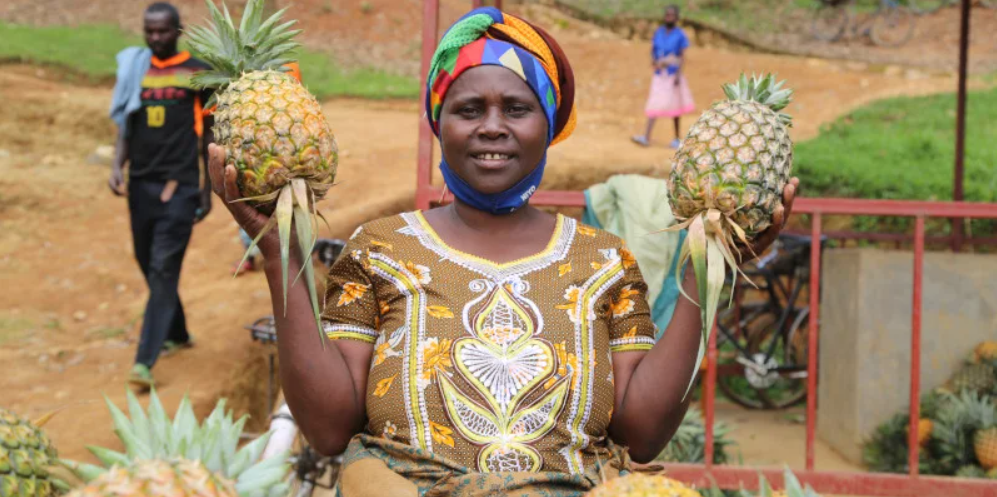
KIGALI, Rwanda — (ABS NEWS) Exports by women-owned firms in Rwanda fell about 51% from a 2021 peak of $1.16 billion to $563 million in 2024, according to a country report produced by the National Institute of Statistics of Rwanda and the United Nations Economic Commission for Africa.
The report, covering 2004–2024 and drawing on customs, business registers and household and financial surveys, also shows exports by women rose from $261 million in 2017 to the 2021 peak before contracting in subsequent years. Between 2023 and 2024 the report records a decline from $689 million to $563 million.
The joint NISR–ECA study disaggregates trade by sector and gender. It reports a drop in manufacturing trade value for women-owned businesses from about $278.1 million in 2023 to about $265.6 million in 2024, and a fall in agriculture, forestry and fishing for women from roughly $15.7 million to $7.6 million over the same period.
The report presents financial‑inclusion indicators showing only 8% of female loan applicants secured financing in 2024 compared with 13% of men, while mobile money use among women reached about 78%. It also finds women made up 61% of informal cross‑border traders in 2024 and that women-led informal trade accounted for $84.2 million in goods that year versus $68.1 million for men, even though the report notes men tend to trade higher‑value consignments on average.
On labour and firm composition, the report says women represented 46% of employees in trading firms in 2023 (up from 39% in 2014) and held 45% of senior management roles (up from 38% in 2017). However, half of women in trading firms held temporary or seasonal contracts in 2023, and women carried more unpaid care time — an average of 3.9 hours per day in 2024 compared with 2.5 hours for men.
Authors of the NISR–ECA report caution that the series are constructed by linking administrative and survey sources and that ownership classification, data‑linkage completeness and year‑to‑year volatility can influence reported magnitudes. The report therefore frames many results as an improved but evolving evidence base and warns against interpreting the figures as definitive causal explanations for the export contraction.
The study sets out a range of policy recommendations aimed at narrowing gender gaps in trade and boosting women‑owned firms’ access to formal export markets. Proposed measures include expanding trade finance targeted at women, introducing export credit guarantees for women‑owned businesses, creating dedicated finance windows under recovery funds, raising partial guarantee coverage for women‑led firms, simplifying cross‑border procedures and improving market information via mobile platforms. The report also recommends measures to help women move into higher‑value processing and manufacturing and calls for a Gender‑in‑Trade Desk to produce annual gender‑disaggregated trade statistics.
The report itself states these recommendations are proposals rather than evidence of committed government or banking policy. It does not establish a single proven cause for the post‑2021 decline, though it highlights constrained access to finance and transaction‑size volatility as important factors that merit further analysis.
This coverage is based on the NISR–ECA country report and reporting by The New Times, republished through AllAfrica. The full NISR–ECA country report provides detailed tables, sources and methodological notes on the compilation of the gender‑disaggregated trade statistics.
Subscribe to our breaking news bulletin