

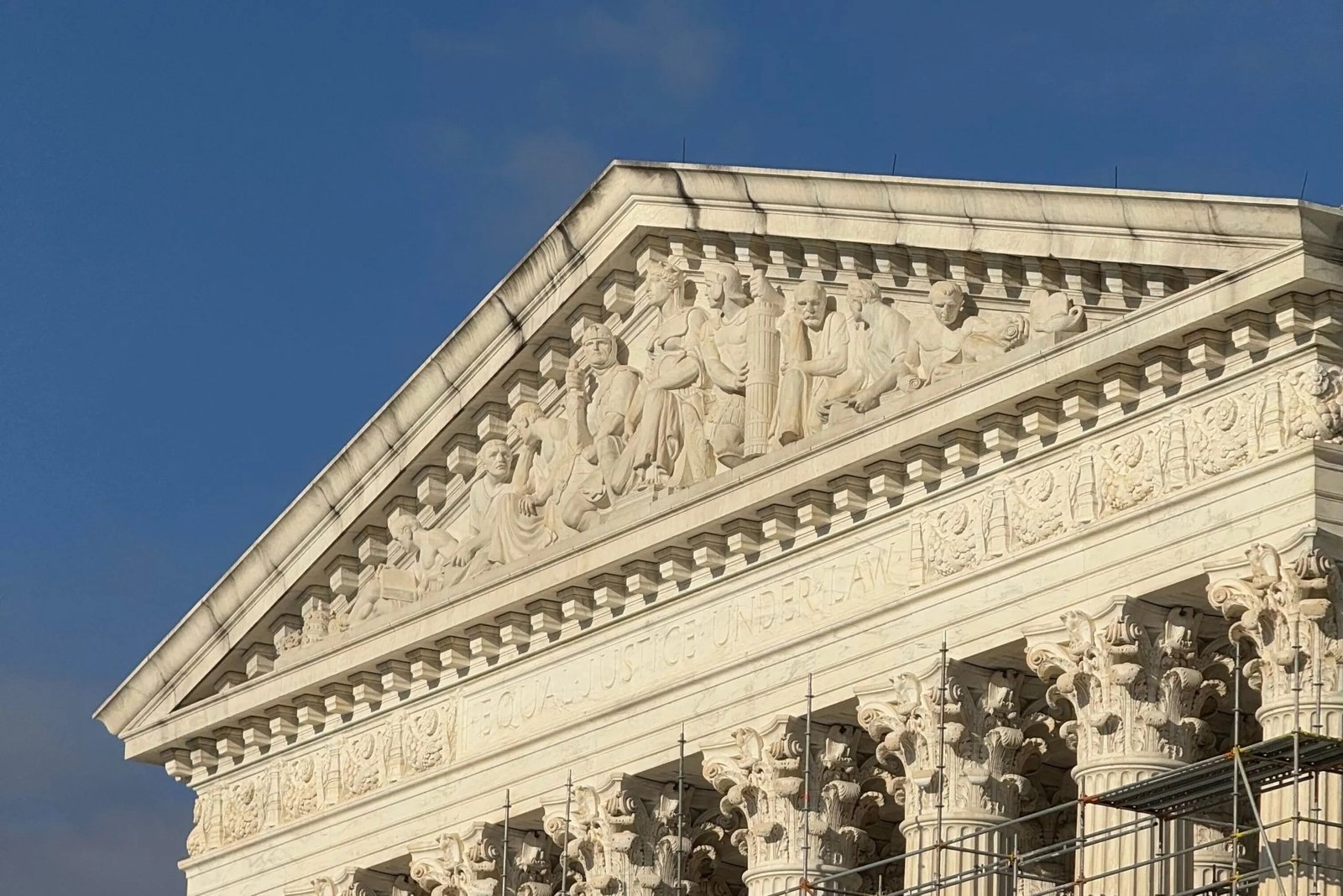
On Dec. 10, 1778, John Jay was elected president of the Continental Congress. He later became the Supreme Court’s first chief justice.
SCOTUS Quick Hits
- On Tuesday, the justices heard argument in National Republican Senatorial Committee v. Federal Election Commission, on whether to further cut back campaign finance limitations. See the On Site section below for key takeaways from the debate.
- Today, the justices will hear arguments in Hamm v. Smith, on how and whether courts should consider the cumulative effect of multiple IQ scores when applying the court’s ban on executing people who are intellectually disabled, and FS Credit Opportunities Corp. v. Saba Capital Master Fund, Ltd., on whether the federal courts should recognize a federal statute as implying a private right of action (that is, providing the ability for private parties to sue) when the words of the statute do not explicitly authorize it.
- The court could issue its decision in the interim docket case on President Donald Trump’s effort to deploy the National Guard to Illinois at any time.
Morning Reads
- Trump thrashes European leaders in wide-ranging interview: ‘I think they’re weak’ (Alexander Burns, Politico) — In a Dec. 8 interview with Politico, President Donald Trump addressed potential future vacancies on the Supreme Court and the birthright citizenship case, among other topics. When asked if he wants to see Justices Clarence Thomas or Samuel Alito retire, Trump said he “hope[s] they stay.” “I think they’re fantastic, OK? Both of those men are fantastic,” he said, according to the full transcript, before criticizing Democrats who “want to pack the court.” On birthright citizenship, Trump said it “would be a devastating decision if we lose that case.”
- Trump argues national security at risk if Supreme Court rules against tariffs (Ashleigh Fields, The Hill) — Trump also spoke about the Supreme Court on Tuesday in a social media post about the tariffs case. “The biggest threat in history to United States National Security would be a negative decision on Tariffs by the U.S. Supreme Court. We would be financially defenseless,” the president wrote, according to The Hill. He added that “[o]nly dark and sinister forces would want to see” his trade policies end.
- Split DC Circuit sides with Pentagon on transgender military ban (Ryan Knappenberger, Courthouse News Service) — On Tuesday, a panel of the U.S. Court of Appeals for the District of Columbia Circuit “froze a federal judge’s order blocking President Donald Trump’s effort to widely bar transgender people from serving in the military, finding the judge afforded ‘insufficient deference’ to Secretary of Defense Pete Hegseth’s judgment,” according to Courthouse News Service. U.S. Circuit Judges Gregory Katsas and Neomi Rao, who comprised the two judge majority, “ruled that Hegseth’s policy likely did not violate the Constitution’s Equal Protection Clause and does not trigger any form of heightened scrutiny as a result, pointing to the Supreme Court’s recent decision in United States v. Skrmetti.” In May, after considering a similar case on the interim docket, the Supreme Court paused an order by a federal judge in Washington state that had barred the government from implementing the transgender military ban anywhere in the United States.
- Scoop: Trump aides bullish on Supreme Court boosting GOP in midterms (Alex Isenstadt, Axios) — Last week, the Supreme Court sided with Texas Republicans in a dispute over that state’s new congressional map, which is favorable to the GOP, and top Trump advisers believe upcoming decisions on the Voting Rights Act and campaign finance rules will similarly benefit Republican candidates, according to Axios. “Trump lieutenants Chris LaCivita and Tony Fabrizio told donors at a Republican National Committee retreat over the weekend” that these decisions “are likely to bolster Republicans in the 2026 midterms — and transform the party’s power to win elections for years.”
- Supreme Court Questions N.Y. Ban on Religious Exemptions for Vaccines (Joseph Goldstein, The New York Times)(Paywall) — On Monday, the Supreme Court vacated a ruling from the U.S. Court of Appeals for the 2nd Circuit upholding school vaccine requirements in New York, which does not offer religious exemptions. The justices “ordered the lower court to reopen the case ‘for further consideration’” in light of their June decision in Mahmoud v. Taylor, in which the court held that religious freedom requires public schools to allow religious families to opt-out of certain types of instruction. “The order from the Supreme Court did not direct the lower appeals court to reach a particular result,” but it may signal that the court “may favor loosening New York’s strict school vaccine requirements,” according to The New York Times.
A Closer Look: Atkins v. Virginia
Today, in the case of Hamm v. Smith, the Supreme Court will consider certain implications of its 2002 decision in Atkins v. Virginia, in which it held that executing someone who is intellectually disabled violates the Constitution’s ban on cruel and unusual punishment.
Atkins centered on Daryl Renard Atkins, who was sentenced to death in Virginia after being convicted of “abduction, armed robbery, and capital murder” for his role in the death of Eric Nesbitt. During the penalty phase of the trial, Atkins’ defense team relied on expert testimony from a forensic psychologist, who said that Atkins was “mildly mentally retarded” and had an IQ of 59. Atkins still received the death sentence, but the Supreme Court of Virginia later “ordered a second sentencing hearing because the trial court had used a misleading verdict form.”
During the second sentencing hearing, the same forensic psychologist testified on Atkins’ behalf. But this time, the state challenged his conclusions with its own witness, who said that Atkins was of “average intelligence, at least.” Atkins was again sentenced to death and again appealed that sentence, contending “that he is mentally retarded and thus cannot be sentenced to death.” After the Supreme Court of Virginia upheld his death sentence, Atkins asked the Supreme Court to weigh in.
Atkins appeared to face an uphill battle at the Supreme Court, which just 13 years earlier had declined in Penry v. Lynaugh to issue a blanket ban on putting to death individuals who are intellectual disabled, in part because the justices felt there was no national consensus on the issue. Nevertheless, the court agreed to consider Atkins’ case and ultimately ruled 6-3 in his favor. As Justice John Paul Stevens put it in the majority opinion, the “state legislative landscape” had undergone a “dramatic shift” over those 13 years, with several states passing laws exempting individuals who are intellectually disabled from receiving the death penalty. “It is not so much the number of these States that is significant, but the consistency of the direction of change,” Stevens wrote. The majority was also “not persuaded that the execution of” these criminals “will measurably advance the deterrent or the retributive purpose of the death penalty.”
Chief Justice William Rehnquist and Justices Antonin Scalia and Clarence Thomas dissented, in large part because they felt justices in the majority had mischaracterized the legislative landscape and used subjective criteria to justify their holding. “Seldom has an opinion of this Court rested so obviously upon nothing but the personal views of its Members,” Scalia wrote.
Significant for the current case, Hamm v. Smith, is that the Atkins majority left it up to states to determine whether a convicted criminal is intellectually disabled. The court is addressing a conflict that has developed amid those determinations – namely, what to do when a person sentenced to death has obtained multiple IQ scores, some of which have not been taken to show intellectual disability. The justices are expected to consider how much weight courts should put on individual scores when applying Atkins.
SCOTUS Quote
JUSTICE ALITO: “I mean, I could go down the list with you of the cabinet officers and ask you whether you think they could be headed by a multi-member commission whose members are not subject to at-rule — at-will removal by the President. Shall we do that? How about the — how about Veterans Affairs? How about Interior? Labor? EPA? Commerce? Education? What am I missing?”
JUSTICE KAVANUGH: “Agriculture.”
On Site
From Amy Howe
Supreme Court Difficult to Read in Case on Campaign Finance Limitations
The Supreme Court on Tuesday considered a challenge to a federal law limiting the amount of money that political parties can spend in coordination with a candidate for office. During over two hours of oral argument in National Republican Senatorial Committee v. Federal Election Commission, some of the justices were sympathetic to the challengers’ position that the coordinated expenditure limits violate the First Amendment. But with Justice Neil Gorsuch remaining silent throughout the debate, and Justice Amy Coney Barrett asking only one question, it remained difficult to make definitive predictions about the outcome of the case. Learn more about Tuesday’s argument by reading Amy’s analysis.
Court Sends Dispute on HIV Disability Claim Back to Lower Court
The Supreme Court on Monday sent the case of a Louisiana man who was prevented from using a physical therapy clinic’s pool because he has HIV back to the state courts for them to take another look at the man’s claim that the clinic violated federal disability laws. The brief, unsigned opinion in Doe v. Dynamic Physical Therapy was part of a list of orders released from the justices’ private conference on Friday, Dec. 5. The list also noted that the justices had denied review in Davenport v. United States, prompting Justice Sonia Sotomayor to reflect on providing a jury instruction on the meaning of reasonable doubt. For more on Monday’s order list, read Amy’s analysis.
Contributor Corner
Originalism’s Campaign Finance Conundrum
In a column for SCOTUSblog, Brian Boyle reflected on how to apply originalist principles to campaign finance restrictions and where that process may lead the court in National Republican Senatorial Committee v. Federal Election Commission. “An originalist approach would ask not only what the understanding of free speech was at the time of the founding … but whether campaign finance was understood to be an area of vigorous judicial oversight or legislative primacy,” he wrote.
When Rules of Statutory Interpretation Change Midstream
In her latest Clear Statements column, Abbe R. Gluck explored how the Supreme Court’s approach to statutory interpretation has evolved in recent years and the challenges this shift creates for policymakers. “Congress … cannot possibly predict how the court’s interpretive approach will evolve over time or amend statutes every time the court changes its interpretive approach – especially during a moment when the court does not really seem to paying much attention to being in dialogue with Congress in the first place,” she wrote.
Posted in Featured, Newsletters
Recommended Citation:
Kelsey Dallas,
SCOTUStoday for Wednesday, December 10,
SCOTUSblog (Dec. 10, 2025, 9:00 AM),
https://www.scotusblog.com/2025/12/scotustoday-for-wednesday-december-10/
