



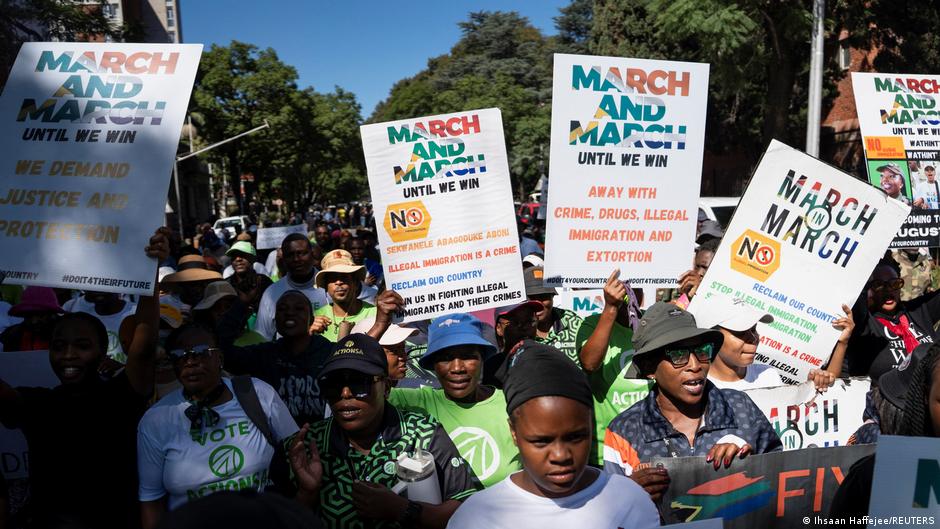
South Africa has experienced heightened tension in the period preceding scheduled anti-migrant demonstrations on June 30, as officials have cautioned against disorder and made preparations for potential violence.
President Cyril Ramaphosa delivered a strong statement amidst rising nationwide tensions. “We will not tolerate any attempts to destabilize the country by anyone, whether marching or otherwise,” Ramaphosa declared on Thursday.
Various organizations, such as “March and March,” have organized these protests, advocating against undocumented migration. These groups have established an unofficial deadline for migrants lacking legal status to depart the country, sparking concerns about a resurgence of xenophobic violence in a nation that has seen multiple incidents since apartheid ended in 1994.
Firoz Cachalia, the nation’s police minister, stressed that although South Africa’s constitution safeguards peaceful protest, any illegal activities would be met with a forceful response. He stated that criminal acts, intimidation, violence, property damage, and any efforts to jeopardize public safety would not be endured.
Cachalia further conceded that officials had responded with insufficient speed to escalating tensions and anti-foreigner rhetoric.
“We have hesitated too long to speak out clearly on this issue. There is no reason why anyone should come to a demonstration with any object that could be used as a weapon,” he said.
In recent weeks, there has been a notable increase in assaults targeting foreign nationals. Vigilante organizations, frequently associated with right-wing populist discourse, have conducted raids on communities, plundered migrant-owned businesses, and harassed individuals believed to be foreigners.
Although these groups assert they are targeting undocumented migrants, their activities often impact anyone seen as an outsider, such as individuals of African or Asian descent, irrespective of their legal standing.
Multiple African nations, such as Nigeria, Ghana, and Malawi, have had to repatriate their citizens. Migration itself has seen consistent growth over many decades. Data from Statistics South Africa, the official government statistics agency, indicates that migrants constituted 2.1% of the population in 1996. By 2022, this proportion had climbed to 3.9%, representing approximately 2.4 million individuals, encompassing both documented and undocumented inhabitants.
Experts have highlighted more profound structural issues underlying the unrest. Political commentator Tessa Dooms has contended that the present crisis is indicative of persistent governance shortcomings.
“The South African government has largely created this dilemma for itself,” she told DW.
On Friday, President Ramaphosa reaffirmed the significance of regional collaboration, emphasizing that no nation can achieve prosperity in isolation.
Dooms outlined a recurring pattern where officials postpone addressing significant issues like joblessness, public amenities, and destitution.
“It ignores problems, tolerates corruption, allows decay to worsen and only reacts once the situation has reached its peak,” she explained.
Dooms suggests that the government has misjudged the influence of movements like “March and March” and “Operation Dudula,” especially their capacity to rally support across various societal segments.
“They [government] are unprepared; they are misanalyzing the problem. They believe it is merely an anti-migrant movement, whereas in reality, migration is being offered as a solution for people facing a multitude of other crises,” she said.
Elevated youth unemployment, restricted access to health services and schooling, along with increasing inequality, have resulted in widespread frustration among numerous communities. For certain individuals, anti-migrant activism provides a feeling of being acknowledged.
“So it’s not that people are xenophobic, but rather that they see this particular movement as a place where they can be heard and where they can find a simple solution to complex problems,” Dooms said. She added that the government has failed to address these grievances and is “in no way prepared to deal with this on June 30.”
Officials have deployed police units and also engaged private security companies to handle potential disturbances. The estimated expenditure for these actions is projected to be 600 million rand (€32 million/$36 million), indicating the magnitude of the foreseen difficulty.
Nevertheless, widespread doubt exists regarding the efficacy of these measures. Dooms asserted that upholding human rights necessitates effective law enforcement agencies, not merely cautionary statements.
“For that, they need law enforcement agencies,” she said, criticizing the lack of prosecutions and accountability. “All of this is happening in a climate where the country’s top police officials sit at the Madlanga Commission.”
This commission, formed in July 2025 and bearing the name of Judge Mbuyiseli Madlanga, is probing claims of corruption, political meddling, and penetration by organized crime within the police force.
Confidence in law enforcement agencies continues to be low. Fredson Guilengue from the Rosa Luxemburg Foundation noted that migrants frequently perceive the police as contributing to the issue.
“The South African police are still viewed by the victims of these attacks as a xenophobic institution,” he told DW. “I don’t see any changes.” Guilengue also criticized the government’s reactive approach. “As long as the leaders of these movements don’t feel the full force of the law, they won’t stop intimidating immigrants,” he said.
Beyond law enforcement, systemic problems within migration management are also exacerbating tensions. Guilengue highlighted corruption and ineffectiveness in immigration processes, which fuel public discontent and foster opportunities for vigilante activities.
He cautioned that recent governmental measures—including heightened deportations, inspections of workplaces, and penalties for hiring undocumented migrants—could inadvertently strengthen anti-foreigner sentiments.
“Numerous political changes have been implemented […] which essentially means that the government agrees with the narrative that South Africa is under attack by foreigners,” he said.
Thousands of Malawians have sought temporary shelter as they await repatriation.
Experts contend that resolving xenophobia necessitates addressing its underlying factors. Youth unemployment persists at a stubbornly high level. Almost 61% of young South Africans were jobless in early 2026, with the total unemployment rate at 32.7%.
Dooms believes that solutions must engage both local communities and policy-makers.
“You can engage them in a conversation about the real problems they face,” she said, emphasizing dialogue over confrontation.
With June 30 drawing near for South Africa, the circumstances underscore not only migration-related tensions but also more profound economic and political issues that are yet to be resolved.





