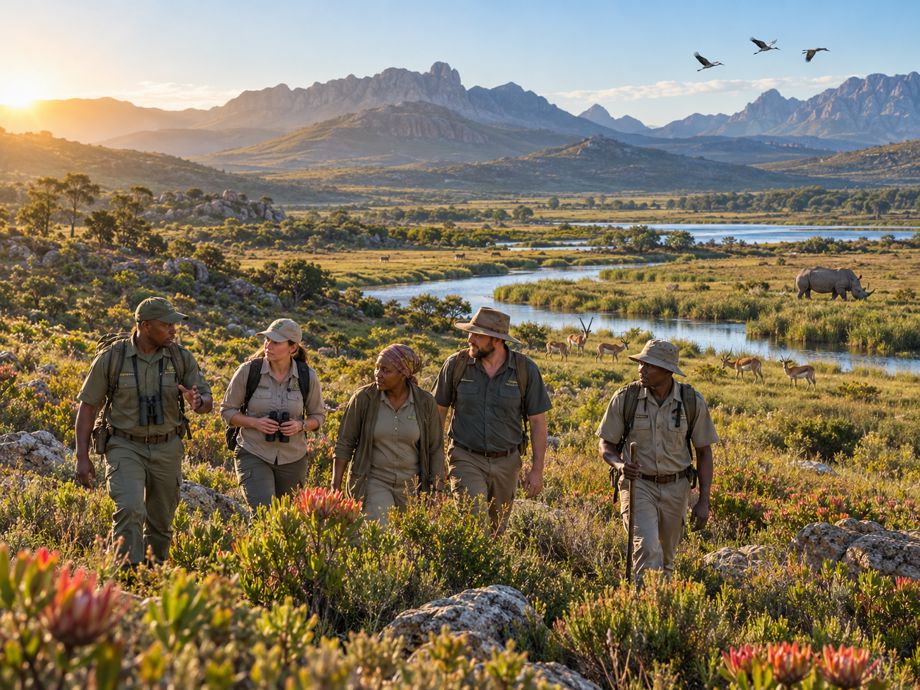
<a href="https://absafricatv.com/australia-reveal-strong-squad-for-south-africa-test-series-icc-world-test-championship/" title="Australia reveal strong squad for South Africa Test series | ICC World Test Championship”>South Africa’s Land Partnerships Rewrite the Rules of Conservation
Biodiversity Stewardship began in the early 2000s, allowing conservation authorities to work directly with landowners who wished to protect ecologically important areas.
- Country:
- South Africa
South Africa is home to extraordinary wildlife, rare plant species and ecosystems found nowhere else on Earth, with parts of the country falling within three global biodiversity hotspots. This natural wealth faces growing pressure as 36% of terrestrial ecosystems and 65% of inland aquatic ecosystems are now considered threatened. Government conservation budgets have also declined while urgent social and economic needs compete for public funding, creating a need for practical solutions that protect nature without placing the full cost on the state.
A new World Bank report, Analysis of 20 Years of Implementing South Africa’s Biodiversity Stewardship Program, shows how voluntary partnerships with private and communal landowners have helped answer that challenge. Developed with the South African National Biodiversity Institute and technical support from the Department of Forestry, Fisheries and the Environment, the assessment draws on 71 interviews, discussions with 11 traditional communities across four provinces, and five technical workshops involving government, conservation specialists and legal experts.
Nearly 2.8 Million Hectares Secured Through Partnerships
Biodiversity Stewardship began in the early 2000s, allowing conservation authorities to work directly with landowners who wished to protect ecologically important areas. Agreements can range from formally declared nature reserves to more flexible conservation arrangements, making the program suitable for privately owned farms, communal territories, land reform properties and working rural landscapes.
Nearly 2.8 million hectares across 469 sites have been secured through the program. These areas account for about 90% of South Africa’s protected-area expansion since the National Environmental Management: Protected Areas Act came into force. The model has delivered these results at only 6% to 25% of the cost associated with buying and managing land through traditional state-led conservation.
Stewardship sites cover more than 650,000 hectares of Strategic Watersupply water to communities, farms, industries and cities. They also safeguard threatened ecosystems whose services are estimated to be worth hundreds of billions of rand each year
Conservation That Supports Communities and Rural Economies
The program has shown that conservation can create opportunities for people living on communal land and land reform properties. Protected landscapes can support jobs, tourism businesses, sustainable farming, wildlife-based enterprises and othering ecosystems healthy
This people-centred model depends on trust built over many years. Experienced facilitators guide landowners and communities through legal agreements, management plans and funding options, while partnerships between government agencies and conservation organisations provide scientific knowledge and practical support. Standard national guidance gives the system greater consistency and credibility across provinces.
Strong governance has also helped attract investment. Biodiversity Stewardship has enabled $64.5 million in multilateral funding from Ecosystem Partnership Fund, along with R179.3 million from local conservation funds. Private landowners and companies have contributed additional investment that has not yet been fully measured
Stronger Leadership Could Unlock the Next Chapter
The report identifies ten actions needed to protect the program’s gains and expand its reach. Immediate needs include stronger national leadership from the environment department, clearer coordination across government, reforms to protected-area legislation, finalised standards for other effective area-based conservation measures, and faster declaration processes.
Dedicated facilitators must also receive stable, continuous funding because stewardship agreements require local knowledge, strong relationships and ongoing support after land is formally protected. Greater cooperation with water security, climate adaptation, land reform and rural development programs could bring conservation into wider national planning.
South Africa’s experience offers a practical model for other countries working toward the global commitment to conserve 30% of land and water by 2030. Its central lesson is simple: nature can be protected at scale when landowners, communities, government agencies and conservation groups share responsibility, re