


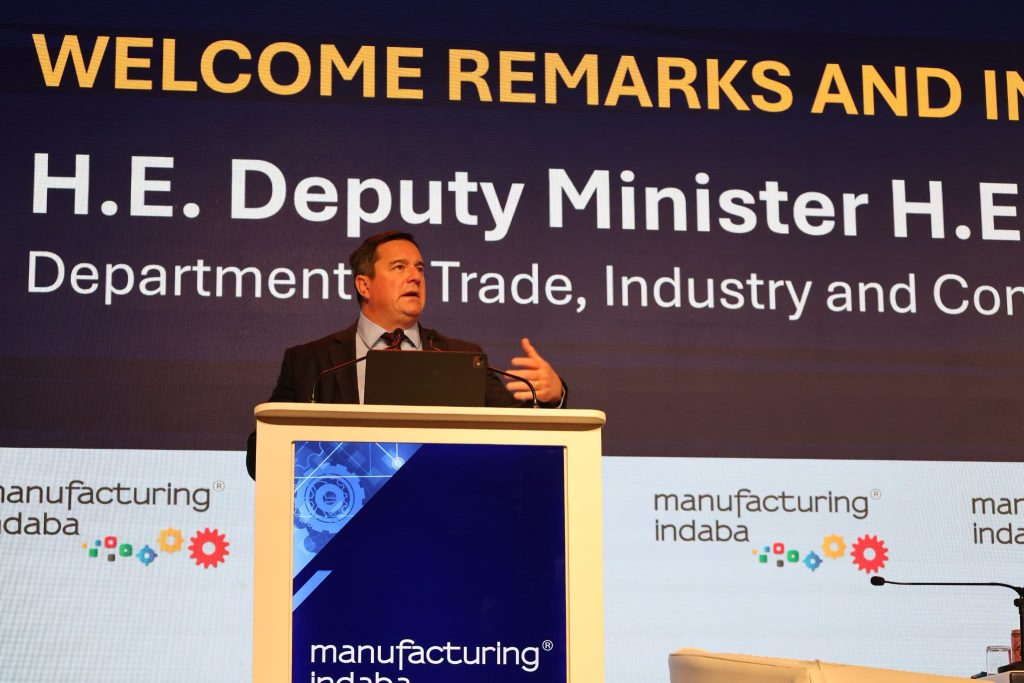


Steenhuisen says manufacturing key to jobs, investment and economic recovery


July 15, 2026
0
PHOTO: DTIC/Facebook


Must read
Fair-trial dispute delays Matlala’s commission testimony
SAPS team to probe murder of Gauteng March and March leader
Mashatile says Africa must industrialise as Ramokgopa warns of manufacturing decline
The government has placed manufacturing at the centre of its economic recovery strategy, saying rebuilding South Africa’s industrial base is key to creating jobs, attracting investment and strengthening the country’s competitiveness in regional and global markets.
Speaking at the opening of the 2026 Manufacturing Indaba, Deputy Minister of Trade, Industry and Competition John Steenhuisen outlined government’s plans to reverse de-industrialisation and position South Africa as a continental manufacturing hub.
Held under the theme “Made in Africa for Africa: Scaling Growth, Shaping Trade,” the two-day conference brought together government leaders, manufacturers, investors and policymakers to discuss industrial growth, localisation and trade.
Steenhuisen said South Africa could no longer rely on exporting raw materials while importing finished goods, arguing that Africa must capture more value through manufacturing.
“Africa should increasingly trade in value-added products rather than exporting raw materials and importing finished goods. Africa must transition from merely being thehe said
He said manufacturing remains the backbone of industrial economies, contributing about 13% to South Africa’s gross domestic product and supporting more than 1.6 million direct jobs, with millions more sustained through agriculture, mining, logistics and other sectors linked to manufacturing value chains.
Steenhuisen said government’s industrial strategy is built on three priorities: diversification, decarbonisation and digitalisation.
The strategy includes expanding manufacturing in higher-value sectors such as automotive components, pharmaceuticals, chemicals, machinery and electro-technical products, while supporting renewable energy, critical minerals beneficiation and green hydrogen production.
He also highlighted the role of digital technologies in improving productivity, expanding the global business services sector and creating future-ready jobs.
Steenhuisen said Special Economic Zones (SEZs) remain a key pillar of government’s industrial strategy by attracting investment, developing industrial clusters and improving export competitiveness.
He announced that the Department of Trade, Industry and Competition, in partnership with the KwaZulu-Natal government, will host South Africa’s second International Special Economic Zones Infrastructure and Investment Conference later this week to promote further industrial investment.
Looking beyond the domestic market, Steenhuisen said South Africa must leverage regional integration through the Southern African Development Community (SADC) and the African Continental Free Trade Area (AfCFTA) to expand markets for locally manufactured products and build integrated industrial value chains.
“The choices we make today will determine the structure of our economy for decades to come.
“We have the industrial capabilities, natural re leading manufacturing economy on the African continent,” he said
Government said the Manufacturing Indaba aims to promote regional manufacturing, localisation and value addition while advancing the objectives of the African Continental Free Trade Area.
Previous articleMadlanga questions legal basis for IDAC probe into crime intelligence officials
Next articleSwarts calls for Africa-wide air quality system


