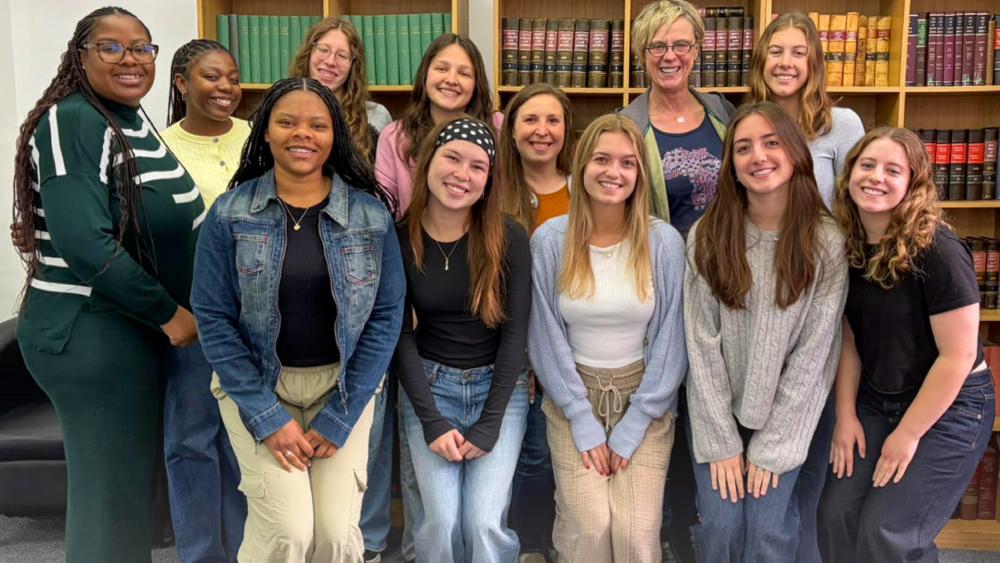
Pa. — Eight Penn State undergraduates gained firsthand experience in nonprofit and activist work in Cape Town, South Africa, this summer as part of the three-week faculty-led program WMNST 399: The Quest for Reproductive Justice in South Africa
The course — one of 14 faculty-led education abroad programs offered in the College of the Liberal Arts this summer — was designed and led by Susanne M. Klausen, Brill Professor of Women’s, Gender, and Sexuality Studies (WGSS) and of African studies in the College of the Liberal Arts, alongside co-leader Camille Sluzis, sexual assault and relationship violence coordinator at Penn State’s Counseling and Psychological Services (CAPS).
Through a combination of in-class lectures, field trips and research projects, students explored the history and current-day politics of reproductive justice in South Africa. When they weren’t in the classroom or conducting research on legal access to reproductive healthcare, students had the opportunity to explore all that Cape Town had to offer culturally.
Klausen, a historian of modern South Africa who has written books on birth control and abortion in South Africa, offered the program for the first time in 2024.
“I wanted to offer it again (because) I find it extremely gratifying and an honor to introduce some incredible reproductive justice activists as well as the country of South Africa to students who have never been there before,” Klausen said. “The course achieved exactly what I had hoped — it sparked a desire to learn more about Africa as well as reproductive justice.”
For Mackenna Grace Rentch, a third-year student majoring in criminology with minors in philosophy and WGSS, the program combined two areas of interest: reproductive justice, and travel.
“My entire life, I’ve been super passionate about reproductive rights and justice—so when I saw that was the topic of the course, I was immediately interested,” Rentch said. “And I’ve also always wanted to go to Africa.”
Third-year student Eloise Bracey Emel, a WGSS and psychology major with a minor in politics and public policy, said the program proved a great way to apply her classroom learning to real-world scenarios.
“I always walk away from class being like, ‘Okay, so what can I do about that?’” Emel said.
Learning in and out of the classroom
Beginning each day in the classroom, Rentch, Emel and their peers attended lectures on South African history and how colonization and apartheid continue to shape current reproductive health and politics. These discussions were paired with a series of excursions that allowed students to see the direct community impact.
“There are so many things that aren’t online, and so many things that aren’t in the news, or aren’t publicly available information,” Rentch said. “I never would have found out about any of it if it weren’t for the first-person contact.”
Rentch said one of the highlights for her was meeting directly with organizations working in reproductive justice advocacy. The group visited healthcare providers and activists, including SWEAT, a group that advocates for sex workers’ rights; Gender Dynamix, a transgender rights organization; and a public-sector clinic that provides access to safe abortions. Through these visits, she said, students were able to connect policy discussions in the classroom with what it actually looks like to have access to reproductive healthcare.
For Emel, speaking with the manager of the clinic, who is also a midwife, was an especially eye-opening experience.
“She talked a lot about the women who come to the facility and the hoops that they have to jump through essentially just to be able to get often life-saving healthcare,” she said. “You could definitely see the difference in the technology that there is. They’re so severely underfunded.”
Working in small groups, students completed research projects for the South African Women’s Legal Center, a legal advocacy organization specializing in feminist litigation. Rentch’s group examined abortion access in the western Cape, while Emel’s group’s research focused on the privatization of abortion healthcare. Although abortion is legally protected in South Africa, both projects explored how geographic, financial and institutional barriers limit safe access.
Both students said they found that learning in Cape Town offered a level of understanding difficult to replicate in a traditional classroom setting, and that speaking with activists gave them an in-depth understanding of the material beyond course readings and lectures.
Space for conversation and connection
Outside the classroom, the group participated in one of the community’s core activities: Sunday lunch with the family. During a township visit, students took part in a meal with community members that offered a space for connection and conversation.
“Every single Sunday, the entire township comes together with all of their families and friends,” Rentch said. “Everyone’s doors are open. People are just coming and going, having food, talking to each other. It’s a beautiful culture.”
The trip also highlighted the global reach of the Penn State community. While in Cape Town, Penn State alumna Stefanie Coyle, a 2005 political science graduate who lives in the city with her husband, Stephen, hosted the class for dinner at their home. Both are lawyers whose work the students said they found inspiring — she with the New York Civil Liberties Union (NYCLU) and he on anti-malaria initiatives across Africa.
Klausen said Coyle and her husband generously hosted the students for dinner, continuing a tradition from the program’s previous visit to South Africa and reflecting Coyle’s enduring connection to Penn State.
“Hearing about Stefanie’s experience in South Africa and how much she’s learned, and the ways that she’s able to relate everything that she’s learned to her career in the States is really inspiring to me,” Rentch said.
Educational experience, lasting change
For Rentch, the experience reinforced her interest in pursuing work related to social justice and public policy. Seeing how legal protections do not always translate to accessible services in practice highlighted the importance of addressing systemic barriers, she said.
“I’ve never fully felt so changed leaving a trip,” Rentch said.
Emel agreed that the program strengthened her belief in the importance of listening to and connecting with communities directly impacted by these issues.
“This is someone’s true experience,” she said. “Being able to experience that for yourself, and carry with you that experience, and that empathy for those people, is really, really important.”
Contact
-
- kea5102@psu.edu