Click the Play button to listen to article
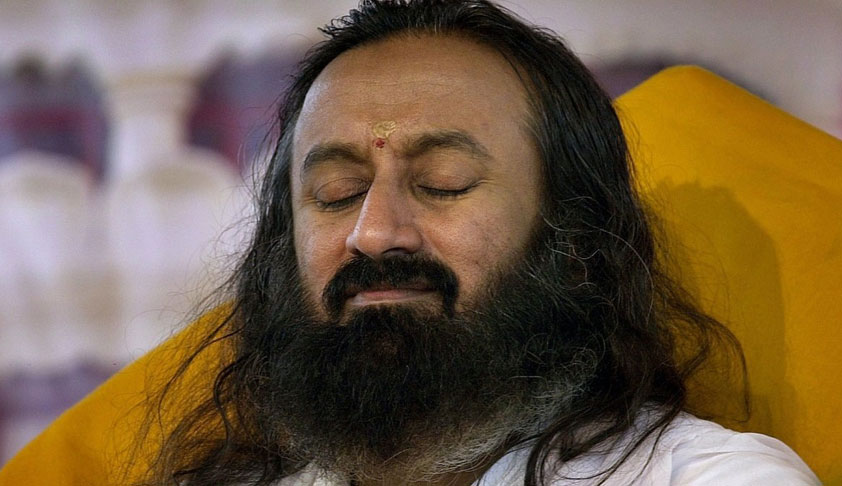
The Supreme Court today(August 22) set aside an order of the National Green Tribunal, which directed Sri Sri Ravi Shankar’s Art of Living International Centre to pay Rs. 5 crore for the damage caused to the river Yamuna floodplains due to its World Culture Festival organised by Vyakti Vikas Kendra in March 2016.
A bench comprising Justice Satish Chandra SharmaandJustice NK Singh,allowed the appeal filed by Vyakti Vikas Kendra, an entity running the Art of Living International Centre, against the order passed by NGT in December 2017. The Bench held that there is no direct evidence that the cultural festival caused damage to the River Yamuna’s fragile ecosystem.
The bench directed the Delhi Development Authority (DDA) to refund the fine of Rs 5 crore paid by Vyakti Vikas Kendra.
The case arose from the World Culture Festival, held from March 11 to 13, 2016, on about 25 hectares of the Yamuna’s active floodplain upstream of the DND flyway. The event had received permissions from the concerned authorities, including the Delhi Development Authority (DDA).
Alleging that the festival caused extensive damage to the floodplains, one Manoj Misra, the convener of campaign Yamuna Jiye Abhiyaan, and two others, Pramod Tyagi, and environmental activist Anand Arya, approached the NGT.
The NGT had initially imposed an environmental compensation of ₹5 crore shortly before the festival, after an expert committee reported that the floodplain had been severely tampered with during preparations. The tribunal subsequently held the organisers responsible for restoration and rehabilitation and directed that the ₹5 crore deposit be used for the work.
The Supreme Court, however, found significant shortcomings in the basis on which the NGT attributed the damage to the organisers. It noted that the floodplain was already in a damaged condition before the event site was handed over. Earlier reports had recorded deterioration and non-implementation of restoration directions, while the organisers themselves had informed the DDA about construction debris already lying at the site and obtained permission to remove it.
The Court was particularly critical of the reliance placed on a September 5, 2015 satellite image and the expert committee’s assessment of the pre-event condition. It observed that the image appeared inconsistent with other contemporaneous material showing the floodplain in a damaged state. The Court also noted that a later government officials’ committee found grass and water at the site, no debris, no significant wetland or water body within the allotted area, and no significant difference between pre- and post-event imagery.
Another key issue was the distinction between restoration and rehabilitation. The Supreme Court held that the two concepts could not be treated as interchangeable. Restoration seeks to return an affected area to its original state, whereas rehabilitation aims to make an ecosystem fully functional and capable of providing optimum ecological services. According to the Court, the NGT erred by imposing a broader rehabilitation obligation on the appellant when the proceedings concerned alleged damage attributable to the event.
The Court also found that the expert committee itself had acknowledged that the ecological condition of the site before the event could not be reliably determined. Despite this limitation, the committee went on to recommend broader rehabilitation measures, including ecological restoration works. The Supreme Court held that the committee had exceeded its mandate and that the NGT had relied on those recommendations in a manner that expanded the dispute beyond the question of damage caused by the event.
The Bench further criticised the NGT for effectively treating its March 9, 2016 interim order as final. The Supreme Court observed that the interim order had been passed on the basis of an initial visual inspection and without a complete appreciation of the competing evidence. Since the NGT had itself subsequently clarified that the order was interim and without prejudice to the parties’ rights, the findings in that order ought to have been reconsidered during the final adjudication.
At the same time, the Supreme Court stressed that the DDA remained responsible for the broader rehabilitation of the Yamuna floodplains. The Court observed that the authority had duties arising from the public trust doctrine and was required to take preventive measures to avoid further deterioration of the active floodplain. However, it clarified that the legality of the DDA’s permission for the 2016 event was not an issue before the Court.
As a consequence of its ruling, the Supreme Court ordered the ₹5 crore environmental compensation deposited by Vyakti Vikas Kendra India to be refunded by the DDA within four weeks. The Court also made clear that the DDA must continue with the rehabilitation of the Yamuna floodplains in accordance with the plans and directions already issued by the NGT.
Case Details: VYAKTI VIKAS KENDRA INDIA v MANOJ MISRA (DEAD) AND ORS.|C.A. No. 683/2018
Citation : 2026 LiveLaw (SC) 847
Click here to read the judgment
For the Appellant(s): Mr. Nikhil M. Sakhardande, Senior Advocate; Ms. Rohini Musa, Advocate-on-Record; Ms. Shubhra Swami, Advocate; Mr. Nipun Katyal, Advocate; Mr. Manan Sharma, Advocate; and Mr. Dhananjay Kumar, Advocate.
For the Respondent(s): Mr. Sanjay Parikh, Senior Advocate; Mr. Rahul, Advocate; Ms. Srishti Agnihotri, Advocate; Ms. Tara, Advocate; Ms. K. V. Bharathi Upadhyaya, Advocate-on-Record; Mr. Kailash Vasdev, Senior Advocate; Mr. Nitin Mishra, Advocate-on-Record; Ms. Mitali Gupta, Advocate; Ms. Neoma Vasdev, Advocate; Mr. Umrao Singh Rawat, Advocate; Ms. Anushka Mamgain, Advocate; Ms. Shivani Sethi, Advocate; Mr. Mukesh Kumar Maroria, Advocate-on-Record; Mrs. Aishwarya Bhati, Additional Solicitor General; Mr. Annirudh Sharma II, Advocate; Mr. Merusagar Samantaray, Advocate; Ms. Suhasini Sen, Advocate; Mrs. Chitrangda Rastaravara, Advocate; Mr. S. N. Terdal, Advocate-on-Record; Mr. Gurmeet Singh Makker, Advocate-on-Record; Mr. Ishaan Sharma, Advocate; Mr. Rohan Gupta, Advocate; Mr. T. S. Sabrish, Advocate; Mr. Sudarshan Lamba, Advocate-on-Record; Mr. Sabarish Subramanium, Advocate; Mr. Kamlendra Mishra, Advocate-on-Record; Mr. Rajeev Kumar Dubey, Advocate; Mr. Ashiwan Mishra, Advocate; Ms. Vaidruti Mishra, Advocate; Ms. Aditi Mishra, Advocate; Mr. Vinod Kumar, Advocate; Mr. Suraj, Advocate; Mr. Manoj K. Mishra, Advocate; Mr. Rahul Choudhary, Advocate; Ms. Tara Elizabeth Kurien, Advocate; Ms. Itisha Awasthi, Advocate; Mr. D. P. Singh, Advocate; and Ms. Anchal Kanthed, Advocate.