



The New Economics Foundation: 40 years of reimagining the economy
Our chief exec looks at the past four decades of NEF and what the future holds for the new economy movement
By
Danny Sriskandarajah
01 July 2026
The early 1980s saw the rise of a new economic ideology. Some called it Thatcherism, others labelled it Reaganomics – we know it today as “neoliberalism”. Its central tenets were simple: regulations were bad, state power should be curtailed, and the market should be set free through privatisation, liberalisation and financialisaton
As Margaret Thatcher was preparing to host the G7 leaders’ summit in London in 1984, the chair of the Ecology Party (now the Green Party) Jonathon Porritt wrote to the economist James Robertson and his wife Alison Pritchard. He was looking at this new economic ideology and saw how it would ravage the planet, exploit the Global South and leave most people worse off
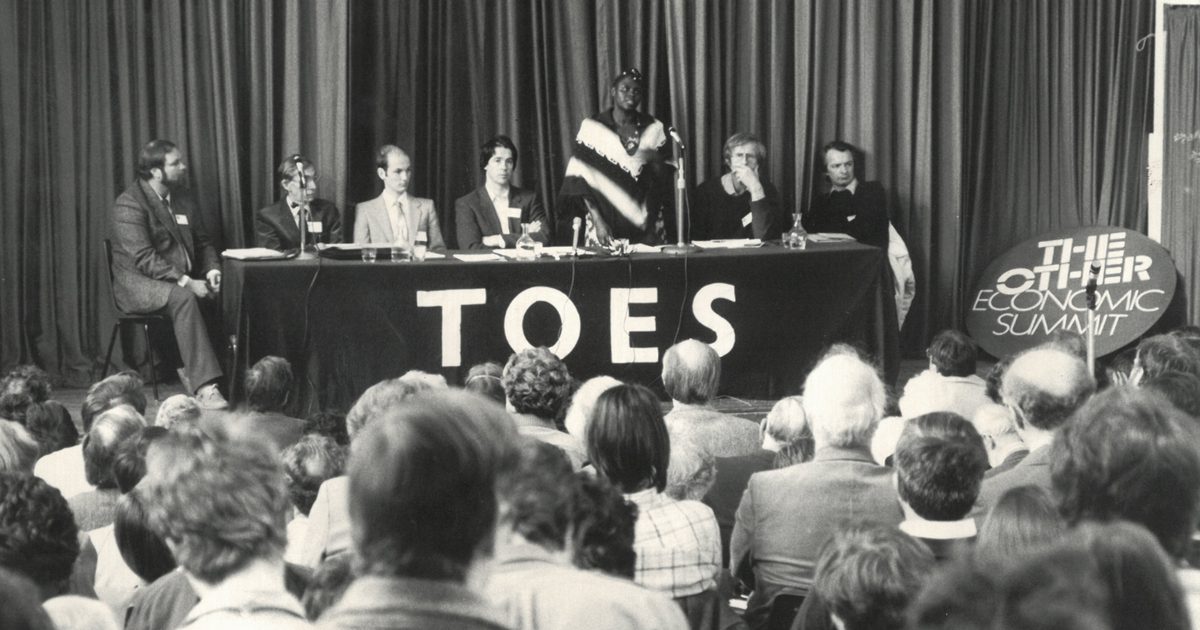
He suggested that they work together with other progressive economists and ecologists to convene an alternative economic summit – one which would contrast the G7’s approach with a new way of doing economics. The group set about organising “The Other Economic Summit” (TOES) in 1984. Around the third of these summits, held at the London School of Economics in 1986, the decision was taken to create a permanent vehicle to promote alternative economic ideas – and the New Economics Foundation (NEF) was born.
Riffling through NEF’s founding materials, I was struck by how clearly they predicted where neoliberalism would take us:
“To challenge the complacent orthodoxies of growth economics was once considered absurdly heretical; not to do so now is positively antediluvian… The pursuit of contemporary industrial economics constitutes the greatest single threat to human rights today, in this and every other country. As the gaps inevitably widen between North and South, between expectation and fulfilment, between finite resources and infinite demands, between economic “necessity” and fundamental ethical ideals of cooperation, solidarity and common humanity, so the tendency towards repressive responses and quasi-totalitarian government is strengthened.”
Four decades later, where do we stand? According to a Gallup World Poll last year, the number one concern for people across 107 countries was the economy. We are living through an inequality crisis. Extreme wealth concentration at the top sits uneasily alongside stagnant wages and falling incomes for the majority. The social contract that promised better living standards for each generation is collapsing. An economy addicted to consumption is ravaging the natural world. Our warming climate is triggering floods, droughts and wildfires both here in the UK and around the globe. And downstream of this faltering economic system are an endemic loss of trust in institutions and a rapidly fracturing political landscape.
Here in the UK, neoliberalism reached its zenith in the austerity project of the 2010s, where the public services we all rely on were stripped of their reped rising, NHS waiting lists ballooned and food banks became a common feature of our neighbourhoods
Today, the damage wrought by neoliberalism is plain to see. But back in the 1980s, questioning this new economic orthodoxy placed NEF fully outside the mainstream. And ever since its foundation, the organisation has challenged the assumptions behind the growth-at-all-costs mentality, deregulated finance and trickle-down economics
For the past four decades, NEF’s work has been underpinned by the conviction that our economy should serve people and the planet – not the other way around. Economics is often treated as a value-free discipline which can be used to create an objective guidebook for policymakers. NEF has consistently shown that this is not the case
I am constantly amazed by the people I encounter who have been influenced by NEF’s work over the years: from the economics student who used our work to challenge the narrow thinking of their lecturer, to the senior South African official who had worked on a NEF project on economic transformation, to a former official who said NEF’s work was critical in the Scottish first minister’s decision to focus on wellbeing as an overarching policy goal
One of NEF’s greatest contributions has been its insistence that better economics is possible. In the late 1980s and 1990s, ideas such as the shorter working week, wellbeing as a policy metric, or community-owned energy were dismissed as eccentric. Today, they influence mainstream debates
Nurturing human flourishing
The economy is not an abstract machine – it is something we interact with every day. NEF has always operated from the concrete reality of people’s lives rather than abstract economic models
2001 saw NEF launch a “time banking” programme, which allowed volunteers to earn credits by spending time helping in their community – and spend these credits in order to receive help from others. In 2009, with Transition Town Brixton, we launched the Brixton Pound, a local currency designed to keep money circulating within Brixton rather than being extracted by corporate chains
Today, we continue our promotion of the living income, a new form of social security which fights back against harmful myths around those receiving benefits and guarantees a decent standard of living for all. Our work on the foundational economy has led to a fierce devotion to the importance of well-funded public services – and the organisation of government finances which will enable us to return to this
Placing people at the centre of our work has led to us becoming the only leading UK thinktank with a community organising wing. Our organisers work with communities across the country to build their power and have a voice in setting the rules of our economy. In addition, the New Economy Organisers Network was incubated in NEF in 2013 and now is an independent organisation which supports new-economy movements around the country
Who controls the economy – and who benefits from it
The economy did not spring up out of the ground in its current state. It a certain set of rules. NEF’s job is to ask: who made these rules? And what would it take to change them? Decisions about how our economy is run should be accountable to those it affects – and yet the brunt of economic decisions are often borne by those who have no say
In 1998, NEF was instrumental in helping establish the Ethical Trading Initiative, the leading alliance of businesses, NGOs and trade unions working together to advance human rights in global supply chains. The Jubilee 2000 campaign mobilised millions of people across dozens of countries to cancel unpayable debt for Global South countries and changed the terms of global finance. Our Clone Town Britain report in 2007 exposed how corporate concentration of places on our high streets hollows out local economics. In 2018, our Co-operatives Unleashed report showed how we could double the number of co-operatives in the UK to democratise economic power. Today, the organisation is concerned with the democratic ownership of our economy through approaches like community wealth building and credit unions.
Sustaining our planet as the foundation of our future
Long before net zero was a policy target, NEF championed the idea that economic success has to be bound by ecological reality. In 1986, the notion of “environmental debt”, that growth pursued without regard for planetary limits merely shifts costs onto future generations, was at the heart of our founders’ concerns. In 2006, NEF conceived Earth Overshoot Day, the date when humanity’s demand for ecological resources and services each year exceeds what the Earth can regenerate. Following the 2008 financial crisis, NEF and our allies coined the Green New Deal, the framework that has since shaped global climate policy debate.
In recent years, NEF has developed a reputation for cutting-edge macroeconomic analysis. Neoliberalism has limited the ability of the state to invest properly in public services or the shift to a low-carbon economy. Our macroeconomic work has been endorsed by former prime minister Gordon Brown and has opened up new economic possibilities. NEF has contributed to real changes in the UK and European Union fiscal rules and in the Bank of England and European Central Bank’s “greening” of some of their monetary policy. The ability to sustain our planet is not an optional add-on to economics – it’s the foundation of our future.
Measuring what matters
Statistics and metrics are an essential building block of economics – and what we decide to count shapes what we do. In the 1990s, NEF pioneered social auditing and ethical investment frameworks. Against the primacy of gross domestic product (GDP) as the key economic indicator, NEF made the case for measuring wellbeing, social value and sustainability. In 2006, NEF developed the Happy Planet Index, which showed how countries could measure human wellbeing within planetary limits. Our Five Ways to Wellbeing report in 2008 created an evidence-based public-health framework which is now used by schools, the NHS and organisations worldwide. And our work developing a measure called “social return on investment” created a practical tool to measure the social benefits of investment in communities. Today, the Office for National Statistics measures UK wellbeing and the United Nations has set up a high-level expert group to recommend measures beyond GDP.
Lessons for the future
More important than looking to the past is learning lessons for the future. As we plot our way into a world which looks to become ever more unstable and fraught, the history of the last 40 years has revealed some lessons
First, we must break free from conventional economics. Faced with inequality, ecological breakdown, economic insecurity and democratic distrust, most progressive politicians are still offering only marginal tweaks to a model that is structurally incapable of delivering justice or sustainability. The tragedy is not just that these fixes fail – it’s that they foreclose the possibility of the deeper alternatives we need
Mainstream politicians are struggling because they have not moved beyond the economic assumptions that produced today’s crises in the first place. They seem unable or unwilling to challenge three great myths that dominate economic policymaking:
Myth 1: We must pursue growth at all costs.
Kenneth Boulding once said that “Anyone who believes that exponential growth can go on forever in a finite world is either a madman or an economist.” Yet, the mission of many governments remains growth at all costs. Keir Starmer said it would be the “defining mission” of his government when he was elected prime minister. There is little regard for the climate or the natural world – nor for the fact that when growth does appear, it does not seem to deliver a better life for most people.
Myth 2: Trickle-down economics will manage inequality.
We have been told that the benefits of economic success will be passed on to all of us. Yet the evidence over the last few decades tells us this isn’t so. Skyrocketing income and wealth inequality are fraying the social fabric that binds our societies, and the concentration of wealth and power shows no signs of abating. Few mainstream politicians are willing to confront the mechanisms through which wealth multiplies at the top while wages stagnate – taxes, corporate governance and workplace power.
Myth 3: Market-based solutions are the only credible ones.
From energy to housing to basic services, progressives have largely accepted the primacy of market logic: competition over cooperation, outsourcing over public purpose, financial returns over collective wellbeing. Even in areas like the climate transition or industrial policy, their proposals are often bolted onto the existing model rather than seeking to remake it.
NEF’s founders understood something many today still resist: politicians cling to conventional economics not because it works, but because de ideologically. Progressive leaders fear being painted as anti-business, fiscally irresponsible, or naively utopian, so they stay within the safe confines of technocratic tweaks
But those confines are a trap. In avoiding structural change, progressives unintentionally validate the far-right narrative that the “establishment” offers only more of the same. When progressive leaders defend a broken economic status quo, they abandon the very people they claim to represent, leaving anger and frustration to be harvested by those promising something more toxic
Mainstream parties need to reclaim the political battleground. Progressives must stop trying to mend a model that cannot be mended. They must build a new one. That was the founding message of NEF 40 years ago. It is the essential lesson for progressive politics today
Second, we need to reimagine international cooperation. While there has been remarkable progress in reducing extreme poverty around the world, the last 40 years of globalisation has also seen inequality and wealth extraction explode. A damaging lack of accountability, as corporations and wealthy individuals have found ways to avoid regulation and taxation on a fragmented global stage, has further empowered an extractive elite
The multilateral mechanisms created after World War II to promote economic cooperation are outdated and the rules-based global order on which they were predicated is fast unravelling. We can see this flagrant disregard for international law and principles at its most horrifying in the treatment of Gaza and Iran. The rise of nationalism and protectionism, tariffs, and new regional trading blocs are all reducing dependence on traditional powers, straining multilateral norms and contributing to a risky weaponisation of trade. At a time when the case for global cooperation on today’s major economic challenges – from inequality to climate crisis to technological disruption – has never been stronger, the status quo is breaking down.
Take a look at the G20, effectively the successor to the G7 as the de facto steering committee for the world’s economy. In 2026, the United States holds the presidency. Trump plans to host the summit at one of his golf courses in Miami, where he wants to discuss market-based capitalism, remove “regulatory burden”, and focus on the “best America has to offer, with American leadership”. It’s a regressive reinstatement of a zero-sum, “America first” view of international economic relationships.
But it is also an opportunity. We need to create more legitimate, open spaces for new economic thinking and genuine cooperation. We need to build confidence in our own politicians to take on these issues and to look to new avenues for international cooperation. And in the face of a fragmenting world order, we need to formulate collective solutions to collective problems.
Across the world, a diverse and growing community of thinkers, policymakers, and practitioners are already building the foundations of a new economy. They are advancing climate-aligned development, tackling inequality, rethinking fiscal rules, redesigning global financial architecture, and redefining what we mean by economic success. And, despite the huge geopolitical challenges we face, small coalitions of committed actors are testing news forms of economic cooperation, from solidarity levies to a borrower’s club of highly indebted countries to South-South swap lines that climate-vulnerable countries can use in times of emergency. Later this year, NEF will be working with partners from around the world to connect, amplify and celebrate the ideas and initiatives that are giving shape to the future we want.
And finally, we need to embrace the answers which are hiding in plain sight. One of those who inspired the creation of NEF was the Anglo-German economist and policymaker EF Schumacher. His 1973 book, Small is Beautiful: a Study of Economics as if People Mattered, critiqued the way that the modern economy was propelled “by a frenzy of greed and indulges in an orgy of envy”. Schumacher was particularly worried about our addiction to fossil fuels and lamented the materialist philosophy that was conquering the world.
One of Schumacher’s key recommendations was democratising the ownership of the economy. History is full of people-centred forms of business, from Roman collegia to medieval guilds to friendly societies to mutual-aid societies. Look close enough and you will find all sorts of fabulous examples, big and small, of more co-operative forms of businesses that put people and planet before profit
There are some 3 million co-operatives around the world today, employing around one in 10 of the world’s employed population and with an estimated 1.2 billion members. Two UK-based co-operatives, the Co-Operative Group and the John Lewis Partnership, account for around 0.5 per cent per cent of business turnover in the UK. In the case of the UK’s community-energy movement, a diverse collection of wind and solar initiatives are helping communities take democratic control over their energy future by understanding, generating, using, owning and saving their own energy. Scaling up the co-operative economy will help strengthen economic resilience, increase consumer choice, make all of us more active participants in economic life, protect the conditions of workers, reduce extreme-wealth accumulation and promote more sustainable business practices.
Or take the proposal to shorten the working week. We sit a full century after the trade union movement won workers the weekend. The world of work is a dramatically different place now. Since NEF’s landmark report in 2010, we have pioneered the promotion of the four-day work week, making the economic and social case for reduced working time. What was once seen as a utopian ideal is now gaining traction in the UK, with several hundreds of UK organisations (including NEF) employing staff on four-day week contracts with full pay. The four-day week is moving from niche experiment to a mainstream option, reshaping expectations around work, wellbeing, and productivity.
Achieving a fairer future
After 40 years of speaking up for people and planet, NEF’s mission feels unfinished – yet more vital than ever. We stand at a moment when the consequences of inequality, ecological breakdown and economic insecurity are no longer abstract warnings but daily lived realities for billions
It is an incredible privilege to be working at an organisation that has such a proud heritage and track-record, but it also feels like an incredible responsibility. Many of the things that NEF’s founders were worried about – from the way that the economy works to the short-sightedness of politicians – feel more important and urgent than ever before
And yet, alongside the urgency, there is a rising swell of possibility – a sense that bold ideas, grounded in justice and community, can still reshape the world for the better. Our work matters because it insists that a fairer future is not only imaginable but achievable
If you value great public services, protecting the planet and reducing inequality, please support NEF today
Make a one-off donation
£5£10£25£50£75£100





