

Questioned over the weekend about how or if the U.S. government will take over governing Venezuela following its capture of President Nicolás Maduro on the weekend, Secretary of State Marco Rubio instead shifted the focus to the enforcement of a U.S. blockade on sanctioned oil tankers.
It’s that blockade — announced by U.S. President Donald Trump back in December — that will be used as leverage as a means to press for policy changes in Venezuela. And it’s that blockade the president is referring to when he speaks about running Venezuela, Rubio said Sunday on CBS News’ Face the Nation.
Here’s a look at the origins of the blockade, what it entails, whether it’s considered legal and just how effective it is.
Announcing the blockade
On Dec. 16, Trump announced in a post on his social media platform Truth Social that Venezuela was “completely surrounded by the largest armada ever assembled in the History of South America.”
He went on to say that he was ordering “a total and complete blockade of all sanctioned oil tankers going into and out of Venezuela.”
This, he said, was in response to the regime being designated a “foreign terrorist organization” over the theft of U.S. assets, and “many other reasons, including terrorism drug smuggling and human trafficking.”
The sanctioned oil tankers are on a list maintained by the U.S. Treasury Department.
When Trump made the announcement, there were more than 30 vessels that had been sanctioned by the United States, the New York Times reported, citing figures from the independent tracking service Tanker Trackers.
The vessels are part of a so-called “shadow fleet” of unflagged tankers that illegally transport crude into global supply chains.
Those ships cloak their locations by altering their automated identification system — a mandatory safety feature intended to help avoid collisions — to either go entirely dark or to “spoof” their location to appear to be navigating sometimes oceans away, under a false flag or with the fake registration information of another vessel.
“Maduro’s regime increasingly depends on a shadow fleet of worldwide vessels to facilitate sanctionable activity, including sanctions evasion, and to generate revenue for its destabilizing operations,” the Treasury Department said in a Dec. 31 news release.

Should it even be called a blockade?
Although Trump has used the term “blockade,” other administration officials, like Rubio, are instead referring to the action as a “quarantine,” which targets illegal activity.
A blockade, under international law, constitutes an act of war — a belligerent act, that is an “all-encompassing tool of war,” Andrew Latham, a professor of international relations at Macalester College in Saint Paul, Minn., recently wrote for The Hill.
“Trump, who doesn’t really know all that much about these issues, used the common-sensical term blockade, but the technical term, which is the workaround, is quarantine,” Latham said in an interview with CBC News.
(Trump himself seemed to qualify his use of the word blockade in his Truth Social post, by his reference to targeting “sanctioned” tankers, suggesting this wasn’t an act of war, but more a law enforcement operation.)

Venezuela’s government says the U.S. seizure of an oil tanker off the coast of Venezuela ‘constitutes a blatant theft and an act of international piracy.’ U.S. Attorney General Pam Bondi says the FBI, the Department of Homeland Security and the U.S. Coast Guard carried out a seizure warrant for the tanker, alleging it was transporting sanctioned oil from Venezuela and Iran.
As for the legality of a quarantine, Latham says that a vessel that is not flying a flag or is illegally flying some other country’s flag, is subject to search and seizure.
Mark Nevitt, an Emory University law professor and former navy judge advocate general, told The Associated Press last month that there is a legal basis for the U.S. to board and seize an already-sanctioned ship that’s deemed to be stateless or is claiming two states.
But he noted that a blockade is a “wartime naval operation and maneuver” designed to block the access of vessels and aircraft of an enemy state. “I think the blockade is predicated on a false legal pretense that we are at war with narcoterrorists,” he said.
Nevitt added: “This seems to be almost like a junior varsity blockade, where they’re trying to assert a wartime legal tool, a blockade, but only doing it selectively.”
How many vessels have been intercepted?
So far, just two boats have been intercepted, but one was before the president made his blockade announcement, and the other was not on the sanction list.
On Dec. 10, a sanctioned vessel called the Skipper that was headed to China was seized off the coast of Venezuela.
A second vessel, the Centuries, was boarded on Dec. 20, but it was not on the sanctioned list.
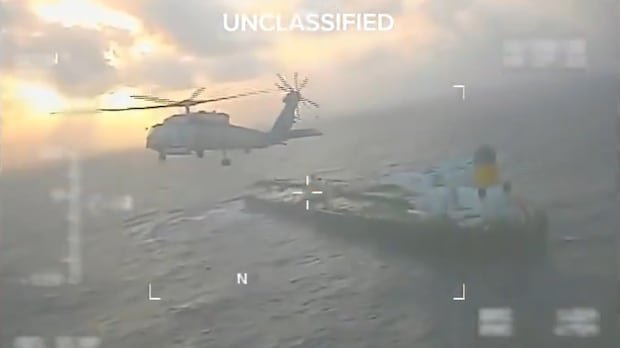
Meanwhile, American forces are planning to intercept another sanctioned vessel, the Marinera, a crude oil tanker formerly known as the Bella 1, according to CBS News.

President Donald Trump says the U.S. has seized an oil tanker off the coast of Venezuela, but provided few other details, aside from calling it the ‘largest one ever.’
Are any boats breaking the blockade?
In recent days, at least 16 oil tankers hit by U.S. sanctions have so far been able to to evade the blockade, in part by disguising their true locations or turning off their transmission signals, the New York Times reported on Monday.
Fifteen of the 16 ships that were on the move on Saturday were under U.S. sanctions for hauling Iranian and Russian oil, according to the Times.
Meanwhile, Reuters also reported that about a dozen oil tankers loaded with Venezuelan crude and fuel had left the country’s waters since the start of the year in apparent defiance of the U.S. government’s blockade.
All the departed vessels identified are under sanctions and most are now sailing without any known flag or current ship safety documentation in place, according to shipping data.
How might the blockade impact Venezuela?
Oil exports are Venezuela’s main source of revenue, but exports from the state-owned oil company Petróleos de Venezuela S.A., commonly known as PDVSA, ground to a halt last week due to the blockade, Reuters reported.
Without more exports, PDVSA could be forced to deepen production cuts it began in recent days because storage tanks are full.
All this means that the blockade could have a significant economic impact on Venezuela. The New York Times reported that if the blockade remains in place, it could shutter more than 70 per cent of the country’s oil production this year.
