


Cooperative Security, Arms Control and Disarmament
The United States–Iran Trap: Neither Side Has a Winning Hand
Taiyi Sun
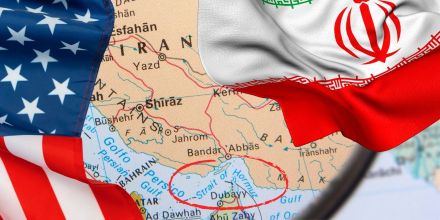
The latest United States–Iran crisis is not simply about whether the Strait of Hormuz is ‘open’ or ‘closed’. Nor is it only about whether President Donald Trump can maintain a domestic political narrative that the United States is keeping energy routes secure. The deeper danger is that Iran is not as internally paralysed as some in Washington seem to believe, while the United States, despite its overwhelming military superiority, does not have a clean or low-cost path to victory. Both sides still have cards to play. Neither side has a winning hand.
Some American officials and commentators appear to see two Irans operating at the same time: one Iran that talks, negotiates, and sends diplomatic signals, and another Iran that threatens the Strait of Hormuz, launches reprisals, and raises the cost of American military pressure. This may look like confusion or internal fragmentation. Yet it may be closer to a division of labour. Iran’s diplomats can keep channels open, calm outside actors, and buy time. Its military and security institutions, especially the Islamic Revolutionary Guard, can preserve deterrence, increase pressure, and remind Washington that Iran still has ways to retaliate.
This is not to suggest that Iran has no internal tensions. It certainly does. But on questions of war, nuclear capability, and the Strait of Hormuz, it is unlikely that major actions are simply being carried out by disconnected groups without central coordination. In Iran’s political system, the final say is still held by the Supreme Leader. What Washington sees as inconsistency may therefore be an organised strategy: negotiate enough to avoid total isolation, resist enough to avoid surrender.
This helps explain why Tehran is unlikely to give up its core leverage easily. Iran’s bargaining power rests on two connected forms of leverage: its nuclear latency, including uranium enrichment, possible weaponisation know-how, and missile delivery capabilities; and its ability to threaten shipping through the Strait of Hormuz. Tehran appears to believe that Trump is more eager to end the crisis than Iran is. For Trump, a prolonged confrontation risks higher oil prices, renewed inflation fears, and an unwanted foreign policy burden before the midterm elections. For Iran, time can be useful if it allows the regime to preserve its deterrent while appearing open to diplomacy.
Trump’s difficulty is that he often treats foreign policy crises as dramatic bargaining situations. The method is familiar: create maximum pressure, force the opponent into a psychological corner, then announce victory. In domestic politics, this approach can work because performance, momentum, and the appearance of strength matter greatly. But Iran is not a domestic opponent, and it is not a real estate negotiation. It has its own regime-security logic, regional networks, ideological commitments, and sense of historical grievance. When military pressure, energy markets, electoral politics, nuclear risk, and Israeli security are all tied together, the United States may appear powerful while becoming increasingly trapped.
This does not mean Washington has no options. The United States can strike Iranian facilities, protect selected ships, reinforce regional bases, tighten sanctions, and disrupt Iranian maritime activity. It may even consider a limited, high-profile military operation aimed at destroying, seizing, or diluting part of Iran’s enriched uranium stockpile. Such an operation would have obvious political appeal. It could allow Trump to declare that the nuclear threat had been neutralized and that he had achieved a major victory without a prolonged war.
But Iran may not follow the script. It could retaliate against American bases, target Gulf partners, attack shipping, activate regional allies, or accelerate the very nuclear activities Washington wants to stop. A tactically successful strike could still be a strategic failure if it opens a longer confrontation in which Iran does not need to defeat the United States, but only needs to make American dominance more expensive.
The Strait of Hormuz is central because it is not only a waterway. It is a symbol of control, a channel of global energy flows, and a test of credibility. The United States can say the Strait is open if ships can still pass under naval protection. Iran can say it is closed if shipping companies, insurers, and energy markets treat the passage as unsafe. In this sense, ‘open’ and ‘closed’ are not purely technical conditions. They are political claims.
This asymmetry favours Iran. To close the Strait, Iran does not need to control every mile of water. It only needs to create credible fear. To open the Strait, the United States must restore confidence. Fear is much easier to create than confidence is to restore. Even if American strikes weaken Iranian capabilities, they may not eliminate Iran’s ability to impose risk through missiles, drones, mines, small boats, or regional proxies. Iran does not need to win every exchange. It only needs to show that it can still make others pay.
Iran’s attacks on or near United States facilities in Kuwait, Oman, Qatar, Jordan, and other regional locations should be understood in this context. These actions are not necessarily proof that Iran wants a full regional war. They are designed to weaken the credibility of the American security umbrella. Iran is effectively telling regional governments that hosting, supporting, or facilitating American operations comes with exposure. The message is not only aimed at Washington. It is also aimed at Gulf states that depend on American protection but do not want to become battlefields.
The sudden death of US Senator Lindsey Graham adds another political layer, but it is unlikely to soften Trump’s Iran policy. Graham was one of the strongest voices for a muscular American foreign policy, and he almost certainly would have supported a hard line against Iran. Yet the most consequential decisions on escalation are usually made in a narrow circle around the president, the national security team, military planners, and, in this case, pressure from Israel. Graham mattered, but he was not the only hawk in Washington.
Nor has Congress lost its pro-war bloc. Figures such as Tom Cotton, Ted Cruz, and House Speaker Mike Johnson remain strongly hawkish. As long as Trump chooses confrontation, most Republican legislators are likely to follow. Indeed, Graham’s death may even allow Trump and congressional Republicans to invoke his legacy in support of sanctions, military authorisations, or other measures against Iran. The loss of one influential senator does not change the deeper political gravity of the Republican Party on Iran.
The true danger lies elsewhere: in an irreversible event. A large number of American casualties, serious damage to a major United States naval asset, an accident at an Iranian nuclear facility, an Israeli strike that exceeds Washington’s control, or the direct entry of Gulf states into the conflict could push the crisis beyond its current grey zone. At present, both sides are still mixing military pressure with diplomatic signalling. That makes war avoidable, but it also makes escalation harder to predict.
Diplomacy, therefore, still matters, even if it cannot solve the crisis quickly. The goal should not be an immediate grand bargain. It should be to prevent irreversible escalation. Mediators should press for a maritime incident hotline, clearer rules for naval encounters, temporary transit protocols for the Strait, and a commitment by all parties to avoid strikes on nuclear facilities while negotiations continue. Gulf states should be included not merely as hosts of American military power, but as exposed actors with their own interest in de-escalation. Israel’s role must also be addressed, because even a temporary United States–Iran understanding can collapse if Israel acts outside Washington’s preferred timetable.
The uncomfortable reality is that strength is not the same as control. The United States remains the stronger power, but it can no longer define the Middle Eastern order unilaterally. Iran remains the weaker power, but it retains enough leverage to make American dominance costly. That is why this crisis is so dangerous. Trump wants a victory he can announce. Iran wants a pause without surrender. Gulf states want protection without becoming targets. Israel wants Iran weakened as much as possible. Each objective is understandable on its own. Together, they form one of the most unstable configurations in the contemporary Middle East.
Hormuz After the Pause: US–Iran Escalation Returns (3-minute read)
A Signature is Not a Settlement: Trump’s Fragile Iran Pause (3-minute read)
Peace Deal or Not, Iran War Has Shattered Trust in Fossil Fuels (3-minute read)
The Author
Taiyi Sun (Ph.D., Political Science, Boston University) is Associate Professor of Political Science at Christopher Newport University.


