


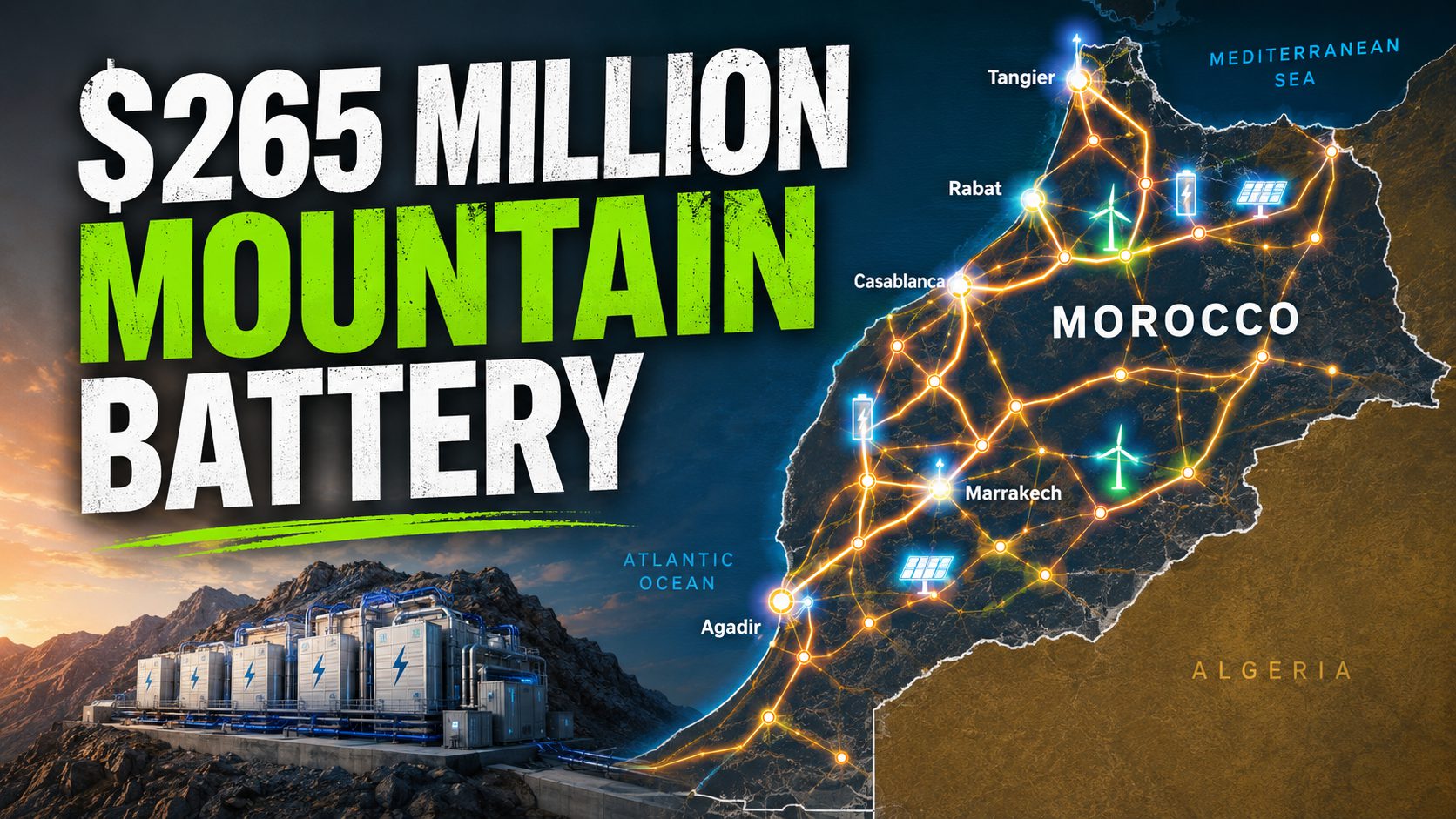
When the sun blazes across Morocco’ssolar farms and wind tears through its turbine corridors, the grid sometimes produces more electricity than it can use. That surplus either gets stored or gets wasted. On July 1, 2026, the World Bank approved $265 million to make sure Morocco picks the first option — financing the Ifahsa Pumped Hydropower Storage Project near Chefchaouen in the country’s north. The facility is being called one of the most significant pumped storage projects on the African continent, according to the World Bank.
How a Mountain Becomes a Battery
Two reversible pump-turbine units will push water uphill during surplus generation and release it through generators when demand spikes.
The concept is deceptively simple, like a Rube Goldberg machine that actually works. Two 150 MW reversible pump-turbine units will push water uphill when renewable output exceeds demand. When the grid needs power, that water drops back through the turbines and generates electricity. Connected to Morocco’s 400 kV transmission network, the 300 MW facility will absorb roughly 690 GWh of energy and generate about 550 GWh annually — an 80% round-trip efficiency rate, according to World Bank project documents. Without storage like this, surplus solar and wind power simply goes to waste.
- 300 MW facility near Chefchaouen
- At least 1 GW of new solar and wind capacity unlocked
- 1.7 million tons of CO₂ avoided annually
- 3 terawatt-hours of fossil fuel electricity replaced per year
- Roughly 820 direct construction jobs annually
- An estimated $1 billion in private investment expected to follow
The Bigger Picture (and the Awkward Timing)
The World Bank backed a landmark climate project the same week it dropped its own formal climate-lending targets.
Morocco’s national utility, ONEE (Office National de l’Électricité et de l’Eau potable), will implement the project with co-financing from the African Development Bank. For the average Moroccan household or business, this translates to a more reliable grid — fewer blackouts, steadier voltage, and the infrastructure backbone that attracts industrial investment.
The approval arrived the same week the World Bank announced it would retire its 45% climate-lending target, replacing it with a broader framework carrying no binding quotas, according to reporting on the institution’s climate finance policy shift. The contrast is worth noting plainly: a major climate-linked infrastructure commitment and a formal retreat from climate-lending accountability, in the same week.
What Grid Storage Signals for Africa
Large-scale energy storage could determine whether the continent’s renewable ambitions survive contact with reality.
Grid-scale storage remains the missing piece for renewable energy across Africa. The Ifahsa project suggests the financing appetite exists — if the engineering delivers. Projects of this scale also signal to private capital that grid conditions are stabilizing, which is what draws industrial investment and downstream energy development. Whether more follows depends on whether this mountain battery performs as the project documents promise.


