

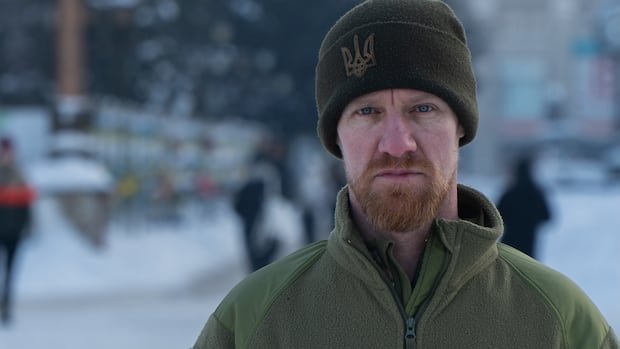
As David Rauser stood outside the entrance of a makeshift Russian bunker in eastern Ukraine’s embattled Donetsk region in November, the Alberta former firefighter-turned-soldier clutched his automatic weapon. He peered into the shelter that was mostly obscured by a large plastic tarp.
Inside, Russian voices cut through the darkness, asking who was there. With his second-in-command just behind him, Rauser yelled out in Russian, ordering those inside to put their hands up and surrender. When there was no response, he opened fire.
A video taken from a camera attached to his helmet recorded the next moments as gunfire erupted outside of the bunker, aimed right at him.
But in the chaos, Rauser, 40, was struck by friendly fire.
“One of the guys on my team — he was new to the team, and I don’t know why, but he mistook me for a Russian,” he said. “He shot me once in the head and once in the arm.”
Rauser was shot on Nov. 10, 2025, in the most intense mission of his 10 months serving in Ukraine with the 63rd Separate Mechanized Brigade. He often worked as a part of a small unit composed of conscripts, professional soldiers and fellow foreign fighters. He spoke with CBC News from Ternopil in western Ukraine.
Now out of the hospital, he is waiting for paperwork before returning, perhaps only temporarily, to Canada.
It’s not clear how many Canadian citizens are fighting for Ukraine, but more than a dozen have been killed since Russia launched its full-scale invasion on Feb. 24, 2022. (Those deaths include both soldiers and a few paramedics.) Besides Rauser, CBC is aware of two Canadian citizens who were recently injured in combat, and are currently hospitalized in western Ukraine.
“War is really scary. It’s terrifying,” he said. “It’s a little bit of a miracle I got shot in the head that I’m able to sit here. I’m thankful for that.”

‘Please don’t die’
Over the next several minutes after he was shot, the video recording shows Rauser, blinded by the wound, nearly stumble into the bunker before a team member grabs him and begins first aid. The American soldier who shot him can be heard apologizing, pleading for him not to die.
Days later, when he woke up strapped onto a hospital bed in Kyiv, Rauser didn’t remember much of his medical evacuation from the east. He was later told he had been tied down to prevent movement. His head injury was severe, and he was missing part of his skull.

He spent nearly two months in hospital, first in Kyiv, then in two separate facilities in western Ukraine.
His team member later told him that a bullet had struck him just under the rim of his helmet, leaving the gear completely intact but shattering a front section of his skull.
On on his upper left shoulder is a large scar from where the second bullet hit him.
He said he feels 90 per cent recovered, though he doesn’t have all his physical strength back.
“I’m always going to be different after an injury like that,” he said. “But it’s adequate. I can function.”
Growing up in Ukraine and Russia
Rauser had no military experience when he decided to cross into Ukraine from Poland, at the beginning of last year, but had a strong connection to the region, including language skills. When he was a child, his father did missionary work and the family spent three years living in Russia and then another six in Ukraine.
They lived for four years in the southern city of Zaporizhzhia — the capital of one of the four regions to which Russia has laid claim throughout its invasion — and then spent two years in Kyiv.

The family returned to Canada when he was a teenager, and in 2012 settled in Sherwood Park, Alta., a community on the eastern outskirts of Edmonton.
A decade later in 2022, as Rauser watched a convoy of Russian tanks move through Ukraine, he spent sleepless nights worrying about the country and his friends there.
When Ukrainian President Volodymyr Zelenskyy urged foreign citizens to take up arms against Russia that year, Rauser considered enlisting. But after thinking and praying about it, he decided it wasn’t the time.
By 2024, the situation on the ground in Ukraine had changed, and so had Rauser’s thinking.
“The fact that the war got harder, I think, and a little bit more desperate as it went on actually increased my motivation to go,” he said. “I felt, ‘OK, they need me now, so I should go.’”
Ukraine has been struggling throughout the war to recruit enough people to defend its front line, which exceeds 1,000 kilometres. At the end of 2023, Ukrainian military commanders were seeking another half-million soldiers. Videos emerged online of conscription officers drafting men from streets, malls and gyms, in some cases taking them directly to enlistment centres.

An Alberta man who went to fight in Ukraine tells CBC News about his brush with death after being shot outside a Russian bunker in Donetsk. David Rauser explains what led him into combat, and why he’s concerned the war is being pushed from the headlines.
From fighting fires to the front line
When Rauser arrived in Ukraine, he signed a contract for three years with the 63rd Separate Mechanized Brigade and was sent for four weeks of training.
Despite his lack of military experience, he figured his time fighting forest fires in northern Alberta would serve him well. He knew how to read a map, was comfortable in remote areas, and had been in many high-stress environments.
“I remember the first fire, my mind went to mush … just full adrenaline,” he said of his time as a firefighter. “That experience was helpful as I learned how to control that a little bit.”

Still, in Ukraine, the challenges were on an entirely different level. After about four weeks of training, which he described as very broad but adequate, he was sent out to the front line on his first mission. He described being sent to a position that was essentially “a tiny hole in the ground.
“I spent two weeks out there and that was a real life-changing experience. We had drones attack our bunker. We had Russian soldiers … move past about two to three hundred metres from us.”
Not long after, he moved into another role, working as a guide escorting soldiers to and from their positions. The constant threat of drones made it too dangerous to travel in a vehicle, so soldiers would walk several kilometres through the forest.

By early fall, Rauser said some small units of Russian soldiers had broken through Ukraine’s defences near Lyman, about 18 kilometres northeast of the city of Sloviansk.
The Russians set up small positions behind Ukrainian lines, “causing a lot of chaos,” so his mission was to clear them out of the area, alongside a small team.
On one occasion, when he and his team were set up in the basement of a house, they heard footsteps walking above them and the crunching of glass. The Russians were moving above them, apparently unaware of the Ukrainian troops sheltering below.
After a call on the radio, a Ukrainian drone unit hit the house and it caught on fire.
“The house burned down over our heads,” he said. “It got really warm, but we survived and we were safe.”
A potential return
Rauser has been offered a job to come back as a trainer, which he is considering, but he is returning to Canada first for a visit.
He needs one more surgery to put a plate in his head and is not sure in which country he will get it.
“I wish I could say peace [in Ukraine] is going to happen tomorrow… I don’t think it’s going to,” Rauser said.
“It depends a lot on other world leaders. Trump is all over the place.”

On Tuesday, asked about Ukraine, U.S. President Donald Trump claimed once again that negotiations were going well, but there still appears to be a large chasm between both sides. Ukraine doesn’t want to simply turn over more land to Russia, which the Kremlin is demanding.
As Rauser sits and follows the news from western Ukraine, he hopes something positive will come out of all the turbulence, including a wake-up call to Europe to renew support for Ukraine.
“They can’t count on the U.S. to solve the problems,” he said.
“[Europe] is going to have to step up and sacrifice.”
