By ABS News Desk | August 4, 2026
YAOUNDÉ — The Trump administration has formally notified the United States Congress of plans to close the American Embassy branch office in Douala, Cameroon, ending Washington’s permanent diplomatic footprint in the country’s largest city and commercial nerve centre, according to separate notices sent to lawmakers late last week and obtained by the media.
The Douala branch office, which employs 14 local staff members and no direct-hire American personnel, is one of five smaller U.S. diplomatic missions earmarked for closure. The others are the U.S. Embassy in Grenada, consulates in Nagoya, Japan, and Medan, Indonesia, and an American Presence Post in Winnipeg, Canada.
Together, the closures are expected to save the U.S. government roughly $4.4 million per year, according to the notices. The State Department described the restructuring as part of a broader effort to streamline America’s diplomatic network at home and abroad.
The closure does not affect the main U.S. Embassy in the capital Yaoundé, which will remain open and continue to serve as Washington’s primary diplomatic mission to Cameroon. However, it will eliminate the only permanent American diplomatic presence in Douala — a city of more than three million people that serves as Cameroon’s port gateway, its financial hub, and the headquarters of most international businesses operating in the country.
The State Department has not publicly announced a timetable for the Douala closure, nor has it indicated what will happen to the 14 local employees who currently staff the office. No statement has been issued on how consular and commercial services previously handled in Douala will be absorbed or redistributed.
The closures come as the Trump administration simultaneously moves to reopen shuttered embassies in Libya, Syria, and Venezuela — missions that were closed following the removal of long-ruling governments in those countries.
The announcement lands at a particularly fraught moment in U.S.-Cameroon relations. On August 1, 2026 — just days before Washington’s closure notice was sent to Congress — the Cameroonian law firm FRULAW CHAMBERS filed a landmark lawsuit before the Administrative Court of the Centre Region in Yaoundé, challenging a clandestine bilateral arrangement under which the United States deported 36 third-country nationals to Cameroon between January and May of this year.

The 36 individuals, nationals of the DRC, Ghana, Angola, Ethiopia, Sierra Leone, Kenya, Senegal, Zimbabwe, and Morocco, had been granted legal protection by U.S. immigration courts and were barred from being returned to their countries of origin due to documented risks of persecution or torture. Their transfer to Cameroon, where they have since been held without charges, legal status, or identity documents at a detention facility in Yaoundé’s Elig Esono neighbourhood, has been characterised by their lawyers as a violation of the principle of non-refoulement and Cameroon’s obligations under the 1951 U.N. Refugee Convention.
The lawsuit further alleges that the bilateral deportation arrangement between Washington and Yaoundé was concluded secretly, without public disclosure, parliamentary ratification, or any transparency about its legal basis or terms — raising constitutional questions that Cameroonian courts will now be asked to resolve for the first time.
The convergence of the deportation lawsuit and the embassy closure notice has drawn sharp attention in Yaoundé and among the Cameroonian diaspora. Critics argue that the United States is simultaneously reducing its diplomatic accountability in Cameroon while using Cameroonian territory as a staging ground for deportations that circumvent its own courts’ protection orders.
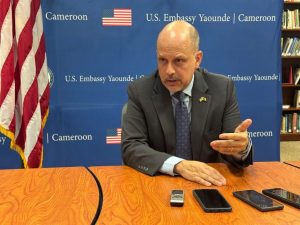
The U.S. Embassy in Yaoundé has been without a confirmed ambassador since January 2026, when Christopher Lamora, who had served as ambassador since March 2022, departed the post. No replacement has been nominated or confirmed. The combination of an ambassadorial vacancy, a branch office closure, and an active lawsuit over a secret deportation deal presents Washington with a deepening credibility deficit in one of Central Africa’s most strategically significant nations — and one currently navigating its most acute political crisis in four decades.
The State Department did not respond to ABS News requests for comment.