

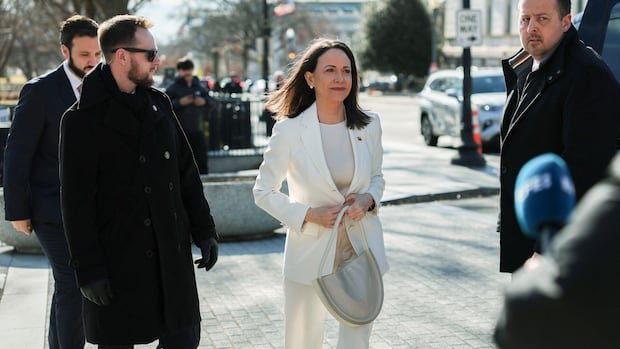
Venezuelan opposition leader Maria Corina Machado gave her Nobel Peace Prize to U.S. President Donald Trump on Thursday during a White House meeting, as she tries to gain some influence over how he seeks to shape the South American country’s political future.
A White House official confirmed that Trump intends to keep the medal.
In a social media post on Thursday evening, Trump wrote: “Maria presented me with her Nobel Peace Prize for the work I have done. Such a wonderful gesture of mutual respect. Thank you Maria!”
Machado, who described the meeting as “excellent,” told reporters she had done so in recognition of his commitment to the freedom of the Venezuelan people.
Machado’s attempt to sway Trump came after he dismissed the idea of installing her as Venezuela’s leader to replace the deposed Nicolás Maduro. Trump openly campaigned for the prize before Machado was awarded it last month and complained bitterly when he was snubbed.
Though Machado gave Trump the gold medal that honorees receive with the prize, the honour itself remains hers; the Norwegian Nobel Institute has said the prize cannot be transferred, shared or revoked. Asked on Wednesday if he wanted Machado to give him the prize, Trump told Reuters: “No, I didn’t say that. She won the Nobel Peace Prize.”
The Republican president has long expressed interest in winning the prize and has at times linked it to diplomatic achievements.
The lunch meeting, which appeared to last slightly over an hour, marked the first time the two met in person. Machado then met with more than a dozen senators, both Republican and Democratic, on Capitol Hill.
While the visit took place, White House press secretary Karoline Leavitt said Trump had been looking forward to meeting Machado, but that he stood by his “realistic” assessment that she did not currently have the support needed to lead the country in the short term.

Machado, who fled Venezuela in a daring seaborne escape in December, is competing for Trump’s ear with members of Venezuela’s government and seeking to ensure she has a role in governing the nation going forward.
After the U.S. captured Maduro in a snatch-and-grab operation this month, various opposition figures, members of Venezuela’s diaspora and politicians throughout the U.S. and Latin America have expressed hope that Venezuela will begin the process of democratization.
“I know the president was looking forward to this meeting, and he was expecting it to be a good and positive discussion with Miss Machado, who is really a remarkable and brave voice for many of the people of Venezuela,” Leavitt told reporters during the briefing.
Democratic Senator Chris Murphy, one of the senators who met with Machado, said the opposition leader had told senators that repression in Venezuela was no different now than under Maduro.

Venezuela’s interim President Delcy Rodríguez is a “smooth operator” who was growing more entrenched by the day thanks to Trump’s support, he said.
“I hope elections happen, but I’m skeptical,” said Murphy, of Connecticut.
Trump has said he is focused on economically rebuilding Venezuela and securing U.S. access to the country’s oil.
Trump has on several occasions praised Rodríguez, Maduro’s second-in-command, who became Venezuela’s leader upon his capture. In an interview with Reuters on Wednesday, Trump said “she’s been very good to deal with.”
In an annual address to lawmakers, Rodríguez called for diplomacy with the U.S. and said should she need to travel to Washington, she would do so “walking on her feet, not dragged there.”
She also said she would propose reforms to her country’s oil industry.
Machado was banned from running in Venezuela’s 2024 presidential election by a top court stacked with government allies. Maduro claimed victory, but outside observers widely believe Edmundo González, an opposition figure backed by Machado, in fact won more votes by a substantial margin.
While the current government has freed dozens of political prisoners in recent days, outside groups and advocates have said the scale of the releases has been exaggerated by Caracas.
U.S. seizes another tanker
The meeting between Trump and Machado came hours after the U.S. seized another Venezuela-linked tanker, U.S. officials told Reuters.

The seizure of the tanker Thursday is the sixth vessel targeted in recent weeks that was either carrying Venezuelan oil or had done so in the past. The officials, speaking on the condition of anonymity, said the seizure took place in the Caribbean.
The U.S. military’s Southern Command confirmed the pre-dawn operation, saying U.S. forces apprehended Motor/Tanker Veronica “without incident.” It said the Veronica was “operating in defiance of President Trump’s established quarantine of sanctioned vessels in the Caribbean.”
“The only oil leaving Venezuela will be oil that is coordinated properly and lawfully,” Southern Command said in a statement.
The Guyana-flagged Aframax tanker Veronica departed empty from Venezuelan waters in early January, according to shipping documents from state company PDVSA and monitoring service TankerTrackers.com. The vessel had not returned to Venezuela as other ships have done in recent days.
The seizures began as part of Trump’s campaign to force Maduro out of power.

The United States is tightening its grip on Venezuela’s oil supplies after seizing two more tankers, one of them flying a Russian flag. The U.S. said the tankers were part of a ‘shadow fleet’ carrying sanctioned Venezuelan oil.
Since then, Trump has said the United States plans to control Venezuela’s oil resources indefinitely as it seeks to rebuild the country’s dilapidated oil industry in a $100 billion US plan.
The U.S. government has filed for court warrants to seize dozens more tankers linked to the Venezuelan oil trade, four sources told Reuters on Wednesday, as Washington consolidates control of oil shipments in and out of the South American country.
The vessels intercepted so far have been either under U.S. sanctions or part of a “shadow fleet” of unregulated ships that disguise their origins to move oil from major sanctioned producers — Iran, Russia or Venezuela.
Most of the Venezuela-linked vessels seized so far were flying fake flags or their flag registrations had been cancelled before the interceptions, the maritime authorities of Panama, Cook Islands and Guyana have told Reuters.
Last week, the U.S. seized a Russian-flagged oil tanker that was being shadowed by a Russian submarine after pursuing it for more than two weeks across the Atlantic.
The move was condemned by Moscow.
