



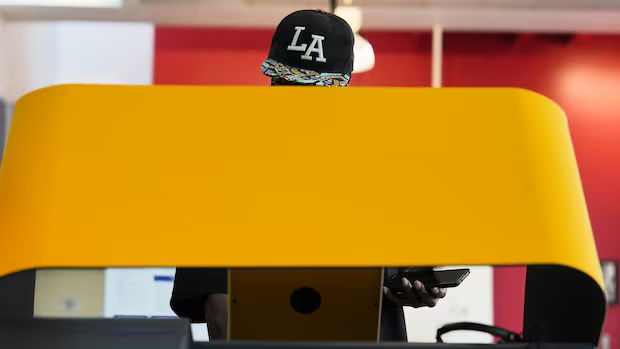
Los Angeles mayoral candidate Spencer Pratt, the former reality TV personality, slipped into third place in the official vote count late on Sunday, prompting unsubstantiated claims by U.S. President Donald Trump and others that something irregular was taking place.
“No way this could have happened. Rigged Election!” Trump proclaimed on Truth Social early Monday after Nithya Raman overtook Pratt.
After incumbent Karen Bass last week secured a place in the Nov. 3 runoff between the top two vote getters, attention has turned to the race for the final spot between Pratt of The Hills fame and Raman, a current city councillor.
Pratt had an 8.1 percentage-point lead over Raman on election night nearly a week ago, but as of late Sunday, Raman leads by about 0.4 points, or 3,100 votes.
The Associated Press has estimated there are fewer than 150,000 ballots left to be counted.
The mayoral election is nonpartisan, but Bass was a Democrat while in the U.S. House of Representatives and Raman has been a member of the Democratic Socialists of America.
In the first months of the campaign, Pratt took pains to portray himself as a sensible conservative and focus on municipal issues. Trump threw his weight behind his surprising campaign late last month by deeming him “a big MAGA person,” although Pratt has sought to distance himself from the endorsement.
While even the social media account of Gov. Gavin Newsom’s press office — which often trolls Trump — has admitted “we wish the votes were counted faster, too,” all candidates are subject to the same rules. California officials have taken pains to explain the process — ballots can be counted as long as they were postmarked by the June 2 primary date and arrive at an election office within seven days. But the counting can take even longer than that.


President Donald Trump wants to do away with mail-in voting, claiming it’s responsible for ‘massive voter fraud’ in the U.S. Andrew Chang explores what might really be behind Trump’s contempt for mail-in ballots and what he can actually do about it.
Images provided by Getty Images, The Canadian Press and Reuters.
Jay Clayton, a Trump-appointed U.S. attorney for the Southern District of New York, said in an interview with CNBC on Monday morning that such a process “makes the opportunity for fraud so much greater.”
Bill Essayli, the first assistant U.S. attorney for the Central District of California, has encouraged the use of a special email address dedicated to “election fraud tips,” while raising the spectre of widespread voting by those who are unauthorized to be in the U.S.
A decade ago, Trump complained that widespread voting by illegal immigrants, particularly in California, padded Hillary Clinton’s vote totals as a presidential candidate, an assertion that was never corroborated with evidence.
‘All I have to do is look’
Trump launched into complaints about California’s process in a Meet the Press interview broadcast on Sunday.
“Do you think it’s appropriate that they have an election and five days later, they’re nowhere close to picking a winner?” he asked host Kristen Welker.
When pressed for evidence that either this vote or his 2020 election loss to Joe Biden was “rigged,” the best Trump could muster was: “All I have to do is look.” He then abruptly ended the interview with a condescending “Thank you, darling,” while putting a hand on Welker’s shoulder.

Trump’s assertions are raising concerns among Democrats that the U.S. is again headed for the kind of post-election tumult seen after the Trump-Biden contest six years ago.
“While the President’s tantrums are absurd, his delusions of voter fraud are dangerous,” Sen. Patty Murray of Washington state posted on social media.
Trump has already heavily influenced the midterms to be held on Nov. 3 by pressuring Republican states to redistrict their congressional boundaries for partisan purposes. While a handful have pushed those changes through, so has California, potentially adding five more Democratic seats to the U.S. House of Representatives.
Marc Elias of Democracy Docket, a frequent legal combatant of the Trump administration, said in an email release on Sunday that he thinks it’s inevitable the fraud complaints will be resuscitated in five months.
“In the days after the November 2026 election, we are almost certain to see an avalanche of California races called in favour of Democrats … to prevent that outcome, Trump is trying to pre-emptively delegitimize California’s results and create a permission structure for Republicans to challenge and set them aside,” he said.
Do early results produce a cognitive bias?
Through private statements or official government releases, Trump’s vice-president Mike Pence, attorney general William Barr and director of cybersecurity Chris Krebs all attested that there was no basis for preventing the transfer of power to Biden in 2020.
Trump’s claims of 2020 fraud have been hard to square with a highly decentralized, complex voting landscape in which some 10,000 separate jurisdictions hold a number of races, including for school boards, local, state and federal races. A voter in Maricopa County in Arizona on Nov. 5, 2020, did not have the same ballot as one in Fulton County in Georgia, and the counties in the perceived seven battleground states that year used several different voting technology systems.
It’s not clear under such a scenario how just one or a few races — Arizona gubernatorial candidate Kari Lake was the only loser to complain as bitterly as Trump — could have vote totals manipulated while other contests on the same ballot across voting systems proceeded cleanly.
Front Burner33:03Will Trump rig the midterms?
The academic research is not on Trump’s side, either.
Voter fraud tends to be individualistic and not organized on a large scale — more than one Canadian citizen has recently been through the court system in the U.S. for illegal voting. One study that analyzed hundreds of audits in over half of the states in the 2020 election concluded that the “net error rate in counting presidential votes was on the order of thousandths of a per cent, with similarly inconsequential errors for other state and federal contests.”
Trump’s objections to absentee ballots have been strategically curious — there have been many surveys and data analyses indicating that registered Republicans enjoy the convenience of absentee voting — and it should be pointed out that he has prevailed in two of the three U.S. presidential elections to feature the most mail-in ballots.
Conducting a series of tests comparing 2016 and 2020, political scientists in one study, shown below, concluded that Trump actually improved on his 2016 performance in California, albeit in a losing cause, as the state sought to make it easier for all to vote at a time when there was no available vaccine for the COVID-19 virus.

Meanwhile, assertions like Clayton’s on Monday may be suggestive of what one group of researchers call cumulative redundancy bias, a cognitive bias that skews perceptions to the early leaders in partial vote counts.
Trump has expressed nostalgia for votes that can be decided on election night, though that wasn’t the case in the presidential elections of 1960 or 2000.
As well, clear and quickly called elections have presented their own problems, historically. In 1980, a Ronald Reagan landslide was projected by the television networks while untold numbers of voters were in line in California, Arizona, Oregon, Washington state and Hawaii.
Many turned around and went home, and officials in those states were livid, as it depressed the vote count for several other races.





