

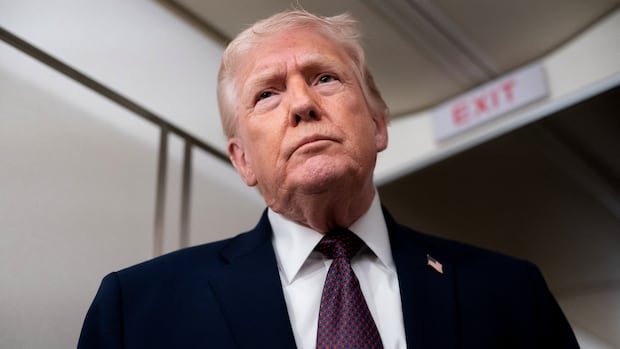
The United States is telling its citizens to leave Iran, as Washington maintains its pressure on Tehran to cease its crackdown on protesters and U.S. President Donald Trump threatens to strike the Iranian government over the issue.
“Leave Iran now,” the U.S. stated in an alert published on its “virtual embassy” website for Iran. “Have a plan for departing Iran that does not rely on U.S. government help.“
For U.S. citizens unable to leave Iran, the advice is to “find a secure location,” to stock up on food and other essential items and to stay aware of their surroundings.
Adding to threats of military action, Trump late on Monday announced that any country doing business with Iran will face a new tariff of 25 per cent on its exports to the U.S.
While the president provided little detail, the move may have more symbolic than practical effect since Iran, a major oil producer, already faces extensive U.S. and international trade sanctions.
The White House did not respond to a request for comment.

Kamran Bokhari, a senior director at the New Lines Institute for Strategy and Policy, says Iran must negotiate as it faces nationwide public unrest and an increasingly dire economic situation. He noted that while public statements from Iranian officials may say one thing, ‘back channels don’t go silent.’
Iran’s mission to the United Nations in New York declined to comment on Trump’s announcement. Top export destinations for Iran include China, the United Arab Emirates and India.
Trump has warned Iran’s leaders that the United States would attack if security forces open fire on protesters. On Sunday, he said the U.S. may meet Iranian officials and that he was in contact with Iran’s opposition. He is said to be evaluating a range of potential actions.

As Iran cracks down on protesters, the diaspora in Canada held solidarity rallies to push for regime change, though there are differing opinions on what that change should be.
Iran’s leaders, their regional clout much reduced, are facing fierce demonstrations that evolved from complaints about dire economic hardships to defiant calls for the fall of the deeply entrenched clerical establishment.
U.S.-based rights group HRANA said by late Monday it had verified the deaths of 646 people, including 505 protesters, 113 military and security personnel and seven bystanders, and was investigating 579 more reported deaths.
Since the protests began on Dec. 28, 10,721 people have been arrested, the group said.
Reuters was unable to confirm the figures independently.
HRANA said it received reports and videos on Monday from Tehran’s Behesht Zahra Cemetery where family members of victims “gathered at burial sites and chanted protest slogans.”
Foreign Affairs Minister Anita Anand, said on X that “Canada stands with the brave people of Iran” and that it joins Australia and the European Union in strongly condemning “repression and in particular the use of violence against peaceful protesters resulting in the unnecessary loss of life.”
Diplomacy ‘always the first option’
While airstrikes were one of many alternatives open to Trump, “diplomacy is always the first option for the president,” White House press secretary Karoline Leavitt told reporters on Monday.

“What you’re hearing publicly from the Iranian regime is quite different from the messages the administration is receiving privately, and I think the president has an interest in exploring those messages,” she said.
Iranian Foreign Minister Abbas Araqchi said Tehran was studying ideas proposed by Washington, though these were “incompatible” with U.S. threats.
Iran has not given an official death toll from the protests. State-run media has focused attention on the deaths of security forces.
The flow of information from has been hampered by an internet blackout since Thursday, although some Iranians still have access to the internet via Elon Musk’s Starlink satellite service, three people inside the country said.
Iran’s Ministry of Intelligence said on Monday it had detained “terrorist” teams responsible for acts including killing paramilitary volunteers loyal to the clerical establishment, torching mosques and attacking military sites, according to a statement carried by state media.
Addressing a large crowd in Tehran’s Enqelab Square on Monday, parliament speaker Mohammad Baqer Qalibaf said Iranians were fighting a war on four fronts — “economic war, psychological warfare, military war against the U.S. and Israel, and today a war against terrorism.”
Declaring the situation “under total control,” Araqchi said on Monday that 53 mosques and 180 ambulances had been set on fire since the protests erupted.

As a deadly crackdown against anti-government protests in Iran continues, U.S. President Donald Trump said he’s weighing the options for reprimands.
Despite the massive scale of the protests, there are no signs of splits in the Shia clerical leadership, military or security forces, and demonstrators have no clear central leadership. The opposition is fragmented.
Trump said on Sunday that Iran had called to negotiate about its disputed nuclear program. Israel and the U.S. bombed Iranian nuclear sites in a 12-day war in June.
“A meeting is being set up, but we may have to act because of what is happening before the meeting,” he told reporters on Air Force One.
Trump was to meet with senior advisers on Tuesday to discuss options for Iran, a U.S. official told Reuters. The Wall Street Journal reported that those included military strikes, using secret cyber weapons, widening sanctions and providing online help to anti-government sources.
Striking military installations could be highly risky, as some may be located in heavily populated areas.
In an interview with CBS News, Reza Pahlavi, son of Iran’s last shah who lives in exile in the U.S., urged Trump to intervene “sooner.”
“I think the president has a decision to make fairly soon,” said Pahlavi, who has urged Iranians to protest and has positioned himself as a transitional leader for the country.
Qalibaf warned Washington against “a miscalculation.”
“Let us be clear: in the case of an attack on Iran, the occupied territories (Israel) as well as all U.S. bases and ships will be our legitimate target,” he said.

