

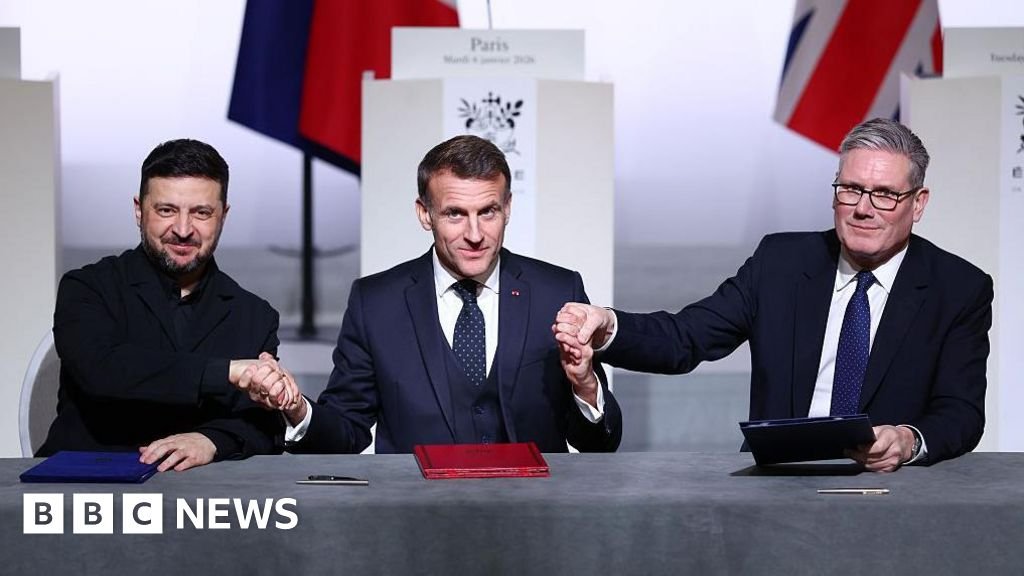
The UK and France have signed a declaration of intent on deploying troops in Ukraine if a peace deal is made with Russia, UK Prime Minister Sir Keir Starmer has announced.
After talks with Ukraine’s allies in Paris, he said the UK and France would “establish military hubs across Ukraine” to deter future invasion, while French President Emmanuel Macron later said thousands of troops may be deployed to the region.
Allies also largely agreed robust security guarantees for Ukraine and proposed that the US would take the lead in monitoring a truce. But the key issue of territory is still being discussed.
Russia has repeatedly warned that any foreign troops in Ukraine would be a “legitimate target”.
Moscow has not yet commented on the announcements made in the French capital.
Russian President Vladimir Putin launched a full-scale invasion of Ukraine in February 2022, and Moscow currently controls about 20% of Ukrainian territory.
Heads of state and top officials from the “Coalition of the Willing” took part in Tuesday’s talks in Paris.
Speaking at a joint press conference after the meeting, Starmer said: “We signed a declaration of intent on the deployment of forces to Ukraine in the event of a peace deal.
“This is a vital part of our commitment to stand with Ukraine for the long-term.
“It paves the way for the legal framework under which British, French, and partner forces could operate on Ukrainian soil, securing Ukraine’s skies and seas, and regenerating Ukraine’s armed forces for the future,”
The UK prime minister added London would participate in any US-led verification of a potential ceasefire.
Top US negotiator Steve Witkoff said “durable security guarantees and robust prosperity commitments are essential to a lasting peace” in Ukraine – referring to a key demand made by Kyiv.
Witkoff said the allies “largely finished” their work on agreeing security protocols “so that people of Ukraine know that when this [war] ends, it ends forever”.
Jared Kushner, US President Donald Trump’s special envoy and son-in-law, said that after a deal Ukrainians needed to know that “real backstops” were in place to ensure war would “not happen again”.
Meanwhile, President Macron said Ukraine’s allies had made “considerable progress” at the talks.
He said “robust” security guarantees for Kyiv had been agreed in the event of a potential ceasefire.
Ukrainian President Volodymyr Zelensky said a “huge step forward” had been made in Paris, but added that he would only consider efforts to be “enough” if they resulted in the end of the war.
What Ukraine calls security “guarantees” and what American officials have described as security “protocols” may leave some wiggle room for Trump in the event of coming to Kyiv’s defence after a future Russian attack – but there is no doubt Zelensky feels he and his European allies have secured an important concession from Washington.
We heard few, if any, new details about where a future ceasefire line would be drawn and what territory, currently occupied by Russian forces, Ukraine would agree to surrender.
That prospect is still something many Ukrainians would find hard to swallow, especially as Russia continues to strike against cities and critical infrastructure across Ukraine on a daily basis.
But as the snows fall and bitter winds sweep in from the east, Zelensky knows the only alternative to a ceasefire and subsequent peace deal, is another costly, attritional winter of warfare with the inevitable loss of life that will hit Ukraine far harder than Russia.
Ukraine’s president clearly hopes that guarantees of American monitoring, a multinational force on Ukrainian soil and more weapons support for his armed forces, will convince a sometimes-sceptical population that he is right to sue for peace, bolstered by a growing international coalition.
But, in concluding the Paris press conference, Zelensky acknowledged today’s “milestone” does not necessarily guarantee peace. Real progress still needs Russian support, and Moscow has been notably silent in recent days about diplomatic efforts to end the war.
Putin is known to oppose the prospect of a European-led international force in any disputed areas and will be reluctant to halt his troops’, albeit slow, advance if Moscow’s war objectives have not been realised.
But pressure is undoubtedly growing on both sides to make compromises and end the war.
Last week, Zelensky said a peace deal was “90% ready”. Agreeing on the remaining 10% would “determine the fate of peace, the fate of Ukraine and Europe”.
Territory and security guarantees have been at the forefront of unresolved issues for negotiators.
Putin has repeatedly warned that Ukrainian troops must withdraw from all of Ukraine’s eastern Donbas or Russia will seize it, rejecting any compromise over how to end the war.
Zelensky has so far ruled out ceding any territory, but has suggested that Ukraine could withdraw its troops to an agreed point – but only if Russia does the same.
Moscow currently controls about 75% of the Donetsk region, and some 99% of the neighbouring Luhansk. The two regions form the industrial region of Donbas.
The original US-led 28-point peace plan widely leaked to the media last year was seen by Kyiv and its European allies as being heavily skewed in Russia’s favour.
This triggered weeks of intensive high-level diplomacy – with Ukraine, the US and European leaders trying to amend the draft.
Last month, Kyiv sent the US an updated 20-point plan – as well as separate documents outlining potential security guarantees and provisions for Ukraine’s reconstruction, Zelensky said.
