



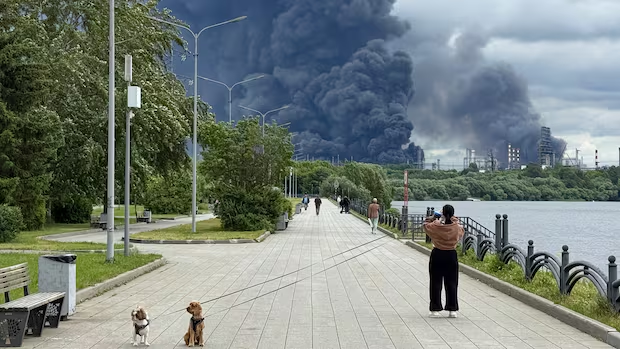
Even before Ukraine launched its largest attack ever on Moscow — striking a major refinery and causing thick black smoke to rise above the capital on Thursday — the effects of Kyiv’s intensifying drone campaign were being acutely felt by many Russians.
In Crimea, which Moscow illegally annexed in 2014, the Russian-installed governor announced a nighttime ban on motorcycles and scooters because they sound too much like the drones routinely buzzing through the skies.
On the peninsula, there have been empty pumps, fuel restrictions and frustration after Ukrainian strikes designed to choke off supply routes to the area.
While Russia’s capital and its 13 million residents are not yet experiencing the same fuel shortages, experts say the country’s energy industry is under increasing pressure as Ukraine tilts the war closer to the country that has been waging it, through a combination of long- and middle-range strikes.
“I don’t like to see civilian people suffering, but on the other side, only people of Moscow can stop this war,” said Oleksandr Kharchenko, director of the Kyiv-based Energy Industry Research Center. “It’s not [Russian President Vladimir] Putin really who will go to peace.”


Largest attack on Russia’s capital so far
Putin wasn’t in Moscow the day Ukraine used around 200 drones to target the capital and the surrounding region. Instead, he was more than 700 kilometres away in the Russian city of Kazan, hosting leaders from Southeast Asian nations.
Russian officials say 16 people were injured and an eight-year-old girl was killed in the attack, which damaged apartment buildings and a mall, and burned cars. An explosion launched the lid of an oil storage tank into the air like a giant Frisbee.
The refinery, which is owned by Gazprom Neft, is in the city’s southeast and had been supplying nearly 40 per cent of the fuel to the capital before it was hit twice this week in large strikes.
Videos posted online showed moments of chaos and panic as air defences tried to shoot down the drones. Afterward, pictures emerged of cars splattered with black residue, with some residents saying inky rain fell from the sky.
On Friday, Igor Sechin, the CEO of Russia’s largest oil company, Rosneft, told domestic media that the country’s fuel market was “experiencing challenging conditions,” which resulted from high seasonal demand for fuel and “unscheduled work at refineries.”
He said the company would be able to guarantee the supply of fuel to “socially significant facilities,” along with industrial and agricultural companies. He added that there are “practically no restrictions on refuelling at gas stations,” but he said filling up canisters is being discouraged.
The Kremlin on Friday acknowledged the drone attacks, with spokesperson Dmitry Peskov saying, “The relevant measures to eliminate the consequences are being taken.”

Rationing in Crimea
In Crimea, where rail lines, roads and even fuel tankers have been targeted repeatedly, fuel is already being rationed. On Friday, the governor of Crimea’s biggest city, Sevastopol, said a 20-litre limit on gas per car would continue.
His announcement came around the same time Ukraine’s military claimed it had struck more railway bridges on the peninsula.
In Russia itself, there have been reports of shortages in regions, including Dagestan, which lies on the western shore of the Caspian Sea.
Citing several unnamed sources, Reuters reported that Russia, the third-largest oil producer in the world, is set to import fuel from Asia this month as a way to try to manage the shortage.
Kharchenko, who tracks Russia’s refining capacity, said Thursday’s attack created the beginning of a real fuel deficit. However, for there to be serious and sustained impacts, he estimated Ukraine would have to continue striking Russia’s energy infrastructure for another four to six weeks.
“They can do maintenance. They can restore capacity and they do,” he told CBC News. “But step by step, it’s more and more damage and more problems.”

Ukraine brings the war to Moscow
On Friday, at a major defence convention in Paris, Ukrainian drone and missile manufacturer Fire Point was playing a looped video of the Moscow strikes carried out a day earlier with the help of its long-range drones.
“Moscow has lived without war … for years,” said Denys Shtilerman, Fire Point’s co-founder and chief designer. “Right now they understand war is coming to Moscow.”
Shtilerman, who spoke to CBC News on Thursday, said Fire Point’s drones have been targeting energy sites in Moscow and logistical routes in occupied Ukrainian territory that are key for Russia’s military.
“The Russian army right now has problems with food delivery, with medicine delivery, with everything,” he said. “And the pressure on our guys in the trench decreases and decreases.”





