

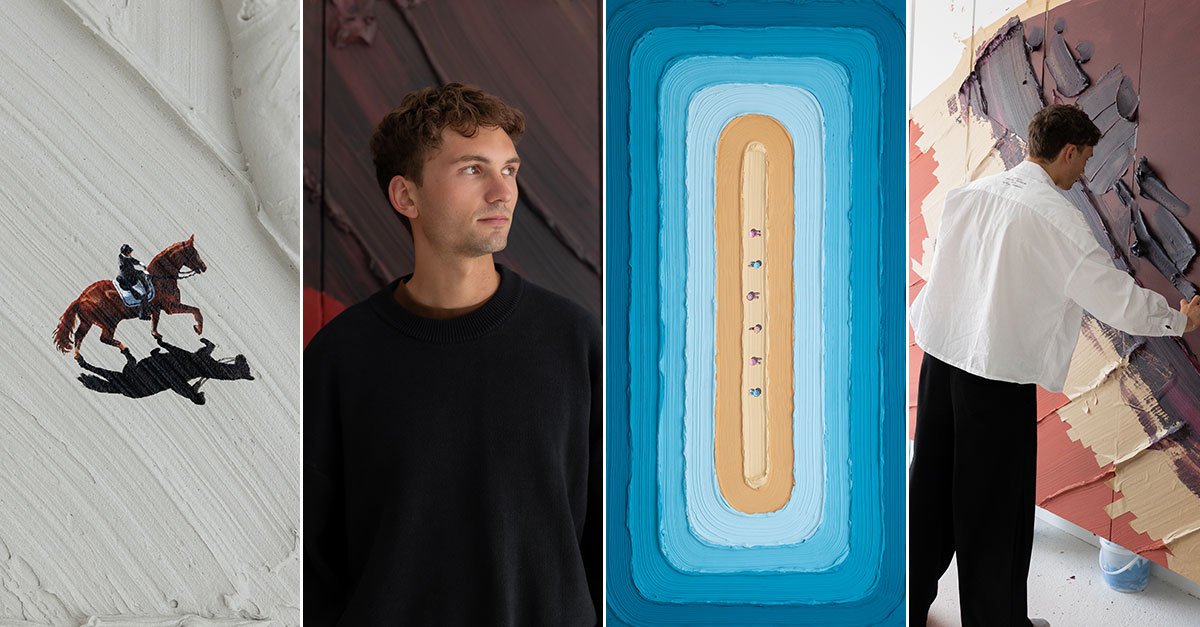
We caught up with contemporary artist Werner Bronkhorst ahead of his exhibition in Dubai
If there’s one thing I personally love about my ’Gram, it’s how meticulously I’ve curated my algorithm. Get your hands on my phone and you’ll be met with a heady mix of things to do in Dubai, travel, art inspiration, and plenty of Formula 1. Lately, it’s been leaning heavily towards the latter of the list, which is exactly how I stumbled upon contemporary artist Werner Bronkhorst.
While I’m not typically drawn to contemporary art, Bronkhorst’s work immediately stood out. His thick impasto layering recalls the textured intensity of Vincent van Gogh, while the introduction of modern figures disrupts the canvas with a jolt of classical realism. The result is work that makes you stop, stare, and linger in thought – exactly what I look for in art.
What’s On caught up with Bronkhorst ahead of his first-ever exhibition in the Middle East at Concrete in Alserkal Avenue in Dubai this January to explore the ideas, influences, and intentional disruptions behind his quietly striking body of work.
What’s On (WO): Sorry, I am a huge F1 fan, so I am going to lead with this. You recently worked with Lando Norris (McLaren F1 racing driver, and current World Champion) on a very special collaboration. How did that come about? Who reached out to whom, and was Lando already familiar with your work?
Werner Bronkhorst (WB): Two years ago, Lando reached out and I couldn’t believe that he wanted an artwork from me! But unfortunately I had no paintings for sale at the time, so we simply kept in contact until his team approached me for an incredible project.
I was asked to design his 150th race helmet to celebrate his achievements through small paintings of him and his team on a track painted with my signature style for Vegas (Las Vegas Grand Prix 2025) last year.
It was the perfect opportunity to show that my style can merge into the real world on a 3D surface.

WO: Was there a particular painting or exhibition that you feel marked a turning point in your career, when your work began reaching a wider audience?
WB: My painting ‘Avid Skier’ (pictured below) which I made in 2023 was perhaps a key part of my journey into the spotlight with my artworks. Two years ago I exhibited my ‘Forbidden Grass’ collection in London and seeing a queue down the street from supporters who wanted to see my show was truly an unforgettable experience. It made me realise that art really can change your life. It changed mine.
WO: How did the concept for your CRACK collection come together?
WB: The idea for CRACK came from a desire to move away from the snow, water, and grassy landscapes I had been painting and to explore desert and earthy surfaces instead. I initially assumed that dry and arid environments might offer limited subject matter, but once I began working on the collection, the ideas came quickly and instinctively.
What drew me in was how different surfaces respond to heat and pressure. Sand, rock, clay, and wood all crack, splinter, or shift in their own way, and that physical quality became central to the collection. As I explored these materials, the works naturally expanded into a wide range of activities and landscapes, which is why the collection took 11 months to complete and evolved into such a broad and layered body of work.
WO: Do you have a favourite piece from the collection, and what makes it stand out for you personally?
WB: ‘The Pilgrimage’ stands out as the most significant work in the collection for me. It is my largest and most complex painting to date and required a completely different level of focus and problem solving. The work is made up of seven separate canvases that come together to form one continuous image, which pushed my technical ability and experience to the limit.

The piece is also partly autobiographical. It depicts a long, purposeful journey across a red sand dune, and that sense of endurance closely mirrors my own experience while creating it. Completing The Pilgrimage showed me that there are no real limits to the scale or complexity I can attempt in my work, making it a clear turning point in my practice.
WO: What do you hope people take away after seeing the CRACK collection? Is there a message or feeling you want to linger?
WB: I hope viewers leave the exhibition with a sense of perspective. I often say that the whole world is a canvas and that we are simply walking on it, and that idea runs throughout CRACK. The figures in my paintings are intentionally small, placed within large abstract landscapes, to reflect how we all exist within something much bigger than ourselves.
I want people to recognise themselves in these works and to notice the beauty in small, everyday moments. If that awareness lingers after they leave the exhibition, then the work has done what I hoped it would.
“The whole world’s a canvas, we’re just walking in it,”
– Werner Bronkhorst
WO: Has increased visibility or success ever changed the way you approach your work, or made you more protective of your process?
WB: Increased visibility and success has made me even more proud of sharing the process behind my work. I have a direct way to connect to my audience and collectors through simply giving them a window to see what I create and why. I am inspired by other artists who are vulnerable enough to share their insights and I’ve personally learnt so much through just watching other artists create. It’s therefore an honour for me to be that inspiration for a new generation of artists.
Swipe through to see Bronkhorst’s creative process
WO: Your impasto style and layered surfaces are instantly recognisable. How did this distinctive approach develop over time?
WB: Texture has always played an important role in my work, and my impasto style developed naturally through experimenting with thick layers of paint. When creating the backgrounds, I push and pull paint across the canvas to build vibrant colour and strong texture, allowing the surface to become abstract while still referencing real world environments.
Over time, these textured backgrounds evolved into landscapes that resemble sand, water, clay, or rock depending on how the paint is handled. The miniature, hyper detailed figures are then added on top of these surfaces, creating contrast and bringing the scenes to life. This balance between abstraction and detail is something that has become central to my visual language.
WO: Do you ever experience doubt or resistance in the studio, and if so, how do you work through it?
WB: I call my studio ‘The Lab’ for one good reason – it’s where I am free to experiment and explore. Art is like alchemy, you’re taking substances with little value and turn it into something so beautiful that it becomes priceless. Alchemists have to learn to fail many times. Not all experiments succeed and I often get frustrated when my ideas don’t work out.
The funny thing is that failure always leads to new breakthroughs which often results in me creating my best work.
WO: When you begin a painting, do you start with a clear idea in mind, or does the image evolve as the layers build?
WB: Before I begin a painting, I have a clear idea of what I want the final work to look like. While the backgrounds of my paintings are abstract and don’t follow a fixed set of rules, I approach them with an instinctive understanding of when to start and when to stop. Over the years, I’ve learned which compositions I enjoy working with, and that experience naturally guides the early stages of the process.
Once the thick layers of paint are complete and fully dry, I move on to painting the figures using a very small brush and placing them deliberately within the composition. At that stage, the painting becomes more defined, and it is clear to me when the work is finished, as long as each figure feels as refined and resolved as it can be.
WO: Looking ahead, is there a direction or theme you feel drawn to next, even if it’s still taking shape?
WB: Working on CRACK has had a lasting impact on how I think about my future projects. I spent 11 months on this collection, which is the longest time I’ve dedicated to a single body of work, and it taught me the value of patience and focus. Taking that amount of time allowed the ideas to fully develop and showed me that when you invest deeply in a project, the results are far more meaningful.
As my exhibitions continue to grow in scale and ambition, I feel encouraged to pursue even bigger and more considered projects. CRACK marks the beginning of a new chapter in my career, and while there is still a long journey ahead, this moment gives me confidence to keep pushing forward, building on this momentum and seeing where it leads next.
Details:
Location: Werner Bronkhorst exhibition in Dubai, Concrete, Alserkal Avenue, Al Quoz
Dates: January 16 to 18, 2026
Contact: alserkal.online
Images: Supplied and Werner Bronkhorst Instagram
