


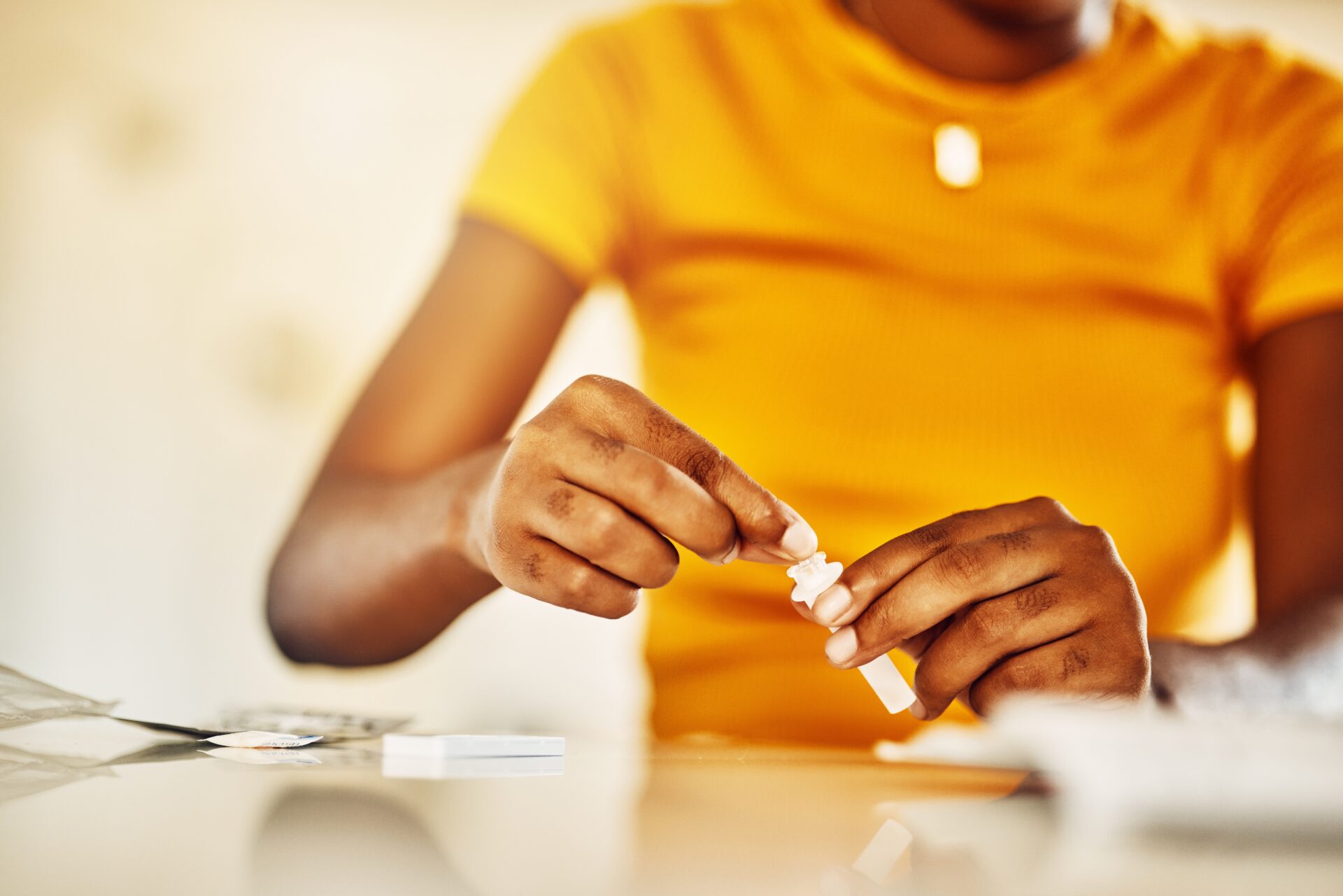
 The World Health Organization recommends HIV self-screening tests as a tool to help find people that are difficult to reach through traditional HIV testing approaches. (Photo: Shutterstock)
 News & Features
24th November 2025 | Catherine Tomlinson
It is estimated that around half a million people living with HIV in South Africa don’t know they are living with the virus. One way to help these people is by offering them the means to test themselves in the privacy of their own homes. As we explain in this #InTheSpotlight special briefing, such self-screening tests are part of our HIV response on paper, but in reality, the tests are massively underutilised.
South Africa has adopted targets that 95% of people living with HIV should know their status, 95% of people who know their status should be on antiretroviral treatment, and 95% of people on treatment should be virally suppressed and therefore unable to transmit HIV.
According to estimates from Thembisa, the leading mathematical model of HIV in South Africa, around 95% of people living with HIV in the country know their status. Of those diagnosed with HIV, 81.5% are on treatment. 90% of those on treatment are virologically suppressed. In other words, South Africa has not yet met its targets in terms of getting people who have been diagnosed with HIV on to treatment. The country has, however, achieved the goal of having 95% of people living with HIV aware of their status.
This means that of the 8 million people living with HIV in South Africa, around 7.6 million have been diagnosed. This is a remarkable collective achievement by the country’s many thousands of healthcare workers. Key to this success over the last decade and a half was the scale-up of rapid HIV testing in public sector clinics.
Yet, almost half a million people living with HIV in the country remain undiagnosed. These people face higher risks of developing opportunistic infections, transmitting HIV onwards to their sexual partners, and death.

According to the Thembisa model, last year around 50 000 adults started taking HIV treatment only once their immune systems were already severely compromised (defined as fewer than 200 CD4 immune cells per drop of blood). This figure suggests that there is a subgroup of people who will only go to the clinic or hospital once they are very ill. The tragedy is that people who start treatment late like this tend to have a much worse longer-term prognosis.
This is where HIV self-screening can play a role. The World Health Organization (WHO) recommends it as a tool to help countries find people that are difficult to reach through traditional HIV testing approaches – mainly rapid testing in public clinics – and linking them to health services.
Based on the Thembisa modelling, we can tell which groups of people in South Africa remain under diagnosed and require targeted testing interventions, such as access to HIV self-screening tests. Young people and men living with HIV remain under diagnosed compared to the general population. Only 85% of women and 84% of men between the ages of 15 and 24 who are living with HIV know their status. These happen to also be age groups in which HIV transmission rates have remained stubbornly high.
What is a self-screening test?
The national HIV testing services policy of 2025 defines HIV self-screening as “a process where a person who wants to know his or her HIV status collects a specimen, performs a test, and interprets the result by him-or herself, often in private”.
HIV self-screening tests use essentially the same diagnostic technology as rapid HIV tests since they detect antibodies that the immune system produces in response to HIV infection, rather than detecting the virus itself. The difference is that they have been adapted to make it easier for people to collect their own samples, perform the test, and interpret their results.
For example, while a rapid HIV test used by a healthcare worker typically has lots of detailed instructions to read, an HIV self-screening test will generally include a series of images that explain how to use and interpret the test.
HIV self-tests are mostly performed using a self-collected sample of blood or oral fluid. A blood sample is collected by pricking one’s finger with a needle-like lancet. Oral fluid is collected by swabbing one’s gums with a test swab. There is also a urine-based test that the WHO approved earlier this year, but as far as we can tell that test is not yet available in South Africa.
Where do self-screening tests fit in?
Maybe the most important thing to know about these tests is that a “reactive” result on an HIV self-screening test, or even on a single professional rapid test, is not considered a “positive” HIV diagnosis.
For someone to be definitively diagnosed with HIV, they must visit a facility that provides HIV testing services and have their status confirmed by three consecutive reactive results using rapid tests. If the three rapid tests give contradictory results, a different more sensitive lab test can be ordered. This approach is used to prevent people with false positive results from being incorrectly diagnosed with HIV.
Thus, while HIV self-screening tests do not provide anything like a definitive diagnosis, they do offer a first layer of screening for people who cannot easily visit a health facility or are reluctant to do so. It may be an imperfect tool, but it is better than nothing and allows people to make more informed decisions about their health.
HIV self-screening tests, like other rapid HIV tests, cannot detect HIV over the “window period” – the period shortly after infection before one’s body has produced enough antibodies for it to be detected. Thus, the health department recommends that people who use HIV self-screening tests retest six weeks after potential exposure and that people with ongoing exposure retest every 12 weeks.
What is the health department’s position on HIV self-screening tests?
The health department first recommended the use of HIV self-screening tests in 2016 in its HIV Testing Guidelines, which state that HIV self-screening “provides people with an opportunity to test discretely and conveniently and may increase uptake of HIV testing among people not reached by other HIV services.” Then in 2018, the health department released guidelines specifically for HIV self-screening.
Most recently, in 2025, the health department again updated its guidelines for HIV testing, providing further guidance on the use of HIV self-screening as part of South Africa’s diagnostic algorithm.
The updated guidelines state that HIV self-screening tests are “not intended to replace current HIV testing modalities, but rather to complement HTS [HIV testing service] and enable more people to know their HIV status, particularly those that are not reached by existing services”.
The policy adds that “anyone who requests [to] self-screen should not be denied the opportunity to do so.”
Expanding the use of HIV self-screening is also recommended in the 2023-2028 National Strategic Plan for HIV, TB, and STIs.
Despite this broad endorsement of HIV self-screening, its use in the country remains limited.
How available are HIV self-screening tests in the public sector?
The health department did not respond to Spotlight’s requests for clarification regarding the number of HIV self-screening tests that it procures and distributes annually. Spotlight therefore used tender documents published by Treasury to estimate this number.
Over the current and previous tenders for HIV rapid tests completed in 2020 and 2024, the health department aimed to procure and distribute around a million HIV self-screening tests over a three-year period. Spotlight’s very simple back-of-the-envelope calculation is that the health department distributes an estimated 333 333 HIV self-screening tests per year.
This is substantially lower than the number of self-screening tests distributed by the HIV Self-Testing Africa (STAR) Initiative. That project, funded by Unitaid (a multilateral donor agency), distributed 2.1 million HIV self-screening tests in South Africa from 2018 to 2020 to test different delivery models for HIV self-tests.
Ezintsha, a research group at Wits University, was one of the implementing partners of the STAR Initiative. Mohammed Majam, director of Medical Technologies at Ezintsha, told Spotlight that the STAR initiative tested 13 different models for distribution of HIV self-screening tests. He said the aim was to understand how to get the test into the hands of the right people.
The STAR initiative modelled how to optimise the distribution of HIV self-screening tests in South Africa, using 1 million as the baseline for the number of tests that would be distributed annually and 6.7 million as a target to scale up to.
The research found that a combination of different distribution approaches is needed to optimise the impact and cost-effectiveness of HIV self-screening in the country.
But the health department is currently distributing only a limited number of HIV self-screening tests to people testing positive for HIV and women attending antenatal clinics to give to their partners.
Majam said that focusing solely on such facility-based distribution, without also using other models such as workplace and taxi-rank distribution, misses key target groups. “We demonstrated that the majority of the missing men that we’re looking for are not found in those settings. They needed non-traditional ways of doing it,” he said.
According to Majam, South Africa lost much of the momentum to scale-up HIV self-screening when the STAR initiative ended in March 2020. This is because the timing coincided with the start of the COVID-19 epidemic, which led to the health department shifting its focus and resources towards COVID-19.
Are HIV self-screening tests cost-effective and affordable?
HE2RO, a division of Wits University working at the intersection of health economics and epidemiology, compares the cost-effectiveness and impact of different tools and strategies to combat HIV. The results of this work are published every two years in HE2RO’s HIV investment case.
Their most recent such document, published in 2023, found that expanding the use of HIV self-screening was the second most cost-effective intervention that the health department can implement to combat HIV. Expanding condom distribution was the first. They however noted that under the current budget, HIV self-screening test distribution could only be expanded to 500 000 kits per year.
The cost of HIV self-screening tests, which are significantly higher than the HIV rapid tests used by healthcare workers, is a barrier to their scale-up. However, the cost of the blood-based self-screening tests have come down in the current tender, compared with the 2020 tender, which may make expanding the use of this tool as part of the country’s package of HIV interventions more feasible.
HIV self-screening tests procured in tender RT41-2020
| Test | Type | Bid price per test kit | Number of tests to be procured |
|---|---|---|---|
| Oraquick HIV Self Test | Oral fluid | R55.72 | 357 704 (min) – 638 757 (max) |
| Insti HIV Rapid | Blood | R68.90 | 281 053 (min) – 638 757 (max) |
| *This table presents as overview of HIV self-screening test kits bought in the RT41-2020 tender. This tender intended to run for 36 months, but received an extension. Source: Treasury. | |||
HIV self-screening tests procured in tender RT41-2024
| Test | Type | Bid price per test kit | Number of tests to be procured |
|---|---|---|---|
| Oraquick HIV Self Test | Oral fluid | R69.95 | 500 000 |
| Wondfo HIV Self-Test | Blood | R31.00 | 500 000 |
| *This table presents as overview of HIV self-screening test kits bought in the RT41-2024 tender. Source: Treasury. | |||
Dr Lise Jamieson, senior researcher at HE2RO, told Spotlight that preliminary work done on the upcoming investment case indicates that HIV self-screening remains cost-effective. The next version of the HIV investment case is expected in early 2026 and should provide greater clarity on the current cost-effectiveness of HIV self-screening tests, and how many are affordable under the health department’s existing budget for HIV.
How are HIV self-screening tests evaluated and regulated?
South Africa embraced the use of HIV self-screening during a period of transition in the country’s regulation of medical devices. While the South African Health Products Regulatory Authority (SAHPRA) was established in 2017 with a mandate to regulate medical devices, including HIV self-screening tests, work towards achieving this mandate is ongoing (as we recently reported).
Currently, SAHPRA only requires that HIV self-screening tests used in the country are manufactured, imported, and/or distributed by a company holding a SAHPRA-granted medical device establishment license.
DID YOU KNOW? Medical devices aren’t regulated in SA. The country’s regulator has however started down a road that should eventually lead to the regulation of all medical devices.
www.spotlightnsp.co.za/2025/10/01/m…
— Spotlight (@spotlightnsp.bsky.social) October 1, 2025 at 9:46 AM
SAHPRA has thus not yet implemented requirements for evaluation and verification of the quality, safety, and performance of HIV self-screening tests prior to their sale in South Africa. The regulator plans to introduce these requirements in coming years and is currently conducting a feasibility study to tests its planned approach for verifying the quality, safety, and performance of medical devices, including HIV self-screening tests.
As SAHPRA does not yet require regulatory approval of test kits prior to their use in South Africa, HIV self-screening kits of questionable quality often appear for sale on online shopping platforms. “I have had numerous fights… over the years, trying to get these tests off,” said Majam.
In the absence of SAHPRA approved tests, the health department and the South African Pharmacy Council have adopted their own requirements for tests used in the public sector and sold in pharmacies.
The health department requires that HIV self-screening tests bought on tender for use in the public sector are approved by the WHO, meaning the WHO has evaluated the test’s quality and performance and confirmed that it meets required standards.
WHO-approved HIV-self screening tests
| Product | Manufacturer | Sample used | Year approved |
|---|---|---|---|
| Oraquick HIV Self Test | OraSure Technologies | Oral fluid | 2017 |
| Insti HIV Self Test | bioLytical Laboratories | Blood | 2018 |
| Surecheck HIV Self-Test | Chembio Diagnostic Systems | Blood | 2019 |
| Mylan HIV Self Test | Atomo Diagnostics | Blood | 2019 |
| Wondfo HIV Self-Test | Guangzhou Wondfo Biotech | Blood | 2020 |
| CheckNOW HIV Self Test | Abbott Rapid Diagnostics | Blood | 2022 |
| ADVANCED QUALITY HIV Self-Test | InTech Products | Blood | 2025 |
| HIV SELF TEST BY URINE | Wantai BioPharm | Urine | 2025 |
| *This table presents a list of HIV-self screening tests approved by the World Health Organization. | |||
The health department also requires that the performance of HIV self-screening tests used in the public sector are evaluated and verified by the National Institute of Communicable Diseases (NICD).
Professor Adrian Puren, NICD executive director, told Spotlight that the institute’s verification of HIV self-screening kits involves confirming that the test kits are approved by the WHO. The NICD also verifies that companies manufacturing and distributing tests for use in the public sector hold the required certification of their quality management and manufacturing standards. Puren added that the NICD also undertakes local “laboratory testing to make sure that the kit performs appropriately”.
Vincent Tlala, registrar and CEO of the South African Pharmacy Council, told Spotlight that HIV self-screening tests sold in pharmacies must be evaluated and approved prior to their sale in pharmacies.
He said pharmacists must ensure that tests sold in pharmacies are approved either by the WHO, a recognised international regulatory body, or SAHPRA. (No tests have yet been approved by SAHPRA.)
“Pharmacists and pharmacy support personnel must have adequate knowledge of HIV and self-screening tests so they can assist customers effectively, including demonstrating how to use the kit if necessary,” Tlala added.
Where to from here?
As we approach the end of 2025, around eight out of every 10 people living with HIV in South Africa are on treatment. Many of those who are not on treatment will be people who, for whatever reason, are unlikely to visit public sector clinics. Giving such people more ways to test for HIV and, if positive, to start and stay on treatment, should arguably be the top priority in our HIV response today.
We are set to take a step forward with the imminent introduction of PIMART, an initiative that will allow pharmacists to provide people with HIV treatment and HIV prevention pills without a script from a doctor. Similar to PIMART, greater use of self-testing can only aid the HIV response by providing new routes into care that do not depend on people having to queue at overcrowded clinics. The more such routes we have, the better.
As we’ve shown in this #InTheSpotlight special briefing, self-testing is one of the most cost-effective HIV interventions around. Yet, for all government’s endorsement of it on paper, it hasn’t really backed the idea and use of the tests remain limited. It is hard to see this as anything other than a missed opportunity.
This is particularly tragic in light of the excellent work done by the STAR initiative, which has given us a roadmap for how to go about providing these tests, and in particular, for getting them to otherwise very hard to engage groups like young men.
To be fair, one can understand that government’s plans for HIV self-tests took a knock with the COVID-19 pandemic in 2020. What is harder to fathom, however, is why we haven’t seen a more meaningful rebound in the five years since.
