


Listen to this article
Estimated 5 minutes
The audio version of this article is generated by AI-based technology. Mispronunciations can occur. We are working with our partners to continually review and improve the results.
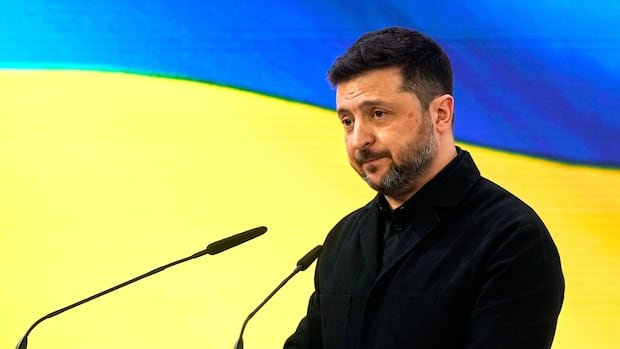
Ukrainian President Volodymyr Zelenskyy voiced hope on Saturday that U.S.-brokered peace talks in Geneva next week would be substantive, but he said Ukraine was being asked “too often” to make concessions.
He also accused Moscow of seeking to delay decisions by changing its lead negotiator.
Ukrainian, Russian and American delegations are due to meet in the Swiss lakeside city on Tuesday and Wednesday as U.S. President Donald Trump seeks to push through a deal to end Europe’s biggest war since 1945.
“We truly hope that the trilateral meetings next week will be serious, substantive, helpful for all us. But, honestly, sometimes it feels like the sides are talking about completely different things,” Zelenskyy said in a speech at the annual Munich Security Conference.
Zelenskyy wants more sanctions, weapons supplies
Ukraine and Russia, which invaded its neighbour in February 2022, have engaged in two recent rounds of talks brokered by Washington in Abu Dhabi. They were described by the sides as constructive but achieving no major breakthroughs.
Zelenskyy called for greater action from Ukraine’s allies to press Russia into making peace — both in the form of tougher sanctions against Moscow and more weapons supplies for his country.
Recalling his appeal four years ago — when he spoke at the same conference days before tens of thousands of Russian forces poured into Ukraine — Zelenskyy said there was too much talk by Western officials and not enough action.
Trump has the power to force Russian President Vladimir Putin to declare a ceasefire and needed to do so, Zelenskyy said. Ukrainian officials have said a ceasefire is required to hold a referendum on any peace deal, which would be organized alongside national elections.

U.S. President Donald Trump says he convinced Russian President Vladimir Putin to pause attacks on Ukraine’s power grid during one of the coldest winters in years. Ukrainian President Volodymyr Zelenskyy suggested Russia has merely shifted to other targets.
The Ukrainian leader, a former television entertainer, acknowledged he was feeling “a little bit” of pressure from Trump, who said on Friday that Zelenskyy should not miss the “opportunity” to make peace soon and urged him “to get moving.”
“The Americans often return to the topic of concessions and too often those concessions are discussed only in the context of Ukraine, not Russia,” Zelenskyy said.
Instead, Zelenskyy said, he wanted to hear what compromises Moscow would be ready for, as Ukraine had already made many of its own.
Russia said its delegation to Geneva would be led by Putin’s adviser Vladimir Medinsky, a change from negotiations in Abu Dhabi, where Russia’s team was led by military intelligence chief Igor Kostyukov.
Zelenskyy told reporters on Saturday the change was “a surprise” for Ukraine, and suggested to him that Russia wanted to delay any decisions from being agreed.
Ukrainian officials have criticized Medinsky’s handling of previous talks, accusing him of delivering history lessons to the Ukrainian team instead of engaging in constructive negotiations.
Deadlock over territory
Land remains the major sticking point in negotiations, with Russia demanding that Ukraine cede the remaining 20 per cent of the eastern region of Donetsk that Moscow has failed to capture — something Kyiv steadfastly refuses to do.
At a news conference on Saturday, Zelenskyy said U.S. negotiators had told Ukraine that the Russians had promised a swift end to the war if Ukrainian forces immediately withdrew from the part of Donetsk it still controls.
He said earlier he was instead ready to discuss a U.S. proposal for a free trade zone in that region, while freezing the rest of the 1,200-kilometre front line.

Ukraine’s chief negotiator Rustem Umerov, who sat beside Zelenskyy during the media briefing, said the only two options were either that Ukraine sticks to the current lines of control, or that a free economic zone is established.
Russia occupies about 20 per cent of Ukraine’s national territory, including Crimea and parts of the eastern Donbas region seized before the full-scale invasion in 2022.
Analysts say Moscow has gained about 1.5 per cent of Ukrainian territory since early 2024. Its recent air strikes on Ukraine’s cities and electricity infrastructure have left hundreds of thousands of Ukrainians without heating and power during the course of a bitterly cold winter.
Ukrainian officials have repeatedly expressed concern in recent weeks that U.S. congressional mid-term elections in November could focus the Trump administration on domestic political issues after the summer.
Zelenskyy said he hoped the U.S. would stay involved in the negotiations, and that there would be an opportunity for Europe, which he said was currently sidelined, to play a bigger role.
“Europe is practically not present at the table. It’s a big mistake to my mind,” he said.
Zelenskyy said that Russia had to accept a ceasefire monitoring mission and an exchange of prisoners of war; he estimated that Russia currently had about 7,000 Ukrainian troops while Kyiv had more than 4,000 Russians.
He also suggested Moscow was opposed to the deployment of French and British troops in Ukraine after the war — which Paris and London have said they are willing to do — because Putin “wants to have the opportunity to come back.”
