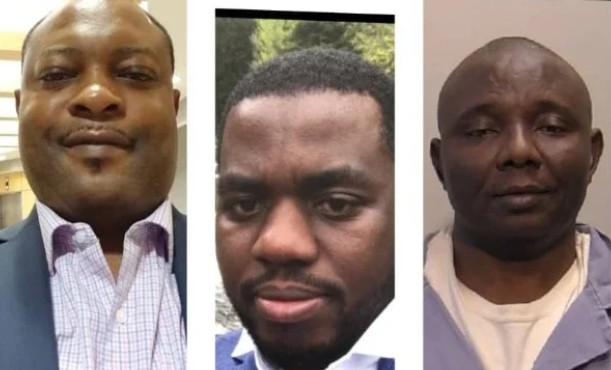
Three U.S. Citizens Sentenced in Federal Case Over Funding Armed Separatists in Cameroon
KANSAS CITY, Mo. (ABS NEWS) — Three U.S. citizens of Cameroonian origin have been sentenced in federal court for their roles in a conspiracy that prosecutors say provided money and other support to separatist fighters involved in kidnappings and the development and use of improvised explosive devices in Cameroon’s conflict-ridden Northwest Region.
The U.S. Attorney’s Office for the Western District of Missouri announced the sentences Wednesday, Aug. 26, following a federal investigation led by the FBI’s Kansas City Field Office.
Francis Chenyi Sr., 52, of St. Paul, Minnesota, and Lah Nestor Langmi, 49, of Buffalo, New York, were each sentenced to 15 years in federal prison, followed by three years of supervised release.
A third defendant, Claude Ngenevu Chi, 43, of Kansas City, Missouri, was sentenced to 63 months — five years and three months — in prison, also followed by three years of supervised release.
Chenyi and Langmi were convicted by a federal jury in December 2025 of conspiring to provide material support or resources intended for conspiracies to kill, kidnap, and maim people in a foreign country and to use a weapon of mass destruction outside the United States. They were also convicted in an international money-laundering conspiracy involving funds transferred from the United States to Cameroon. Chenyi was convicted on an additional material-support conspiracy count.
Chi had previously pleaded guilty to conspiring to provide material support and resources for the use of weapons of mass destruction abroad.
The sentences bring a major phase of the case to a close nearly four years after the three men were arrested in November 2022.
According to the Justice Department, the men had held senior positions in an organization supporting the Ambazonian Restoration Forces and other separatist fighters operating in Cameroon’s Northwest Region. Federal prosecutors said the defendants and their associates had raised more than $350,000, primarily from supporters in the United States and Europe, beginning no later than January 2018.
Prosecutors said some of the money financed equipment, firearms, ammunition and components for improvised explosive devices, or IEDs.
Court evidence also linked the conspiracy to kidnappings.
According to prosecutors, Langmi sent an audio message requesting that separatist fighters kidnap a traditional ruler. Fighters subsequently abducted Sehm Mbinglo II, the Fon of Nso, along with prominent Roman Catholic cleric Cardinal Christian Tumi, who was traveling with him in November 2020.
The Justice Department said Chenyi supplied questions to be used during the interrogation of the two men and approved funds intended to further the kidnapping.
Prosecutors also said Chenyi was involved in ransom payments made from outside Cameroon for the release of kidnapped relatives. The original 2022 indictment alleged that, in some cases, U.S. residents were pressured to pay ransoms to secure the release of family members being held in Cameroon, with proceeds subsequently transferred to separatist fighters.
Prosecutors Detail IED Funding
The federal case went considerably beyond allegations of ordinary financial support for the Ambazonia independence movement.
Prosecutors said Chenyi and Langmi participated in financing the development and deployment of IEDs and that Chenyi coordinated with individuals in Cameroon to ensure fighters received training in their use.
Around Dec. 3, 2020, prosecutors said, Chenyi was asked to finance multiple explosive devices intended to enforce a lockdown ahead of an election. Chenyi and Chi agreed to provide funding, with money transferred from the United States to fighters through peer-to-peer transactions.
Langmi, according to the Justice Department, also coordinated funding for the development of IEDs and rocket-propelled grenades. Prosecutors said he later attempted to coordinate attacks around the period of the 2021 Africa Cup of Nations, which Cameroon ultimately hosted in early 2022, as well as attacks in cities across the Northwest Region.
Case Emerged From Cameroon’s Anglophone Conflict
The prosecution has its roots in the nearly decade-long conflict in Cameroon’s English-speaking Northwest and Southwest regions.
The crisis began in 2016 with protests by teachers and lawyers over what they described as the erosion of the regions’ English-language educational and common-law systems by Cameroon’s predominantly Francophone central government. The government’s response helped radicalize the political dispute, and separatist groups eventually declared an independent state they call Ambazonia.
The conflict subsequently developed into an armed insurgency, with government security forces and separatist fighters both facing allegations of serious abuses against civilians.
The U.S. prosecution does not criminalize advocacy for Ambazonian independence itself. The charges centered instead on specific alleged and proven conduct involving material support for kidnappings, killings, explosives, and other violent acts abroad.
That distinction is significant for the large Cameroonian diaspora in the United States, where fundraising for political and humanitarian causes connected to the Anglophone conflict has been widespread.
The Justice Department’s action also appears to be part of broader federal scrutiny of U.S.-based individuals accused of financing violence in Cameroon. In a separate case announced in September 2025, federal prosecutors in Minnesota charged naturalized U.S. citizens Benedict Nwana Kuah and Pascal Kikishy Wongbi with allegedly financing and directing kidnappings, bombings and killings connected to the Ambazonia Defense Forces. Those are allegations, and that separate case should not be confused with the convictions and sentences announced this week.
The Chenyi-Langmi-Chi prosecution was handled by Assistant U.S. Attorneys Sean T. Foley and Joseph M. Marquez of the Western District of Missouri with assistance from the Justice Department’s National Security Division. The FBI’s Kansas City Field Office investigated the case.
For the three defendants sentenced this week, however, the legal battle that began publicly with their arrests in 2022 has now resulted in substantial federal prison terms — including 15 years each for Chenyi and Langmi.