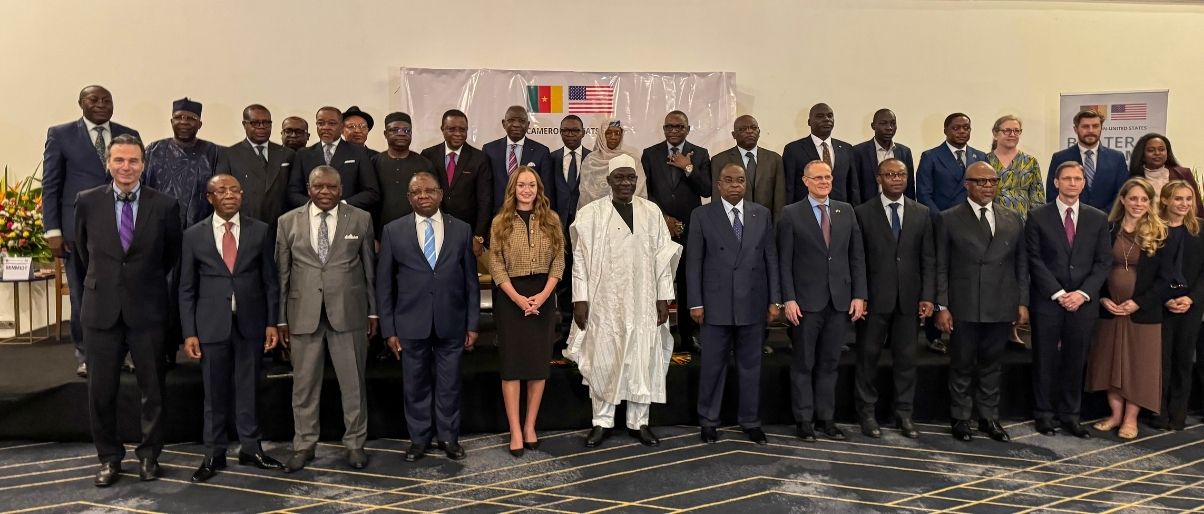
YAOUNDÉ (ABS News) – Cameroon and the United States have launched their first bilateral Economic and Commercial Dialogue, opening a new framework intended to expand trade, attract American investment and confront longstanding obstacles that have limited business between the two countries.
The inaugural dialogue was held Aug. 27 in Yaoundé and co-chaired by Cameroon’s Economy Minister Alamine Ousmane Mey, representing Prime Minister Joseph Dion Ngute, and Sarah Troutman, a U.S. deputy assistant secretary of state for African affairs. Government officials, private-sector representatives and U.S. Embassy officials participated.
The talks focused on three broad areas: improving Cameroon’s business and investment environment, promoting investment partnerships, and expanding bilateral trade and market access. Sectors identified for potential American involvement include digital technology and infrastructure, mining and critical minerals, agro-industry, logistics, financial services and major infrastructure projects.
Reports surrounding the dialogue have pointed to billions of dollars in potential investment opportunities, but the figures require careful distinction. Business in Cameroon reported before the meeting that U.S. officials discussed unlocking as much as $15 billion in potential investment across sectors if regulatory and business-climate barriers are addressed. Separately, Cameroon is pitching a portfolio containing several multibillion-dollar projects. The official account describes prospective projects, partnerships, and investment mobilization.
One of the biggest projects being presented to American investors is the proposed Grand Eweng hydroelectric dam, estimated at roughly $3 billion. The project, planned for the Sanaga River, is part of a broader Cameroonian portfolio that also includes a proposed new airport for Douala and major data-center and cloud infrastructure.


The scale of the ambition contrasts sharply with current commercial ties. U.S.-Cameroon trade in goods and services totaled an estimated $704.6 million in 2025, according to the Office of the U.S. Trade Representative. Goods trade accounted for $456.6 million, with American exports to Cameroon at $169.3 million and imports from Cameroon at $287.3 million.
The dialogue also comes against a complicated trade backdrop. Cameroon remains ineligible for the African Growth and Opportunity Act, the U.S. preferential trade program. Yaoundé has identified improved access to the American market and strengthening Cameroonian companies’ ability to compete there as priorities.
For Washington, opportunity is accompanied by concern over Cameroon’s investment climate. Ahead of the dialogue, businesses highlighted foreign-exchange restrictions, fintech regulation, infrastructure deficiencies, trade procedures and administrative unpredictability as impediments to investment. The U.S. Commerce Department nevertheless identifies substantial opportunities in transportation, energy, agriculture and information technology, including fiber networks, data centers and fintech.
The significance of the meeting, therefore, may lie less in headline dollar figures than in whether the two governments can convert proposed opportunities into actual contracts and investment.
Both sides say they want the dialogue to become a permanent mechanism, with joint road maps, public-private partnerships and concrete projects expected to follow.
For Cameroon, the test will be implementation: can Yaoundé improve the business environment sufficiently to turn American interest into American capital?