


Listen to this article
Estimated 2 minutes
The audio version of this article is generated by AI-based technology. Mispronunciations can occur. We are working with our partners to continually review and improve the results.
U.S. President Donald Trump on Tuesday said the Canada-U.S.-Mexico Agreement — the trade pact also known as CUSMA — is not relevant for the U.S., but Canada wants it, as he pushed for companies to bring manufacturing back to American soil.
“There’s no real advantage to it — it’s irrelevant,” Trump said. “Canada would love it. Canada wants it. They need it.”
The Detroit Three automakers are heavily reliant on supply chains that include significant parts production in Mexico and Canada, and all three produce hundreds of thousands of vehicles annually in both countries.
Major automakers last year urged the Trump administration to extend CUSMA, saying it is crucial to American auto production.
The American Automotive Policy Council, representing the Detroit Three automakers, said CUSMA “enables automakers operating in the U.S. to compete globally through regional integration, which delivers efficiency gains” and accounts “for tens of billions of dollars in annual savings.”
“Our supply chains go all the way through all three countries. It’s not simple. It’s very complex,” Mark Reuss, the president of General Motors, said at an event Tuesday. “The whole North American piece of that is a big strength.”
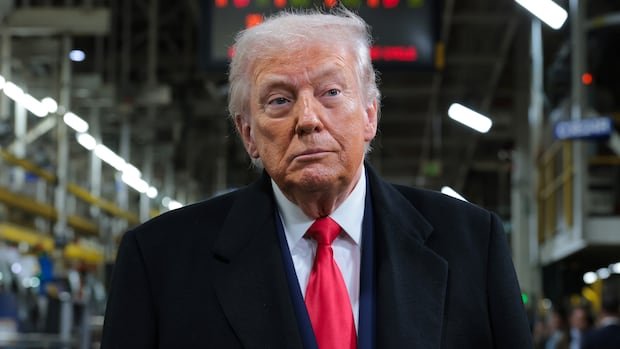
Trump made the comments as he toured a Ford factory in Dearborn, Mich., ahead of a speech on the economy he is delivering in Detroit.
No need for cars from Canada: Trump
“The problem is we don’t need their product. You know, we don’t need cars made in Canada. We don’t need cars made in Mexico. We want to take them here. And that’s what’s happening,” Trump said.

The Trump administration is listing specific changes it wants from Canada in order to stay within the Canada-U.S.-Mexico Agreement. The list includes policy changes on energy, more access to dairy markets and bidding on certain government projects, as well as changes to the Online News Act.
In November, Stellantis said that under 15 per cent tariffs with Japan, U.S. vehicles complying with North American content rules “will continue to lose market share to Asian imports, to the detriment of American automotive workers.”
CUSMA is up for review this year to decide whether it will be left to expire or another deal will be worked out.
The trade pact, which replaced the North American Free Trade Agreement (NAFTA) and was negotiated during Trump’s first term as president, requires the three countries to hold a joint review after six years.
