

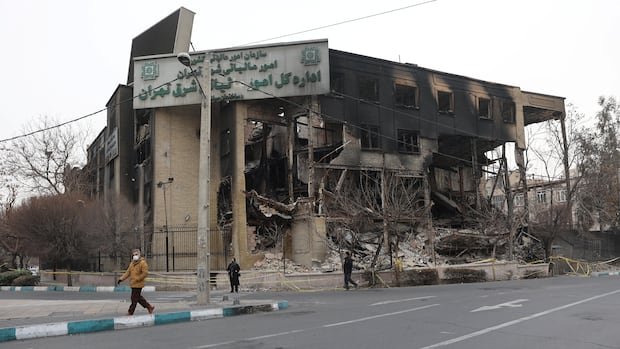
Hackers disrupted Iranian state television satellite transmissions to air footage supporting the country’s exiled crown prince and calling on security forces to not “point your weapons at the people,” online video showed early Monday, the latest disruption to follow nationwide protests in the country.
The hacking comes as the death toll in a crackdown by authorities that smothered the demonstrations reached at least 4,029 people, activists said. They fear the number will grow far higher as information leaks out of a country still gripped by the government’s decision to shut down the internet. Iran’s Foreign Minister Abbas Araghchi had his invitation to speak at the World Economic Forum at Davos, Switzerland, withdrawn over the killings.
Meanwhile, tensions remain high between the United States and Iran over the crackdown after President Donald Trump drew two red lines for the Islamic Republic — the killing of peaceful protesters and Tehran conducting mass executions in the wake of the demonstrations. A U.S. aircraft carrier, which days earlier had been in the South China Sea, passed Singapore overnight to enter the Strait of Malacca — putting it on a route that could bring it to the Middle East.
The footage aired Sunday night across multiple channels broadcast by satellite from Islamic Republic of Iran Broadcasting, the country’s state broadcaster. The video aired two clips of exiled Crown Prince Reza Pahlavi, then included footage of security forces and others in what appeared to be Iranian police uniforms. It claimed without offering evidence others had “laid down their weapons and swore an oath of allegiance to the people.”
“This is a message to the army and security forces,” one graphic read. “Don’t point your weapons at the people. Join the nation for the freedom of Iran.”

Iran now appears relatively quiet after days of widespread protest, and harsh reprisals by Iranian authorities, including reported mass executions. Members of Iran’s diaspora are now urging U.S. President Donald Trump to follow through on his promises to act against the regime.
The semi-official Fars news agency, believed to be close to the country’s paramilitary Revolutionary Guard, quoted a statement from the state broadcaster acknowledging that the signal in “some areas of the country was momentarily disrupted by an unknown source.” It did not discuss what had been aired.
A statement from Pahlavi’s office acknowledged the disruption that showed the crown prince. It did not respond to questions from The Associated Press about the hack. How much support Pahlavi has inside of Iran remains an open question, though there have been pro-shah cries at the demonstrations and at night since the crackdown.
Sunday’s hack isn’t the first to see Iranian airwaves disrupted. In 1986, The Washington Post reported that the CIA supplied the prince’s allies “a miniaturized television transmitter for an 11-minute clandestine broadcast” to Iran by Pahlavi that pirated the signal of two stations in the Islamic Republic.
In 2022, multiple channels aired footage showing leaders from the exiled opposition group Mujahedeen-e-Khalq and a graphic calling for the death of Iran’s Supreme Leader Ayatollah Ali Khamenei.
US aircraft carrier possibly on path to Mideast
As tensions remain high between Tehran and Washington, ship-tracking data analyzed by The Associated Press on Monday showed the USS Abraham Lincoln aircraft carrier, as well as other American military vessels, in the Strait of Malacca.
The Lincoln had been in the South China Sea with its strike group as a deterrent to China over tensions with Taiwan. Tracking data showed that the USS Frank E. Petersen Jr., the USS Michael Murphy and the USS Spruance, all Arleigh Burke-class guided missile destroyers, were traveling with the Lincoln through the strait.
Multiple U.S. media reports quoting anonymous officials have said the Lincoln, which has its homeport in San Diego, was on its way to the Mideast. It likely would still need several days of travel before its aircraft would be in range of the region. The Mideast has been without an aircraft carrier group or an amphibious ready group, likely complicating any discussion of a military operation targeting Iran given Gulf Arab states’ broad opposition to such an attack.
As the Iranian government quashes protests across the country, some people in the Iranian diaspora hope foreign intervention can push this latest attempt at revolution to the next stage. For insight, CBC’s Stephen Quinn spoke with Maryam Mazrooei, a freelance journalist from Iran who was imprisoned during the 2022 protests in her country. She says the scale and crackdown this time is incomparable from what she experienced there.
Meanwhile, the World Economic Forum withdrew its invitation for Araghchi to speak at Davos.
“Although he was invited last fall, the tragic loss of lives of civilians in Iran over the past few weeks means that it is not right for the Iranian government to be represented at Davos this year,” the forum said.
Iran’s ambassador to Switzerland, Mahmoud Barimani, called the decision an “unreasonable act which was no doubt under the pressure and influence of anti-Iranian currents and radical American-Zionists.”
The Munich Security Conference separately withdrew invitation for Iranian government officials over the crackdown.
Death toll from crackdown rises
The death toll exceeds that of any other round of protest or unrest in Iran in decades, and recalls the chaos surrounding the 1979 revolution. The U.S.-based Human Rights Activists News Agency put the death toll Tuesday to at least 4,029, warning it likely would go higher.
It said of the dead, 3,786 were demonstrators, 180 were security forces, 28 were children and 35 were people not demonstrating.
The agency has been accurate throughout the years of demonstrations and unrest in Iran, relying on a network of activists inside the country that confirms all reported fatalities. The AP has been unable to independently confirm the toll.
Iran’s Supreme Leader, Ayatollah Ali Khamenei, has acknowledged that thousands of people were killed during anti-government protests over the last two weeks, but blamed the U.S. for the death toll. He also called President Donald Trump a criminal for supporting the protests, which have been countered by tens of thousands of pro-government demonstrators. The U.S.-based Human Rights Activists News Agency said it has verified 3,090 deaths, including 2,885 protesters, and over 22,000 arrests. CBC News speaks to exiled Iranian journalist and activist Masih Alinejad about the demonstrations.
Iranian officials have not given a clear death toll, although on Saturday, Khamenei said the protests had left “several thousand” people dead and blamed the United States for the deaths. It was the first indication from an Iranian leader of the extent of the casualties from the wave of protests that began Dec. 28 over Iran’s ailing economy.
The agency also reported over 26,000 people had been arrested. Comments from officials have led to fears of some of those detained being put to death in Iran, one of the world’s top executioners.
“While the killers and seditious terrorists will be punished, Islamic mercy and leniency will be applied to those who were deceived and did not have (effective) roles in the terrorist event,” a statement Monday from Iran’s president, its judiciary chief and parliament speaker said.

