

A greater part of Africa’s populationcan’t afford a healthy diet than any other regional population. Food insecurity in sub-Saharan Africa is caused by climate change, high levels of poverty, rapid population growth, low economic growth, inadequate infrastructure and conflicts. Women are the backbone of agricultural labour in the region. The problems of limited access to land, water and technology faced by these women also worsen food insecurity.
People have a right to food – to produce food, to be free from hunger, and to participate in policy decisions that affect food systems. The right to food is also recognised and protected by various international frameworks and agreements
But in sub-Saharan Africa, access to food has long been regarded as a privilege rather than a basic human right. Malnutrition is a feature of the region. As part of a group of food microbiologists, food scientists and food researchers, I tried to find out what scientific, policy and socio-economic interventions could move sub-Saharan Africa away from food insecurity towards food sufficiency
Our research found that governments across sub-Saharan Africa need to target inequality, gender imbalances and environmental degradation if they want to end hunger. This is because food sovereignty is very tightly interlinked with social justice and sustainable development
Successful food projects
We reviewed five projects that work on the right to food. We looked at how these initiatives had worked, or not, and what lessons they offered
In Senegal, the Community-Led Total Sanitation approach mobilises communities to construct household latrines and improve sanitation practices. This reduces waterborne diseases and enhances food safety
Wire stock/Shutterstock
Rwanda’s Agricultural Transformation Agenda has led to an increase in agricultural productivity, food security and rural development. It has done this through promoting sustainable agricultural practices and connecting smallholder farmers with markets
The Malawi Social Cash Transfer Programme and the Mtukula Pakhomo Programme provide unconditional direct cash transfers to 10% of Malawi’s most impoverished households in 22 districts. The families who qualify receive about US$8.80 per month each. These organisations have found that this alleviates poverty and improves food security. The families who are part of these programmes buy and consume a wider variety of food, resulting in better nutrition for children.
In Zambia, conservation agriculture has enhanced the food available to rural families who practise smallholder farming. This kind of agriculture involves minimum soil disturbance (no digging), and permanent soil cover (covering soil with mulch so that it retains water and needs less irrigation). In these projects, farmers have grown grain, legumes, cowpeas and soybeans with maize, instead of only growing maize.
Soil health and crop yields have improved. This has meant more income for farmers and more food available. Farmers are also less vulnerable to climate change impacts
The Sasakawa Africa Association in Ethiopia also runs smallholder farmer community-based programmes, providing training and access to markets and improved agricultural practices. This comes in the form of different extension models – on- and off-farm demonstrations, field days and exchange visits for farmers. Crop production was at 7.81 million tons in 1992, the year before the project started, and rose to 26.7 million tons in 2015/16.
These case studies show that collective efforts can succeed in protecting and promoting the right to food. They show that community-based approaches can enable local communities to achieve a right to food. Support in the form of direct cash transfers from governments, even in the form of small amounts of money, can enable even the most vulnerable households to afford a more varied and nutritious diet. Climate-smart practices, such as conservation agriculture, also enhance food security.
The way forward
Under international conventions, governments are supposed to take steps to make sure that people realise the right to food. They can do this by promoting sustainable food production, and equal access for everyone to food distribution and vital re
In Africa, this can only begin when governments embrace the idea that everyone has the right to food. From there, governments should develop policies and programmes to make sure that everyone can access nutritionally balanced food. Governments would have to make sure that people could eat diverse and nutrient-rich diets. Creating access to safe drinking water and sanitation facilities is part of this. Governments should invest in maternal and child health programmes, and programmes that fortify food with essential vitamins.
Adapting agricultural practices to the warming climate would also help ensure the right to food. This includes investment in climate-smart agriculture and improving water management systems. Traditional knowledge should be fused with innovative technologies to enhance agricultural productivity in the face of climate change
Read more:
Kenyans have a right to food, enshrined in the constitution – government must be held accountable
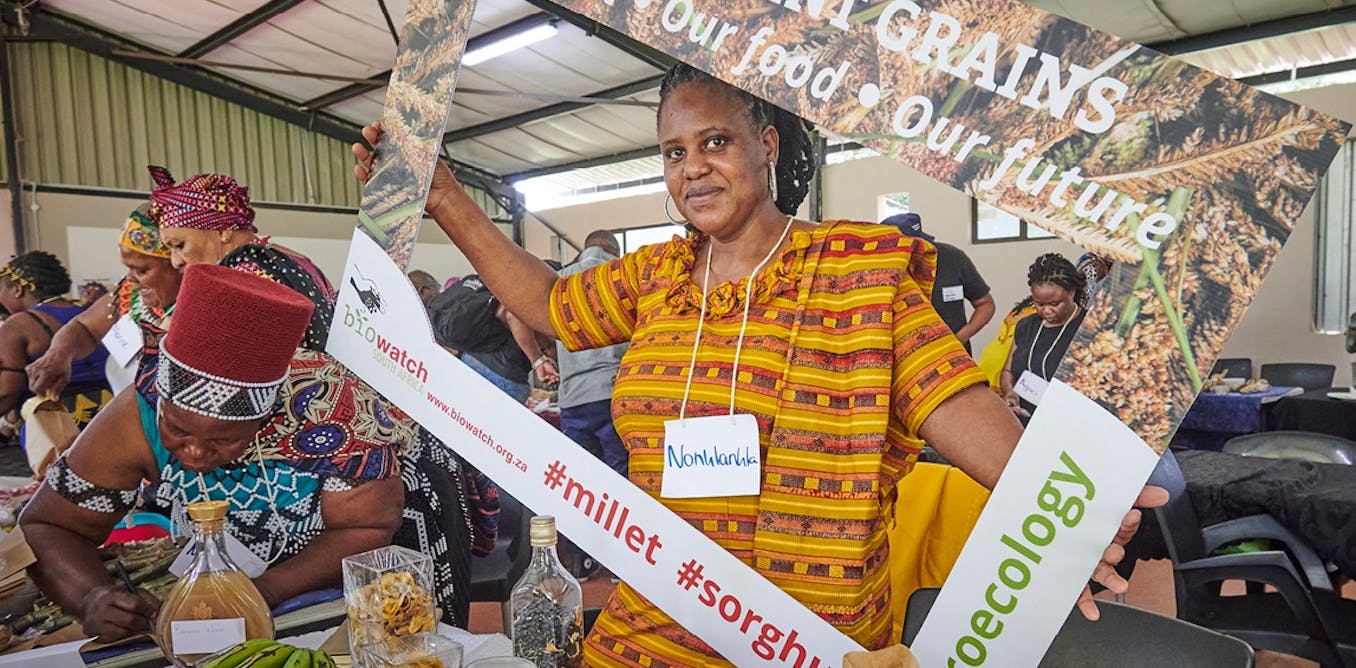
Creating systems where everyone has an equal right to food involves making sure that everyone has equal access to food resources, markets and opportunities to grow and buy food. It is vital that indigenous knowledge about food security is preserved and revived. This includes attempts to revive the growth of climate-change resilient ancient grains such as ancient finger millet, pearl millet and sorghum.
We picture a world where social justice and human rights efforts result in everyone having access to food. To achieve this, governments must recognise the connection between food rights, poverty alle to adequate food is crucial to addressing hunger
Governments will have to work with communities and civil society organisations to set up food systems that are resilient to climate change. Our research has found that governance structures must create the space for individuals and communities to be part of decisions about food and agriculture, and to help draw up food policies
Adedola S. Adeboye, Oluwaseun P. Bamidele, Isiguzoro Onyeoziri, Oluwafemi A. Adebo, Maria M. Adeyemi and Susan N. Thera-Sekgweng co-authored the research for this article

