

- Climate
In sub-Saharan Africa, soil degradation threatens maize yields as much as climate change
Results & impact3 February 2026
An international study published in Global Change Biology, coordinated by CIRAD in collaboration with 32 institutes, reveals that declining soil fertility could have a greater long-term impact on agricultural yields than climate change itself.
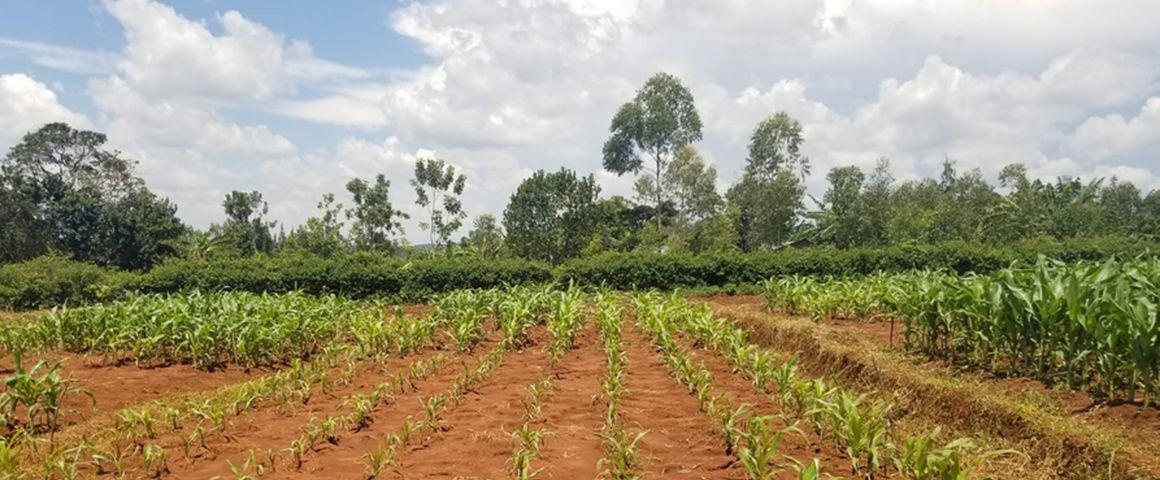
Long-term field experiment on integrated soil fertility management in western Kenya (Sidada, Siaya District). No-input treatments are shown in the foreground, while different levels of soil fertility management are visible in the background and on the right © A. Couëdel, CIRAD
The essentials
- Declining soil fertility has a greater impact on yields than future climate change;
- Combining organic and mineral fertilisers helps offset fertility losses and adapt to climate change;
- Soil restoration is a priority for climate change adaptation.
Climate change is widely recognised as a major threat to food security in sub-Saharan Africa. However, a new study based on four long-term field experiments and a set of 15 soil–crop models shows that theprogressive decline in soil fertility could reduce maize yields more than the effects of rising temperatures, changes in rainfall patterns, and increasing atmospheric CO₂ concentrations
Soil degradation as limiting as, or evenmore limiting than, climate change
Our study shows that soil degradation could lead to maize yield losses of 20 to 50% over a few decades—an impact greater than that of climate warming, changes in precipitation, and increased CO₂ when considered individually. Ignoring soil degradation in future impact assessments would result in a severe underestimation of upcoming production losses
Antoine Couëdel
Researcher at CIRAD and lead author of the study
At present, the magnitude of yield losses due to declining soil fertility exceeds that of climate change impacts. This is largely because soil fertility levels are often so low that crops are primarily constrained by nutrient availability rather than by climatic conditions
Régis Chikowo
University of Zimbabwe
What solution can secure yields in the face of climate change?
In response to these findings, integrated soil fertility management strategies—combining organic and mineral inputs—can limit soil fertility decline and triple yields, with benefits that increase over time, including under climate change
“Integrated soil management, based on the efficient use of organic and mineral fertilisers, helps initiate a virtuous cycle that ensures sustained access to essential mineral nutrients for crop growth,” adds Antoine Couëdel
The combined use of organic and mineral fertilisers therefore represents a credible long-term adaptation strategy to climate change
Our results show that addressing soil degradation is both a priority for food security in sub-Saharan Africa and a so-called ‘no-regret’ adaptation strategy to climate change. Fertiliser use efficiency is only weakly affected by climate change and, in all cases, allows yields to be achieved that are far higher than those currently observed under low-input conditions
Babacar Faye
Sine Saloum El Hadj Ibrahima Niass University, Senegal
These findings highlight the urgent need to consider soil restoration and the maintenance of soil fertility as a central pillar of climate change adaptation strategies.
Robust results based on 15 models
The originality of this study also lies in its multi-model methodology. The researchers mobilised 15 independent soil–crop models within the framework of the international AgMIP project, developed by NASA and Columbia University. CIRAD coordinates the “low-input cropping systems” component of the project, in partnership with modelling institutes in sub-Saharan Africa. This multi-model approach reduces uncertainties and allows robust trends to be identified. In particular, the authors explicitly incorporate the long-term impacts of soil fertility into their simulations—a dimension that remains largely absent from climate change impact studies in sub-Saharan Africa.
ReferenceCouëdel, A., G. N. Falconnier, M. Adam, et al. 2026. “ Beyond Climate Change: The Role of Integrated Soil Fertility Management for Sustaining Future Maize Yield in Sub-Saharan Africa.” Global Change Biology 32, no. 2: e70720. https://doi.org/10.1111/gcb.70720
