

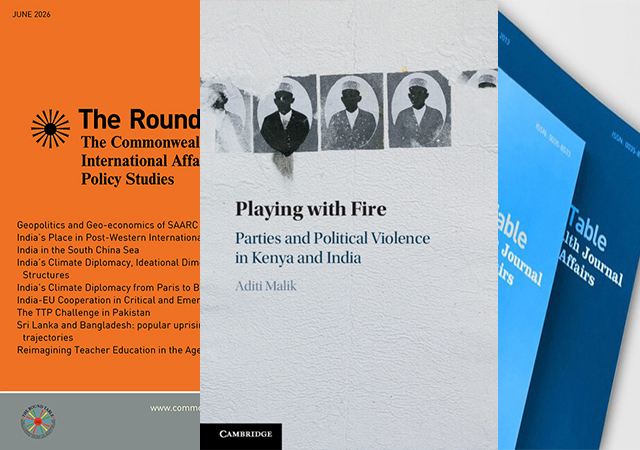
Book Review – Playing with fire: Parties and political violence in Kenya and India
Examining the politics of various Commonwealth nations through comparative studies proves highly valuable. Many member states exhibit significant, if not extensive, similarities. Upon achieving independence, these nations typically begin with comparable legal, administrative, and political frameworks, subsequently evolving in distinct and noteworthy directions. The contrasts and commonalities between them reveal things that analyses of any country in isolation cannot. Regrettably, there is a noticeable scarcity of this type of comparative research.
Aditi Malik tackles this gap by investigating the connections among political parties, civil society groups, and political violence in both Kenya and India. Her methodology is novel and compelling, promising to enhance our understanding of these complex subjects. Malik judiciously examines both national and local contexts within these nations, contending that during significant episodes of political violence, political parties and their leaders exert greater influence than civil society organizations, which typically strive to prevent disorder.
While this observation holds some familiarity, she subsequently introduces a novel perspective, positing that politicians’ tendencies to incite or prevent violence are partly contingent on the prevailing party systems. When there is relative stability within and between the main parties that vie for power, leaders will be less tempted to initiate violence. Conversely, if key parties lack a secure footing, the propensity for violence escalates. Drawing on data from recent decades, she constructs a fairly convincing argument.
Despite its merits, the analysis presents several significant shortcomings. Primarily, a crucial element appears to be overlooked. While the Kenyan and Indian situations are treated as comparable, they diverge fundamentally in a critical aspect. Before 2002, Daniel arap Moi in Kenya headed a brutish tyranny. The reviewer personally witnessed the brutality of this regime and the fear it instilled among intellectual circles. Following Moi’s departure, however, an commendable new Constitution was enacted in 2010, fostering pluralism and allowing authentic democratic governance to flourish. By contrast, since 2014 when Narendra Modi became India’s Prime Minister, systematic efforts to promote religious bigotry and to suffocate democracy have made great headway.
Essentially, these two nations have embarked on divergent paths. This is clearly relevant to an analysis of the political logic underpinning outbreaks or the avoidance of sectarian violence. However, this crucial distinction is not adequately highlighted within the study.
A further challenge emerges when the author addresses the role of civil society. An Appendix discussing the ‘Development’ of civil society in both nations asserts – accurately, as previously mentioned – that civil society organizations lack the capacity to deter politicians from instigating violence. Nevertheless, proceeding further reveals additional issues.
Civil society played a partial role in the drafting of Kenya’s new Constitution, and since its implementation, civil society has undeniably achieved progress in the country. Yet, when the focus shifts to India, a profoundly significant aspect is neglected. Under the Modi administration, civil society in India has not experienced ‘development’. Since he took power in 2014, a huge number of civil society organisations – apart than those that assist in brutalising the large Muslim minority – have been systematically intimidated or crushed. This systematic suppression has proven effective and notably overt. Its targets include two Nobel Peace Prize winners, Amnesty <a href="https://absafricatv.com/shailesh-pednekar-appointed-coo-international-business-at-bharat-serums-and-vaccines/” title=”Shailesh Pednekar appointed COO – International Business at Bharat Serums and Vaccines”>International – which has been forced to leave India – and even Mother Teresa’s Missionaries of Charity.
Furthermore, the author’s observations fail to convey the sheer scale and ferocity of the brutal assaults against Muslims during Modi’s tenure. She describes ‘targeted attacks against minorities’ as ‘mild’ (p. 189). Such a characterization is, frankly, perplexing. India has seen hundreds of beatings and murders, mainly of Muslims on flimsy (or no) grounds – on which the Prime Minister remained silent for over two years. Moreover, the study omits any mention of a prevalent tactic utilized by Hindu extremist groups and even state governments led by Modi’s party. Bulldozers are deployed impulsively and without proper legal procedure to demolish homes and businesses, predominantly those belonging to Muslims.
Playing with fire: Parties and political violence in Kenya and India by Aditi Malik, Cambridge, Cambridge University Press, 2024

