Close Menu
    Facebook X (Twitter) Instagram
    • Home
    • Contact Us
    • About Us
    • Privacy Policy
    • Terms Of Service
    • Advertisement
    Tuesday, July 14
    Facebook X (Twitter) Instagram Pinterest Vimeo
    ABS Africa TV
    • Breaking News
    • Trending
    • Africa News
    • World News
    • Features
    • Technology
    • More
      • Sports
      • Politics
      • Culture
      • Lifestyle
      • Travel
      • Business
      • Environment
      • Legal
      • Health
      • Cameroon
      • Ambazonia
      • AfroSingles
      • Environ/Climate
      • Editorial
      • The Leak Magazine
    • Donate
    Subscription
    ABS Africa TV
    Home»Politics»The Guardian view on xenophobic violence in South Africa: anti-migrant politics can’t fix domestic problems
    Politics

    The Guardian view on xenophobic violence in South Africa: anti-migrant politics can’t fix domestic problems

    Chukwu GodloveBy Chukwu GodloveJuly 2, 2026No Comments3 Mins Read
    Facebook Twitter Pinterest LinkedIn Tumblr Email
    The Guardian view on xenophobic violence in South Africa: anti-migrant politics can’t fix domestic problems
    Share
    Facebook Twitter LinkedIn Pinterest Email
    Post Views: 28

    The Guardian view on xenophobic violence in South Africa Launches National Science Month with Focus on Innovation”>South Africa: anti-migrant politics can’t fix domestic problems

    Editorial

    Foreigners are not to blame for unemployment, crime and the state of public services. Leaders should have the courage to say so more clearly

    Just over 30 years ago, Nelson Mandela expressed his sadness and anger at the rising hatred of foreigners in South Africa. “We had a legacy of unity and solidarity here,” the president told an African National Congress rally. “We are not victims to the influx of foreign people.”

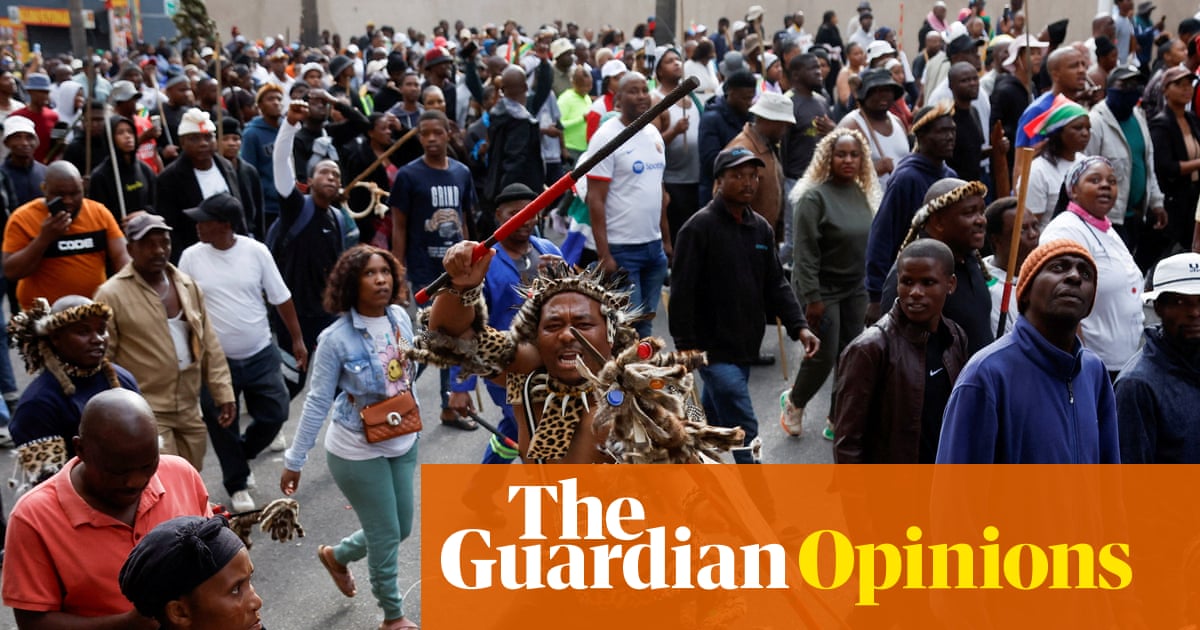
    Since then, xenophobic violence has periodically erupted. In 2008, anti-migrant attacks killed at least 62 people. Now a new wave is sweeping the country. Thousands marched in the streets on Tuesday – the arbitrary “deadline” that campaign groups had set for migrants to leave the country. More than 25,000 people did so in the run-up, with some countries evacuating their nationals and individuals fleeing in fear. Mozambique says five nationals were killed in anti-foreigner violence in May, and Ghana says a citizen was killed on Monday, though South African officials have offered different accounts. Migrants have been systematically blocked from health and other services by the Operation Dudula and March & March movements.

    Official statistics show that migrants make up less than 5% of the population, or around 3 million. Campaigners implausibly claim that there could be 10 times as many and say that they are targeting illegal migration. Migrants say that documentation, living in the country for decades and marriage to South Africans have offered no protection from intimidation and worse

    Faced with unemployment at over 40%, inequality, crime and overstretched public services, poorer South Africans especially blame migrants for taking jobs, breaking the law and burdening health and education systems. They are right to be angry at the state of the country, but wrong about who is to blame. These are problems of South Africa’s own making – the bitter legacy of apartheid, and subsequent corruption and mismanagement

    Jean Pierre Misago and Loren Landau, the founders of the Xenowatch monitoring platform, argue that anti-migrant mobilisation is not only about frustrated communities. It is “a political enterprise co-produced by vigilante groups and the state through acts of commission and omission” – including the failure to censure violence adequately. Ahead of municipal elections in November, it is fair to ask who benefits. Politicians from the opposition party ActionSA have said that citizens have no choice but to demand action against illegal migration. Associates of the former president Jacob Zuma have links to the March & March movement, with politicians from his uMkhonto we Sizwe party attending its events.

    Cyril Ramaphosa, the president, has attempted to straddle political concerns by launching a crackdown on illegal migration while decrying “fear, anger, hatred or violence”. Yet the government has mostly tried to play down the xenophobic harassment and violence as an issue of law and order. Though some at the grassroots are speaking out, there is little moral clarity at the top

    The anti-apartheid struggle was an African struggle, hosted and supported by other countries and individuals. Now significant parts of the population seem to be pursuing the exclusion and oppression that people once sought to vanquish – angering politicians and the public across Africa. That’s bad for diplomacy, for sorely needed tourism, trade and investment, and for South Africa’s ability to attract the skilled and hard-working people that it needs. Forcing out migrants will deepen the problems so angering South Africans, not solve them.

    Explore more on these topicsShare
    Reuse this content

    Guardian South view Violence xenophobic
    Share. Facebook Twitter Pinterest LinkedIn Tumblr Email
    Chukwu Godlove

    Related Posts

    Appeal court nullify ADC congress: ADC counter Nafiu Bala presidential candidate upload for Inec portal

    July 13, 2026

    Navigating South Africa’s US$1.12B Medical Device Market

    July 13, 2026

    South Africa Opens Final Call for National Arts Awards Nominations | Law

    July 13, 2026
    Leave A Reply Cancel Reply

    Search
    Latest Post

    Kenya Luxury Safari Tourism Rises as JW Marriott Opens Mount Kenya Rhino Reserve Safari Camp in Solio Game Reserve with Wellness and Conservation Experiences

    July 13, 2026

    Focus turns to building stronger institutions in Africa to speed shift to renewable energy

    July 13, 2026

    African Economic Conference Calls for Stronger Trade and Unity

    July 13, 2026

    What the end of PEPFAR funding could mean for South Africa’s HIV response | Harvard T.H. Chan School of Public Health

    July 13, 2026

    Google comes out against site blocking in the EU

    July 13, 2026

    Subscribe to Updates

    Get the latest creative news from FooBar about art, design and business.

    • Facebook
    • Twitter
    • Pinterest
    • Instagram
    • YouTube
    • TikTok
    ABS TV and ABS Network News is a leading Pan-African 24/7 broadcasting network delivering nonstop news, talk shows, lifestyle programs, and digital media content worldwide through Satellite, Streaming Platforms, and Roku TV.
     
    Based in the United States, we connect Africa to the world while empowering creators, journalists, and brands through innovative media and broadcasting services.
    Facebook X (Twitter) Pinterest WhatsApp Instagram

    Our Picks

    Travel

    Kenya Luxury Safari Tourism Rises as JW Marriott Opens Mount Kenya Rhino Reserve Safari Camp in Solio Game Reserve with Wellness and Conservation Experiences

    Environment

    Focus turns to building stronger institutions in Africa to speed shift to renewable energy

    Business

    African Economic Conference Calls for Stronger Trade and Unity

    Most Popular

    Health

    What the end of PEPFAR funding could mean for South Africa’s HIV response | Harvard T.H. Chan School of Public Health

    Legal

    Google comes out against site blocking in the EU

    Lifestyle

    Introducing Nollywood actress Bisola Omobolanle who’s chasing her dream against all odds

    © 2026 Copyright. All Rights Reserved by ABSAFRICATV
    • Privacy Policy
    • Terms of Services

    Type above and press Enter to search. Press Esc to cancel.

    We use cookies to ensure that we give you the best experience on our website. If you continue to use this site we will assume that you are happy with it.