


Each year, millions of young Africans enter the labour market in search of stable and fulfilling employment. In Mozambique alone, more than half a million young people join the workforce annually.
Many will find work in agriculture, but opportunities for formal employment remain limited. Even in urban areas, many jobs are informal, offering little security and falling short of the aspirations of an increasingly educated young population.
Since 2017, the United Nations University World Institute for Development Economics Research (UNU-WIDER) has conducted surveys to trace the path of students from the classroom into the labour market.
We are researchers at Inclusive Growth in Mozambique, a research and capacity development initiative launched in 2015. Our recent statistical report provides a rare look at what actually happens when young people leave university and technical-vocational (TVET) colleges and enter the workforce. The study followed graduates from 2019 to 2024.
The evidence shows that most do find work, eventually, but often not the kind policymakers assume.
Close to half of graduates find a job in the first year after graduating. For the rest, it takes significantly longer. Only by the third or fourth year do the vast majority find work. And results vary widely, depending on the educational level (university or TVET), the type of course, and gender. The differences are seen not only in employability but also in early-career wages and the quality of work. There is a high rate of employee dissatisfaction with their jobs.
The graduates’ experience reveals the limits of the current labour market strategy of widening access to education. It’s doing so within an economy that isn’t growing fast enough, especially in creating formal employment. The results also underline the importance of strong evidence about the labour market and education.
The hidden story behind employment statistics
The young people in the study eventually found some form of work. Economic activity rates reached around 90% for university graduates after five years, and just under 80% for TVET graduates after four. Unemployment rates among them are lower than for other young people of the same age. University graduates showed a 7% unemployment rate in 2024 compared to nearer 19% among equal-aged young people (as per the 2022 national household survey).
At first glance, this looks like success. The reality is messier.
The transition into employment is slow and uneven. Among university graduates, employment rises from about 69% soon after graduation to nearly 90% five years later – a gradual climb, not a quick absorption. For TVET graduates it’s slower still: starting near 42% and reaching only 79% after four years, with some slippage after that.
These averages also hide wide variation. Some graduates find work quickly; others cycle through job search, casual work and inactivity for years. The result is a “staggered” transition into stable employment. Some don’t make it.
Not all work is the same
Behind these slow transitions lies another problem: “employment”, as a statistic, blurs the line between simply being in work and having a decent, stable job.
Years after graduation, stable employment is still far from universal. About 72% of employed university graduates hold fixed positions with an employer (Figure 1). Among TVET graduates it’s only 39% (Figure 2), with far more reliance on self-employment and casual work (not always by choice).
Wage jobs are not always good jobs. Among TVET graduates, 42% lack a written contract and 41% aren’t registered for social security. Unsurprisingly, satisfaction is low: about two-thirds of university graduates and more than four-fifths of TVET graduates say they’re dissatisfied with their current work.
Source: Guiliche et al. (2026)
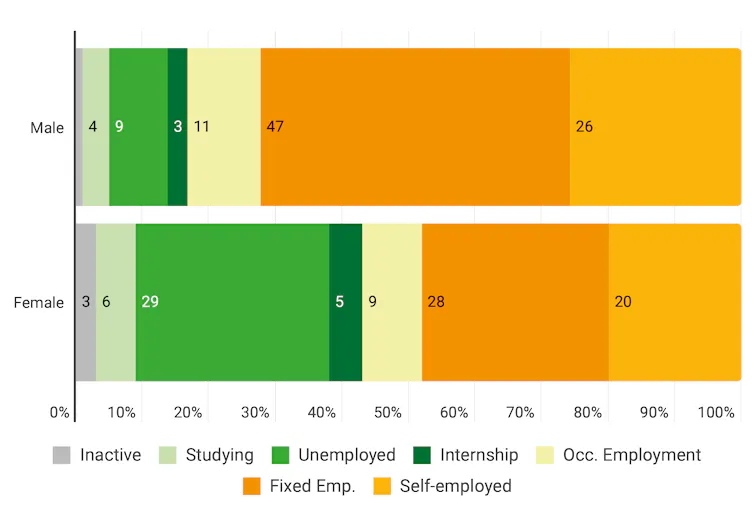
Source: Guiliche et al. (2026)
Training isn’t the whole answer
Much of Mozambique’s policy response to youth unemployment, as elsewhere, has focused on expanding education and training, especially TVET. It’s assumed that better skills mean better jobs.
The evidence partly bears this out: graduates in specialised fields such as health (up to 95% employment) and engineering (over 90%) do consistently better. But a skills-only approach has limits. Around 31% of university graduates and 43% of TVET graduates work in jobs unrelated to their field of study (Figures 3 and 4). Among TVET graduates, 32% say their job doesn’t even use the skills they trained for.
This points to a demand problem, not just a skills gap. In Mozambique, as across much of sub-Saharan Africa, economic growth has often come from capital-intensive sectors, like extractives, that create relatively few jobs. Growth and employment are becoming disconnected, and so are skills and opportunity.
Read more:
Mozambique’s economy is failing: the tough policy choices that need to be made urgently
This challenge becomes even more stark when we realise how few young people graduate from universities and technical and vocational training schools in Mozambique. Close to 18,000 youngsters graduated from universities in 2017, with an average age of 26 years. Close to 16,000 graduated from TVET schools in 2019, with an average age of 22 years. This contrasts with 600,000 Mozambicans aged 18 years old, according to official estimates.
Each group of graduates represents around 2.5% of its age cohort. The fact that they face such difficulties in entering the labour market should come as a serious warning about the limits of post-school education as a way to get young people employed.

Source: Guiliche et al. (2026)

Source: Guiliche et al. (2026)
Rethinking the policy agenda
What does this mean for policymakers?
First, expanding training alone will not solve youth employment challenges. Skills development must go hand in hand with job creation, particularly in higher-productivity sectors.
Second, greater attention is needed on the transition from education to work. Many young graduates spend years on this. Internships, apprenticeships and effective career services can connect education systems more closely with employers.
Third, employment policy must focus not only on the number of jobs created, but also on their quality. However, policies that attempt to force formalisation too quickly or impose rigid labour regulations may have unintended effects, pushing more workers and firms into informality.
Finally, education policy should be evaluated against its intended purpose. TVET and university systems are designed to make an impact in the formal sector.
The fact that many graduates end up in informal work reflects the limited capacity of the formal economy to absorb skilled workers. Graduate informality mostly represents an under-use of human capital.
Effective higher education and TVET systems, by supplying the skills needed for innovation and productivity growth, help create the foundations of the formal economy.
Why better data matters
The value of our Mozambique tracer studies is in the method. By following the same people over time, it reveals how labour-market transitions actually unfold – something one-off surveys cannot capture. Yet this kind of longitudinal data remains scarce across low income Africa.
As the continent grapples with a fast-growing youth population, that evidence gap matters. Without it, policy risks being built on assumptions about how labour markets work, rather than evidence of how they actually do.
