

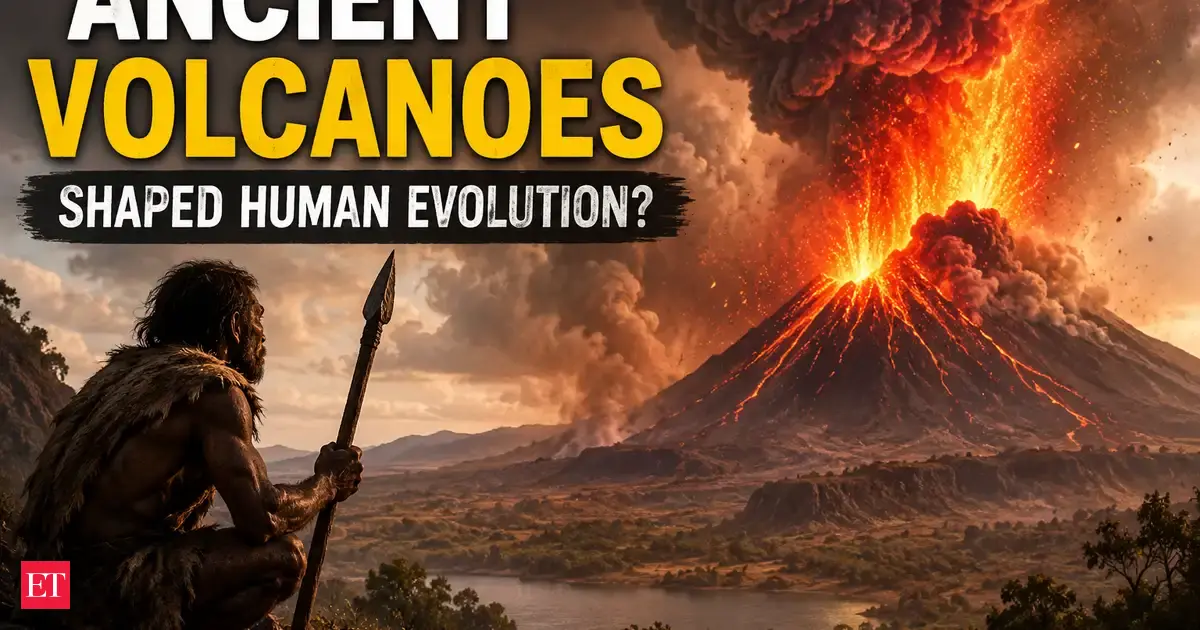
Hundreds of thousands of years before cities, civilizations or even modern humans existed, a chain of powerful volcanoes repeatedly transformed one of the most important landscapes in human history. The East African Rift Valley, often described as the birthplace of humanity, experienced a series of enormous eruptions during a period when some of our earliest ancestors were evolving. Now, scientists believe those volcanic events may have influenced far more than the landscape itself.
A study published in Nature Communications suggests that explosive eruptions across the East African Rift Valley between about 320,000 and 170,000 years ago created dramatic environmental changes that early humans had to navigate. Rather than viewing volcanoes as isolated natural disasters, researchers say these events may have played an important role in shaping the environments where early human populations lived, adapted and survived.
How Earth’s most active ancient volcanic region may have influenced the survival of early humans
The East African Rift Valley stretches from the Middle East through eastern Africa to Mozambique. Beyond its remarkable geological history, it is also one of the world’s most significant archaeological regions. Fossil discoveries from this vast landscape have helped scientists piece together the story of early human evolution, including the emergence of Homo sapiens nearly 200,000 years ago.
Researchers led by William Hutchison of the University of Oxford examined volcanic deposits from four volcanoes in the Rift Valley to better understand their eruption history. By analysing the argon content preserved within ignimbrite lava and studying layers of volcanic rock, the team reconstructed a timeline of major eruptions across the region.
Instead of finding eruptions spread evenly over time, the researchers identified a concentrated period of unusually intense volcanic activity. This burst of explosive eruptions occurred during the mid-Pleistocene, overlapping with an important chapter in early human evolution.
The finding raises an intriguing possibility: as early humans were adapting to changing climates, they may also have faced repeated environmental disruptions caused by massive volcanic eruptions.
How these ancient volcanoes transformed the landscape
The eruptions examined in the study were capable of producing enormous volcanic collapses known as calderas. These events occur when large volumes of silica-rich magma collect beneath a volcano before being released during an explosive eruption. As magma chambers empty, the ground above collapses, forming vast basin-like depressions.
Such eruptions would have dramatically altered the surrounding landscape. Thick blankets of volcanic ash could have covered the Rift Valley floor, making it difficult for plants to grow and reducing access to water and food res, ash and rock—would have devastated nearby ecosystems, leaving large areas temporarily uninhabitable
According to the researchers, the environmental effects of these eruptions may have persisted for thousands of years, forcing both animals and early human populations to adjust to rapidly changing conditions.
Rather than being a single catastrophic event, the repeated volcanic activity likely created cycles of destruction followed by ecological recovery, continually reshaping the region where early humans lived.
Destruction was followed by new opportunities
While the immediate effects of these eruptions would have been severe, the study also highlights how volcanic landscapes can gradually become places where life returns.
After major eruptions, the large calderas left behind slowly collected water, eventually forming lakes across parts of the Rift Valley. These freshwater bodies became valuable ecological centres, supporting vegetation, attracting wildlife and creating reliable water
As ecosystems recovered, these newly formed habitats may have provided favourable locations for early human communities. Areas surrounding lakes often support greater biodiversity and more stable re
The researchers suggest that these environmental changes may have influenced where early humans travelled, settled and found food. Although the study does not claim volcanoes directly drove human evolution, it presents evidence that volcanic activity likely became another powerful environmental force that shaped the challenges our ancestors faced.
The findings add a new dimension to scientists’ understanding of early human environments by combining geological evidence with questions traditionally explored through archaeology and anthropology.
Researchers want to connect geology with human evolution
The authors say their work represents only the beginning of a broader effort to understand how ancient volcanic activity influenced prehistoric ecosystems and human history.
Hutchison hopes that volcanologists, paleoanthropologists and paleoclimatologists can work together to investigate how explosive eruptions affected landscapes over long periods. By combining evidence from rocks, fossils and ancient climate records, researchers hope to build a more complete picture of the world early humans experienced.
The study also draws attention to the importance of preserving geological records. Ancient eruptions are often difficult to reconstruct because volcanic deposits erode over time or become buried beneath younger sediments. Even so, these records provide valuable insights into Earth’s environmental history and the natural forces that shaped life on the continent.
Understanding how volcanic activity interacted with climate and ecosystems could help answer long-standing questions about the environments in which modern humans evolved.
Ancient eruptions still offer lessons for today
Ancient volcanic eruptions are not just distant history. They provide a vital playbook for modern climate resilience.
When massive volcanoes erupt, they inject millions of tons of sulfur dioxide into the stratosphere. Ice-core data reveals that 15 of the 16 coldest summers in the Northern Hemisphere over the last 2,500 years directly followed major volcanic eruptions. These events triggered sudden global cooling of 1°C to 2°C, causing sudden crop failures and widespread famines.
When ancient super-eruptions like Mount Toba (~74,000 years ago) decimated local habitats, early Homo sapiens survived by expanding trade networks, creating social alliances, and sharing food across regions. More isolated human groups failed to adapt.
As modern society faces rapid environmental change, these ancient events offer three clear lessons:
- Build Food Grid Redundancy: Centralized, single-crop agriculture is highly vulnerable to sudden climate drops.
- Strengthen Regional Cooperation: Resource-sharing networks keep local disasters from becoming global supply chain crashes.
- Approach Geoengineering Cautiously: Proposals to artificial cool Earth using stratospheric sulfur clouds risk disrupting global monsoons and rainfall.
Ancient history proves a simple truth: humanity survives sudden shocks through adaptation and mutual support.
Add

as a Reliable and Trusted Newsp channel)
Read More News on
Ancient volcanoes may have rewritten the story of human evolutionmagmarift valleyuniversity of oxfordnature communicationshomowilliam hutchisonDid volcanoes shape early human evolution?
(Catch all the US News, UK News, Canada News, International Breaking News Events, and Latest News Updates on The Economic Times.)
Download The Economic Times News App to get Daily International News Updates.
…moreless
(You can now subscribe to our Economic Times WhatsApp channel)
Read More News on
Ancient volcanoes may have rewritten the story of human evolutionmagmarift valleyuniversity of oxfordnature communicationshomowilliam hutchisonDid volcanoes shape early human evolution?

