

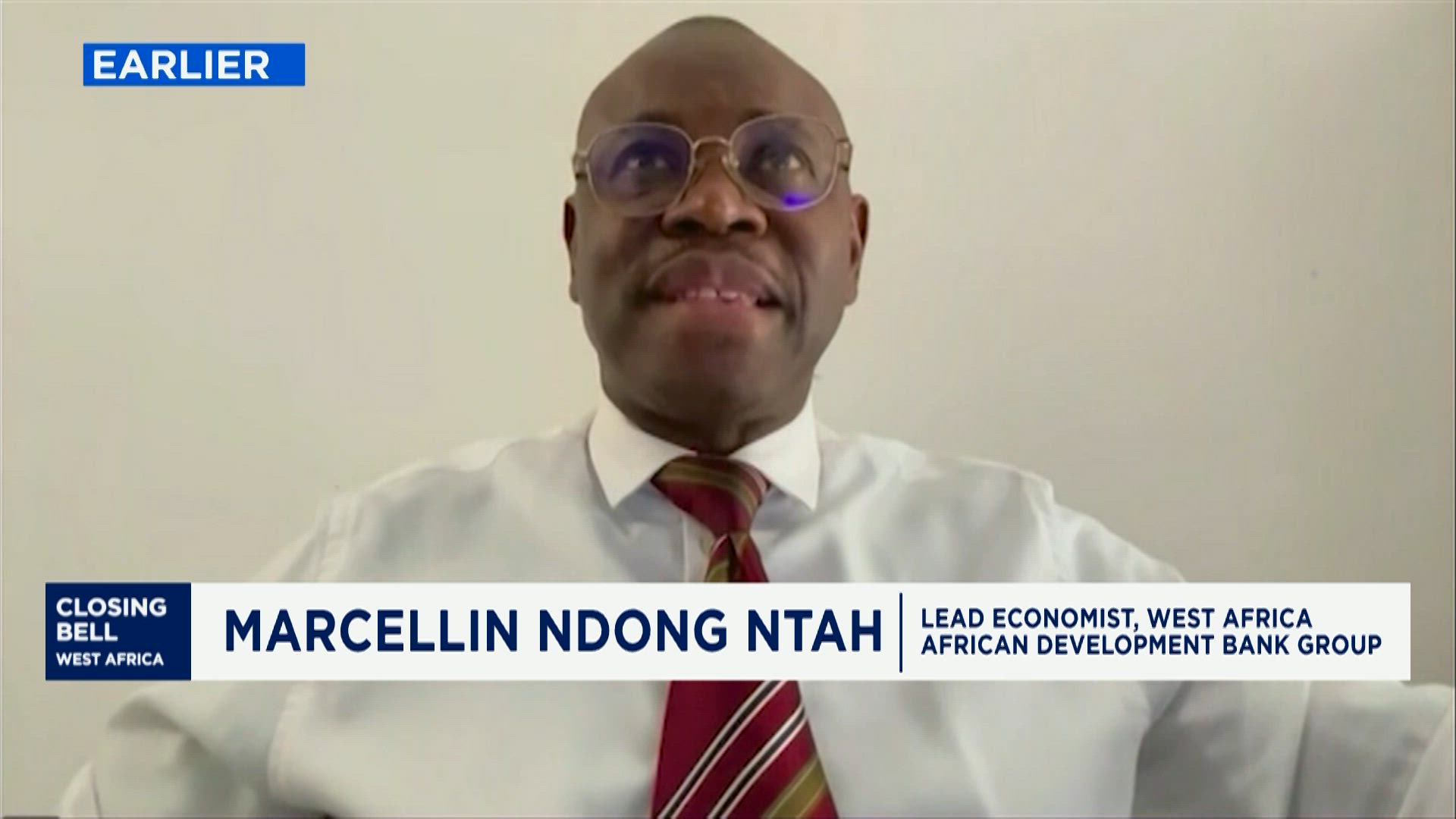
West Africa’s economy is projected to remain one of Africa’s fastest-growing regions, according to the African Development Bank in its West Africa Economic Outlook 2026. The report projects regional growth of 4.7 per cent in 2026, supported by agriculture, mining, hydrocarbons and infrastructure investment, while highlighting the need to strengthen domestic resource mobilisation, deepen financial markets and mobilise long-term capital to finance sustainable development. Marcellin Ndong Ntah, Lead Economist for West Africa at the African Development Bank Group, joins CNBC Africa to unpack the report’s findings and the region’s outlook.
Thu, 30 Jul 2026 15:21:24 GMT
Disclaimer: The following content is generated automatically by a GPT AI and may not be accurate. To verify the details, please watch the video
AI Generated Summary
Key Points:
- The African Development Bank forecasts West Africa’s economy will grow 4.7% in 2026.
- The bank said agriculture, mining, oil and gas output, private consumption and public infrastructure investment will support expansion.
- A prolonged war in the Middle East could disrupt logistics and raise oil and fertilizer costs, creating downside risks for the region.
- The AfDB said better tax administration, improved public spending efficiency and deeper domestic financial markets are critical to closing Africa’s $90 billion to $100 billion annual development financing gap.
- The report called for structural transformation, export diversification and domestic-currency financing to improve resilience and make growth more inclusive.
Topics
African Development BankAfDBWest AfricaWest Africa Economic Outlook 2026Africa growtheconomic outlookdomestic reopment financing gapMarceline NdongtaCNBC Africa
- The African Development Bank expects West Africa’s economy to grow 4.7% in 2026, keeping the region among the fastest-growing in Africa.
- The bank said growth should be supported by agriculture, mining, hydrocarbons, private consumption and sustained public investment in infrastructure.
- It warned that a prolonged conflict in the Middle East could raise energy, logistics and fertilizer costs, posing a major risk to the outlook.
- The report said stronger domestic resource mobilization, deeper financial markets and structural reforms are needed to close Africa’s annual development financing gap of about $90 billion to $100 billion.
West Africa’s economy is projected to expand 4.7% in 2026, the African Development Bank said, as stronger agricultural output, mining activity, hydrocarbons production and infrastructure investment keep the region on track to remain one of Africa’s most resilient growth areas despite mounting external risks.
In its West Africa Economic Outlook 2026, the AfDB said the region’s expansion is being underpinned by both demand-side and supply-side drivers, with sustained public investment in energy, logistics and transport combining with private consumption and expected gains in agricultural production.
“Economic growth of the region is supported by a number of factors from the demand and from the supply side,” said Marceline Ndongta, lead economist for West Africa at the African Development Bank, in an interview with CNBC Africa.
Ndongta said public investment in “key infrastructure areas like energy, logistics” and transport was helping support growth, while improved agricultural prospects and expanding output in mining, gas and oil were also expected to lift activity across the region.
She added that structural reforms already adopted by countries in the bloc were beginning to provide additional support to the medium-term outlook.
The bank’s projections come as several African economies continue to navigate elevated borrowing costs, currency pressure and external shocks, even as growth in parts of the continent has held up better than many advanced economies.
Still, the AfDB warned that geopolitical tensions remain a major threat to the region’s baseline forecast. Ndongta pointed to the risk of a prolonged conflict in the Middle East, saying it could disrupt logistics chains and raise the cost of critical imports including oil and fertilizer.
“One of the greatest major risks is about the prolonged war in the Middle East because that impacts actually the logistics, the access of oil, and also the fertilizer,” Ndongta said.
Those pressures could weigh on both food production and energy costs in import-dependent economies, while also feeding through to inflation and fiscal strains. Fertilizer prices are particularly important for West African farm output, given the sector’s central role in employment, incomes and export earnings.
Ndongta said governments, alongside multilateral institutions including the AfDB, were putting buffers in place to limit the negative effects of such shocks. She did not specify which country-level measures were most advanced, but framed resilience-building as a central policy priority.
A major theme in the report is how West African countries can fund development more sustainably at a time when Africa’s broader development financing gap is estimated at roughly $90 billion to $100 billion a year.
According to Ndongta, the report argues that countries in the region can close much of that gap through better policy choices rather than simply higher tax rates.
“West African countries like other African countries can really finance themselves if they make good choices in terms of domestic re and more efficient public spending could unlock reent priorities
That focus on domestic rernments seek to reduce reliance on volatile external financing, hard-currency debt and commodity-linked revenues
The AfDB economist also said growth alone would not be enough unless it translated into higher living standards and broader poverty reduction. She described the challenge as requiring a “dual track strategy” in which governments both lift economic efficiency and ensure that poorer households can participate in, and benefit from, expansion.
Ndongta identified four broad channels to drive stronger per-capita growth while making it more inclusive. These include promoting structural transformation and sector diversification, improving human capital and labor productivity, expanding market access and financial inclusion, and implementing institutional and fiscal reforms.
Those reforms are especially relevant in a region where headline GDP growth has not always translated into sufficient job creation or broad-based gains in household incomes.
On tax reform, Ndongta pointed to five areas that could help countries broaden the tax base and improve collection efficiency without increasing the overall tax burden on households.
She said governments should digitalize and modernize tax administration, integrate and formalize the informal sector, rationalize tax incentives while combating fiscal evasion, strengthen property and environmental taxation, and restore tax compliance and civic engagement.
“There is no need to increase the level of taxation to population,” Ndongta said, arguing that better administration and enforcement can generate more revenue while preserving social and political support.
The report also places heavy emphasis on building resilience to future shocks, an issue that has become more urgent after repeated disruptions from global inflation, tighter financial conditions and geopolitical conflict.
Ndongta said one policy priority is to deepen financial sustainability through domestic relow-productivity activities into higher-productivity sectors that can create better jobs and more stable income streams
She also called for a shift toward domestic-currency financing to reduce exposure to external debt risks. Diversifying exports andrdependence on one or two raw materials
That message aligns with broader policy debates across Africa about how to move from commodity dependence toward more diversified and value-added production, especially as governments look to strengthen resilience against imported inflation and swings in global demand.
Ndongta also referenced the potential role of regional initiatives such as PAPSS, the Pan-African Payment and Settlement System, and the African Continental Free Trade Area in supporting resilience and growth, although she did not go into detail on specific policy recommendations tied to those frameworks.
Her broad recommendation was for countries to build on progress already made while reducing inefficiencies that continue to weigh on investment and cross-border economic activity.
The AfDB’s 2026 outlook suggests West Africa has room to maintain solid momentum if reform efforts continue and external shocks remain contained. For investors and policymakers, the next test will be whether governments can turn that growth into stronger domestic revenue, more inclusive gains and a more resilient financing model.
ChooseCNBC Africaas your preferred in business news
Join readers across the continent. It’s free, and you can unsubscribe at any time.

