

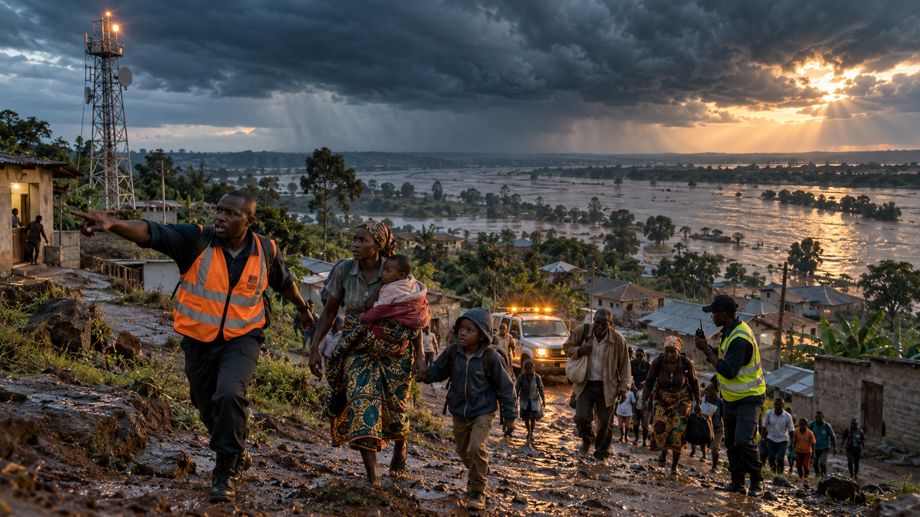
Africa’s Warning Gap: Can Better Forecasts Protect All Communities Before Disaster Strikes?
The Addis Ababa Call to Action urges <a href="https://absafricatv.com/south-african-economy-contracts-0-2-in-second-quarter-ending-6/” title=”South African economy contracts 0.2% in second quarter, ending 6″>African governments and partners to convert improved weather forecasting into clear, trusted warnings backed by reliable funding and early-action plans. Its success will depend on whether alerts reach vulnerable communities in time and provide the practical support needed to protect lives, livelihoods and infrastructure.
Africa’s effort to protect communities from floods, droughts, storms and other hazards is entering a decisive phase as governments confront the gap between predicting extreme weather and preventing its worst consequences. The Addis Ababa Call to Action, issued after the Africa Early Warnings Forum in Ethiopia from September 2 to 4, 2026, urges public institutions and their partners to build warning systems that people can understand, trust and use before disaster strikes.
The forum brought together more than 400 participants from over 50 African countries, including government officials, humanitarian organisations, regional climate centres, development banks, scientists, community representatives and private companies. It was organised by the United Nations Office for Disaster Risk Reduction, the World Meteorological Organization, the International Telecommunication Union and the International Federation of Red Cross and Red Crescent Societies, in partnership with the African Union Commission.
Can Africa Turn Better Forecasts Into Safer Communities?
Africa has made visible progress since the United Nations launched the Early Warnings for All initiative in 2022, which seeks to protect every person through multi-hazard early-warning systems by 2027. Forty-one African countries now report on such systems, while their overall strength has reportedly more than doubled. Regional cooperation has also expanded through the Africa Multi-Hazard Early Warning and Early Action System.
Yet continental progress conceals substantial differences between countries and communities. Small Island Developing States, Least Developed Countries and fragile nations frequently lack reliable monitoring equipment, trained specialists, telecommunications coverage and long-term financing. Displaced families, informal settlements and communities in remote or conflict-affected areas are particularly likely to be missed.
The problem is not limited to forecasting accuracy. A technically sound warning cannot save lives if it arrives late, uses unfamiliar language or fails to explain what people should do. Residents must receive enough time and practical guidance to evacuate, protect homes, relocate livestock, secure crops or prepare for interruptions to water, electricity and transport.
Community participation is therefore essential. Residents understand local hazards, communication practices and evacuation barriers. Warning systems designed without that knowledge may overlook women, children, older people, persons with disabilities, Indigenous Peoples and families living beyond formal public services.
Why Early Warning Must Become Essential Public Infrastructure
The Call to Action asks African governments to treat early-warning systems as essential infrastructure rather than temporary projects financed primarily by international donors. This would require national budgets to support weather stations, forecasting technology, equipment maintenance, qualified personnel, local communication networks and preparedness programmes.
Such spending may be difficult for governments facing limited revenues, debt pressures and competing demands for healthcare, education, food security and infrastructure. International climate and development finance will remain important, especially for lower-income and fragile countries. However, donor-funded equipment offers limited value if national institutions cannot maintain it after a project ends.
Policymakers must also resolve institutional fragmentation. Meteorological services may generate forecasts, but disaster-management agencies, local authorities, health departments, schools and transport operators must know when and how to respond. Confusion over responsibility can delay decisions when every minute matters.
Early-warning plans should consequently be integrated across agriculture, healthcare, education, water, transport, urban planning and social protection. A drought forecast could trigger support for farmers, while a flood warning could prompt authorities to prepare clinics, close unsafe schools, clear drainage routes and assist high-risk households.
Will New Technology Reach the Last Mile?
Artificial intelligence, satellite information, shared data platforms and mobile networks could improve forecasting and distribute alerts more quickly. Cell broadcasts, radio, television, community volunteers and trusted local leaders can form a layered communication system that does not depend on any single channel.
Technology companies and telecommunications operators could help extend coverage and strengthen cross-border information sharing. Banks, insurers, energy providers, transport operators and agricultural businesses could also use earlier warnings to protect assets, adjust services and manage climate-related risks.
However, digital tools could deepen inequality if warning systems assume that everyone owns a connected mobile device or has dependable electricity. Governments must ensure that alerts are delivered in appropriate languages and accessible formats while combining advanced technology with community-based communication.
Greater digital dependence also creates cybersecurity and accountability risks. Common technical standards will be needed so national agencies, regional centres and private platforms can exchange information reliably. Governments must determine how data will be protected, who validates automated forecasts and who carries responsibility when systems fail.
Artificial intelligence may help specialists process large volumes of environmental data, but it should support rather than replace qualified professional judgment.
What Will Determine Whether the 2027 Target Delivers?
Warnings must be connected to early-action plans and financing arranged before a crisis. Humanitarian groups and public agencies require clear thresholds for releasing money, positioning supplies, supporting evacuations or protecting essential infrastructure.
Without such mechanisms, vulnerable families may receive an accurate warning but lack transport, safe shelter or the financial means to act. This is particularly important for people who cannot leave work, move livestock or relocate without immediate assistance.
The African Union Commission has reportedly been asked to coordinate implementation of the Call to Action. Its challenge will be converting a continental commitment into national plans with defined responsibilities, budgets, deadlines and measurable coverage targets.
Development partners should support durable national capability instead of creating parallel systems. Private companies will need clear rules covering affordability, interoperability, data governance and service continuity. Community organisations should be involved in design, testing and evaluation rather than being treated only as recipients of information.
The 2027 deadline should be regarded as a milestone, not the end of the effort. Success cannot be measured merely by the number of countries possessing warning systems or the volume of alerts issued. The meaningful test is whether warnings reach people in danger, produce timely action and reduce deaths, displacement and economic losses. Africa has growing access to the necessary science; lasting protection now depends on sustained political commitment, predictable investment and systems built around the realities of communities.

