

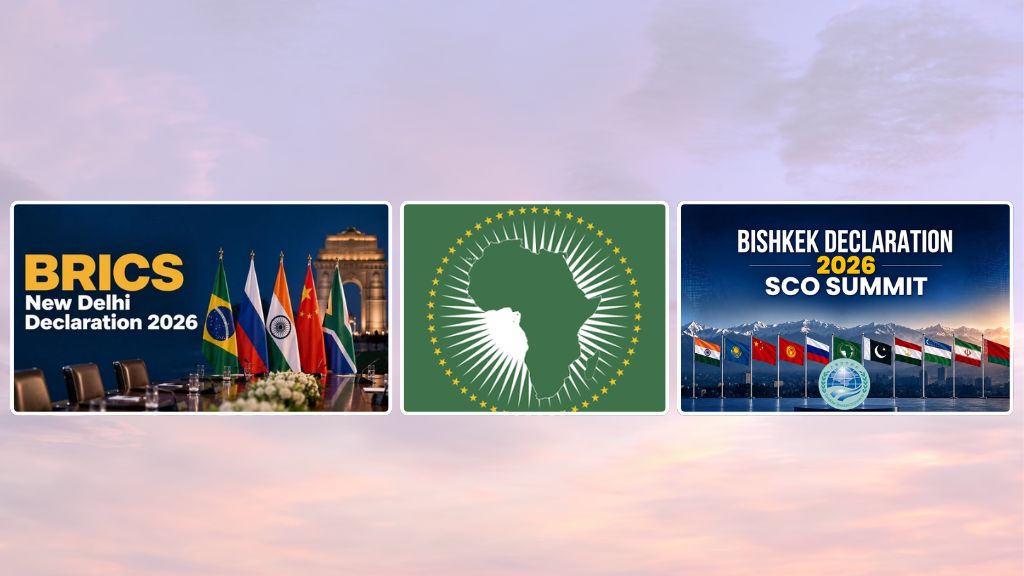
One of the most important economic consequences of the Shanghai Cooperation Organization’s recent September Bishkek summit is the institutional bridge that could allow dozens of already existing Russia-Africa, China-Africa, Central Asia-Africa and EAEU-Africa projects to begin operating within a wider Eurasian framework.
At the SCO Council of Heads of State in Bishkek, the Leaders from all 10 Shanghai Cooperation Organisation member states signed a Memorandum of Understanding between the SCO Secretariat and the African Union Commission. The decision was one of 28 documents approved at the summit. The official SCO account describes it as a decision to sign the MoU, rather than a detailed trade treaty, and the full text of the memorandum has not been publicly released. That distinction matters. There is no publicly disclosed tariff package, investment fund, quantified trade target or binding infrastructure programme attached to the MoU.
But the economic significance lies elsewhere: the agreement creates an organisation-to-organisation channel between the SCO’s 10 member states and the African Union’s 55 countries at precisely the moment when Eurasian transport, payment, industrial and digital networks are being reorganised. The opportunity is therefore not to create Africa-SCO economic relations from zero. It is to connect economic systems that are already expanding separately. Moreover, the recently concluded 2026 BRICS Summit in India and its results have given a strong boost to Africa-Eurasia connectivity, economic initiatives, financial cooperation, and more. We also examine the SCO-Africa and BRICS-Africa engagements and how they can complement each other.
Recent forms of engagement between Russia-Africa, China-Africa, BRICS-Africa and India-Africa suggest that major SCO countries are increasingly engaging with African countries to expand economic cooperation, trade, business, investment, logistics, and connectivity.
This trend is also becoming increasingly visible within the BRICS framework and appears to be extending into the SCO-Africa context. The growing institutionalization of SCO-Africa engagement could create significant opportunities for strengthening economic and commercial relations between SCO member states and African countries.
The participation and engagement of African countries in the SCO-Africa format will enhance trade, connectivity, investment, business cooperation, and broader economic integration between the SCO and Africa. Looking ahead, it is important to analyze how these emerging relationships can be further developed, institutionalized, and connected in order to promote mutually beneficial economic cooperation between SCO member states and African countries.
From A Security Bridge To An Economic Platform
The relationship has deeper roots than the Bishkek decision suggests. In December 2018, the SCO Regional Anti-Terrorist Structure and the African Union’s African Centre for the Study and Research on Terrorism signed a cooperation memorandum in Algiers. At that time, no African country had formal status within the SCO.
The 2026 initiative is broader because it moves the relationship from a specialised security channel to the level of the SCO Secretariat and AU Commission. Egypt became the first African dialogue partner of the SCO after the September 2022 Samarkand summit.
Prior to this, Cairo had already developed an important security infrastructure linking African and Eurasian interests. In November 2021, Egypt activated the 14,300-square-metre CEN-SAD Counterterrorism Centre, involving the security networks of 27 Sahel-Saharan states and backed by a commitment of 2,000 military scholarships. The centre therefore sits at an unusual intersection of AU, African regional and SCO security structures.
This history explains why the economic relationship is developing faster than a formal membership process. Security cooperation created confidence; dialogue-partner status created political access; the new SCO-AU institutional channel now provides a framework for economic coordination.
The timing is important. The SCO has grown from six founding members in 2001, China, Kazakhstan, Kyrgyzstan, Russia, Tajikistan and Uzbekistan, to 10 members after the accession of India, Pakistan, Iran and Belarus. These member states account for more than 3.4 billion people, around 40% of the global population, and roughly25% of global economic output according to figures cited in the summit analysis. Africa adds another 55 states to the potential institutional network. This does not mean a 65-country (55+10) free-trade bloc has suddenly appeared. It means that a platform now exists through which existing bilateral and regional mechanisms can be connected.
The Real Economic Prize Is Logistics And Connectivity
The most important long-term question is not whether SCO-Africa trade grows by another few percentage points. It is whether Eurasian transport corridors can physically reach African ports and markets.
Central Asia is the natural starting point. Kazakhstan, Kyrgyzstan, Tajikistan and Uzbekistan sit between China, Russia, South Asia, the Caspian region and West Asia. The China-Kyrgyzstan-Uzbekistan railway is particularly important because it creates another east-west and potentially southward axis. During the 2026 visit to Kyrgyzstan, Chinese President Xi Jinping again stressed the importance of building the railway to a high standard and modernising border crossings and related “soft connectivity”. Kyrgyz President Sadyr Zhaparov has previously described the project as being as indispensable to his country as air and water. This economic logic does not stop in Central Asia. Once railways, highways and logistics hubs are connected, their commercial geography can extend towards the Middle East, the Red Sea and Africa. That is why the SCO’s 2026-2030 ports-and-logistics action plan is particularly relevant to the new AU relationship. The Bishkek package also includes work on transport connectivity, digital transit, regional data-processing and artificial-intelligence infrastructure. These initiatives provide the “hardware” and “software” that an SCO-AU economic relationship would require.
Russian officials have also examined the possibility of establishing a logistics hub and cargo base on Africa’s eastern coast as an extension of theInternational North-South Transport Corridor (INSTC). Kenya and Mozambique have been identified as potentially suitable locations. Such a hub could eventually handle SCO-origin cargo moving into African markets while providing a collection point for African minerals and agricultural products heading north.
The Emergence Of Egypt As An Asian Gateway To Africa
Egypt provides the second major gateway as under normal usage, approximately 12% of global maritime trade passes through the Suez Canal. For China, Russia, Central Asia and other SCO economies, Egypt is therefore not simply an African market; it is a logistics junction connecting the Mediterranean, Red Sea, Middle East and the African hinterland.
During his historic state visit to Egypt in early September 2026, Chinese President Xi Jinping signed more than 20 cooperation agreements with Egyptian President Abdel Fattah el-Sisi covering areas such as artificial intelligence, renewable energy, and the expansion of the Suez Canal Economic Zone. The two leaders also issued a joint statement aimed at deepening the China-Egypt Comprehensive Strategic Partnership, including commitments to develop a new regional security architecture, promote the use of local currencies in bilateral trade, and strengthen military, infrastructure, and economic cooperation.
Egypt is both an important political actor in Africa and a significant regional economy, while China has emerged as one of Africa’s most important economic partners. Against this backdrop, the deepening China-Egypt relationship could have broader implications for the evolving SCO-Africa relationship. Egypt’s participation as a dialogue partner at the recently concluded SCO Summit in Bishkek further strengthens this potential connection. In this context, Egypt can serve as an important bridge between the SCO and African countries, particularly by facilitating cooperation in trade, investment, infrastructure, logistics, energy, and connectivity. The China-Egypt experience therefore provides a useful model for examining how bilateral partnerships between major SCO economies and key African states could contribute to the gradual institutionalization and expansion of SCO-Africa engagement.
Egypt is also the most developed example of an African country positioning itself between the SCO and the wider Eurasian economy. At the 30 August 2025 SCO Plus summit in Tianjin, Egyptian Prime Minister Mostafa Madbouly secured a reported US$1 billion commitment from China Energy Engineering Corporation for renewable-energy and desalination projects. The company also agreed to relocate its regional headquarters to Cairo.
Additional cooperation covered electric-vehicle manufacturing in the Suez Canal Economic Zone and renewable energy. This is important because it demonstrates the difference between political participation and economic integration. Egypt did not need to become an SCO member to attract SCO-linked capital and technology. Its value came from its geography, infrastructure and position as a bridge between Africa, Asia and the Middle East.
The same logic is visible in the nuclear sector. Rosatom’s El-Dabaa nuclear power project remains the flagship Russian energy project in Africa, while discussions over a major nuclear power project and a nuclear science and technology centre in Ethiopia have also been reported. The Ethiopian concept has particular development implications because research-reactor capacity can support medical isotope production and agricultural applications in addition to energy-related scientific development. Thus, the economic relationship is already moving beyond commodities. It includes nuclear technology, desalination, renewable energy, electric vehicles, logistics and industrial localisation.
India-Africa Trade
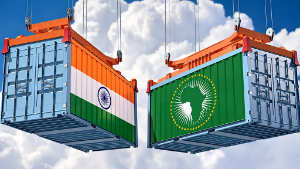
Recent India-Africa engagements demonstrate a growing focus on expanding trade, investment, business partnerships, and connectivity. India-Africa trade has reached around US$36.7 billion, while business forums and project partnerships are increasingly connecting Indian companies with African governments and investors, creating opportunities in infrastructure, digital connectivity, energy, manufacturing, and logistics. These developments indicate that India-Africa bilateral cooperation is gradually evolving into a broader economic partnership with potential implications for wider multilateral frameworks such as SCO-Africa engagement.
Although these engagements are primarily bilateral in nature, the SCO Secretariat could potentially transform such bilateral partnerships into a broader multilateral and institutionalized framework. In this context, establishing an effective cooperation framework between the SCO and the African Union (AU) could be a feasible and valuable initiative, providing an institutional platform to consolidate existing bilateral engagements and promote wider cooperation in trade, investment, connectivity, infrastructure, security, and economic development.
Russia-Africa Trade
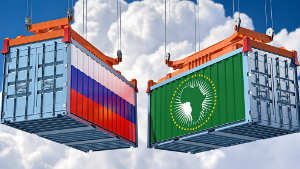
Russia-Africa bilateral trade reached a record US$27.7 billion in 2025, while Russian agricultural exports to Africa rose sharply in H1 2026 to US$2.9 billion, with wheat accounting for over 90% of volumes and Egypt taking the largest share. Russia’s overall exports to Africa reached about US$10.7 billion, compared with around $2.2 billion of imports, reflecting Moscow’s efforts to expand trade and diversify markets.
Russia’s FESCO Transport Group has expanded regular maritime container services from Russian ports to Durban, South Africa, and Dar es Salaam, Tanzania,g about 45 days
The Tanzania route already carries Russian plastics and industrial spare parts and is expected to bring back African tea, coffee and agricultural goods. Russia is also exploring an African extension of the INSTC, with Russian Railways studying rail projects in Burkina Faso, Ghana, South Africa and potentially Libya. These plans aim to connect Russian and Eurasian supply chains with African rail, road and port networks through Iran, the Persian Gulf and the Indian Ocean.
The Russian government has provided about ₽1.2 billion (US$14 million) in logistics subsidies for priority shipments to African and Latin American markets, including Senegal, South Africa and Tanzania, while support is expected to broaden. In addition, Russia is developing industrial and logistics hubs, including plans for an industrial zone in Egypt’s Suez Canal Economic Zone, combining maritime routes, rail corridors, subsidies and industrial investment to strengthen long-term Russia–Africa connectivity. Construction work starts next years and the zone should be ready for occupation by mid-2030. It will offer Russian manufacturers the opportunity to export component parts, integrate them with African sourced components, and sell the finished product either back to the CIS markets or onto the wider African market.
Russia Has A Direct Economic Interest
For Russia, the African Union memorandum could become useful as an institutional mechanism for market diversification. Russia’s established African trading partners include Egypt, Algeria, Morocco, South Africa, Nigeria and Tunisia. Cooperation spans agriculture, energy, mining and industrial products.
The commodity logic is especially strong. The document cites Russian domestic deficits in manganese, uranium, chromium, titanium and bauxite at 97%, 82%, 60%, 59% and 50% respectively, while Africa possesses major resources of these and other minerals. This creates a two-way commercial equation. Africa needs machinery, fertilisers, energy, transport equipment, technology and industrial investment. Russia needs access to minerals and expanding consumer and infrastructure markets. The most important change would be to shift the relationship from extraction and commodity trade towards processing.
This is precisely where the new SCO-AU mechanism could become more valuable than a conventional trade agreement. Belarus and Russia, for example, have discussed exporting automobiles, agricultural machinery and other equipment and developing local automotive production in Africa. The EAEU has already developed institutional relations with the African Union and COMESA, while cooperation with the East African Community and Economic Community of Central African States has also been discussed. EAEU-Africa trade increased 3.5% in 2022 and was reported to have grown 15.5% during the first four months of a later reporting period. The proposed Eurasian business mission to Africa is therefore important.
EEC Chairman Mikhail Myasnikovich proposed a “Eurasian technologies – a common future” approach involving technology transfer, localised production, specialist training, scientific cooperation and information and communications technologies. Russian Deputy Prime Minister Alexei Overchuk said EAEU business representatives from agriculture, transport, industry, mineral processing, energy and digitalisation were expected to participate. This is precisely the type of practical mechanism the SCO-AU relationship now needs.
The Sahel Adds Re
Russia’s July 2026 African diplomacy adds another dimension. Foreign Minister Sergey Lavrov’s African tour, undertaken ahead of the planned October 2026 Russia-Africa summit in Moscow, focused strongly on Mali, Burkina Faso and Niger, the three members of the Confederation of Sahel States. The economic potential is substantial. Niger ranks seventh globally in uranium reserves, while Mali and Burkina Faso are among Africa’s major gold producers. The region also possesses underdeveloped deposits of lithium, manganese and phosphate. Russia’s stated interest increasingly goes beyond extraction towards processing and industrial development.
In Niamey, Russia and the Sahel states also agreed on regular foreign-ministry consultations and discussed expanding the 3+1 mechanism into economic and financial cooperation. It is estimated that the Russian military and instructor presence in the wider region at roughly 3,000-3,500 personnel. For the SCO-AU relationship, this creates both an opportunity and a limitation. Infrastructure, mining and industrial projects cannot be scaled without security. The earlier SCO-AU counterterrorism relationship can therefore become economically relevant: security cooperation reduces the political and physical risks that otherwise discourage investment. This is why the economic and security tracks should not be treated as separate stories.
Togo Could Become A West African Gateway
Togo illustrates how smaller African economies can become strategically important within a Eurasian-African network. The country possesses the deep-water port of Lomé, described in the source material as the only deep-water port in West Africa. Officials and analysts have consequently viewed Togo as a potential gateway for Russian and Belarusian goods into the region. In March this year, Russian Defence Minister Andrei Belousov visited Togo as part of ongoing military cooperation between the two countries as well as to secure port access.
At the Bishkek SCO Plus meeting, Togolese Council of Ministers Chairman Faure Essozimna Gnassingbé argued that multipolarity should give African countries more choices rather than force them into new blocs. He specifically identified production, technological investment, infrastructure, raw-material processing and value creation as African priorities. His message is commercially important.
African governments are increasingly looking for partnerships that create factories, processing capacity, technology transfer and employment rather than simply exporting raw materials. Togo also offered a practical follow-up: during his meeting with Belarusian President Alexander Lukashenko, Gnassingbé proposed a large joint business forum in 2027 involving other African countries. That could eventually provide a commercial bridge between Russian, Belarusian and wider EAEU industrial companies and West African markets.
Digitalisation Is Already Creating An Africa-Eurasia Business Channel

The emerging relationship is not confined to ports and commodities. The June 2026 international IT forum in Khanty-Mansiysk involved representatives from almost 50 countries and included BRICS and SCO participation. Angola and Zimbabwe showed interest in Yugra’s technological solutions. Angola, an oil-producing country, was particularly interested in digital technologies for hard-to-recover oil. According to Yugra Governor Ruslan Kukharuk, digital solutions had reduced field-development costs by 2.5 times in relevant projects.
Zimbabwe has showed interest in an AI-supported forest-monitoring system capable of detecting illegal logging. AI-based medical diagnostics were also presented. Angolan Ambassador Augusto da Silva Cunha linked the opportunity to university education and technology departments, indicating that training could accompany technology transfer. This is an important model for future SCO-AU cooperation: technology should be exported together with skills, universities, localisation and industrial applications.
Finance Will Determine Whether The MoU Becomes Economically Significant

The largest weakness in the current SCO-Africa relationship is not demand. It is finance. The Bishkek summit again placed discussion of an SCO Development Bank and broader financial cooperation mechanisms on the agenda. Belarusian analysis stressed the idea of financial sovereignty, while Russian economists have discussed integrating national payment systems and establishing clearing mechanisms. One estimate suggests that transferring 30-40% of mutual SCO trade onto such alternative settlement infrastructure could represent US$700-800 billion in transactions and reduce banking costs by billions of dollars. This is an expert estimate rather than an existing settlement volume, but it illustrates the scale of the potential. Africa has a parallel requirement. The continent is developing the African Continental Free Trade Area and has repeatedly debated how to reduce dependence on external currencies and payment systems. The strategic opportunity is therefore obvious: if SCO financial mechanisms mature, African regional institutions could eventually connect to them. But this remains a future possibility, not an existing institutional arrangement.
The Scale Of The Market Changes The Calculation
The SCO’s internal economic scale is already approaching a critical threshold. Trade between SCO members is described in the Bishkek material as approaching US$1 trillion. Kazakhstan President Kassym-Jomart Tokayev called for pilot industrial consortia, cross-border trade zones and digital transit platforms. For Africa, access to this market matters more than symbolic association with the SCO. The earlier figures demonstrate the trajectory.
In 2021, SCO members had combined GDP of about US$23.3 trillion, nearly one-quarter of global GDP. China’s trade with SCO members reached US$343.1 billion in 2021, 28 times the 2001 level and 40% higher year-on-year; Chinese direct investment in SCO member countries had exceeded US$37.5 billion by June 2022.
Today, the SCO has a combined GDP (PPP) of approximately US$80 trillion, representing about 35% of the total global economy. These figures show why African governments view the SCO network as commercially relevant.
Agriculture, Food Security And Industrialization Offer The Fastest Gains
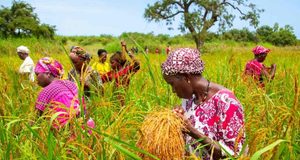
Agriculture could become one of the easiest areas for practical cooperation. Russia and other EAEU members can supply grain, fertilisers, agricultural machinery and processing technologies, while African economies offer growing consumer markets and agricultural commodities. Africa’s demographic structure reinforces this demand: the source material cites a median age of 19, with about one million young Africans entering the labour market every month. The stronger model, however, is not simply shipping grain and machinery to Africa. It is establishing local processing plants, machinery assembly, storage facilities, logistics centres and agricultural training systems. That approach would align the SCO-AU relationship with the African demand for value addition expressed by Togo and other African policymakers.
Tourism And People-To-People Links Should Not Be Overlooked

Tourism is already included in the SCO’s expanded economic agenda. The Bishkek summit discussed tourism alongside trade, investment, energy, industry and new technologies, while Lahore was designated the SCO Tourism and Cultural Capital for 2026-2027. For Africa, Egypt is again the natural starting point, followed by Morocco, South Africa, Kenya and other established tourism markets. Greater air connectivity, simplified visa procedures, educational exchanges and cultural programmes could eventually turn the economic relationship into a broader people-to-people network. The SCO’s evolution from a security-focused organisation towards trade, investment, energy, transport, digitalisation, education, health and culture makes this possible.
The Immediate Challenge Is Implementation

The most important caution is that the Bishkek MoU should not be overstated. The official SCO release confirms that the leaders decided to sign the memorandum. It does not publish a detailed trade schedule, investment target, financing commitment or project list. The same release says 28 documents were approved and places the AU memorandum among the summit’s institutional decisions. This means the real test begins after the summit.
The first practical step can be expected to reveal an SCO-AU economic working mechanism bringing together the SCO Secretariat, AU Commission, EEC, development-finance institutions and relevant ministries. Its agenda should be concrete: a Eurasian-African logistics map, priority ports, customs digitalisation, national-currency settlements, industrial parks, mineral processing, agricultural machinery, energy projects and digital technology.
The second step is likely to involve country clusters being developed, rather than an attempt to treat all 55 African states identically. Egypt can lead the Mediterranean-Red Sea corridor; Kenya and Mozambique can serve the eastern maritime route; Togo can provide a West African logistics gateway; Ethiopia can develop nuclear science and energy cooperation; Angola and Zimbabwe offer digital and energy-technology opportunities; Mali, Burkina Faso and Niger represent a resource-processing and security-intensive frontier.
The BRICS membership makeup already reveals this strategy: Egypt in North Africa, Ethiopia to the east, and South Africa to the south. This is further augmented by BRICS Partners Nigeria in the West and Uganda in Central Africa.
The third step will be financing. Without credit, insurance, settlement mechanisms and project preparation, infrastructure corridors remain maps rather than trade routes.
The Real Significance: Formalizing African Integration With Eurasia
The SCO-AU memorandum is therefore best understood not as a conventional trade agreement but as an institutional switch. For the first time, the SCO’s economic geography and the African Union’s continental architecture have a formal organisation-to-organisation channel. That channel arrives when SCO trade is approaching US$1 trillion, EAEU-Africa trade is growing, Russia is expanding industrial and energy engagement in Africa, China is deepening Egypt-centred connectivity, Belarus is examining West African gateways, and Central Asian transport corridors are moving towards the Middle East and potentially the Red Sea.
The key economic idea is simple: Africa does not need another declaration about partnership with Eurasia; it needs access to Eurasian infrastructure, technology, finance and markets. The SCO does not need another external dialogue for its own sake; it needs commercially useful southern extensions for the transport, industrial and financial systems it is building inside Eurasia. That is where the interests converge.
The Bishkek MoU provides the institutional bridge. The China-Kyrgyzstan-Uzbekistan railway can provide part of the land connectivity. Suez, Lomé, Kenya and Mozambique can provide maritime gateways. Russia and Belarus can provide industrial machinery, energy and processing technologies. China can provide infrastructure and digital capacity. India can add pharmaceuticals, services and technology. Central Asia can serve as the transit and production interface between China, Russia, South Asia and western markets.
If these pieces are connected, the SCO-AU relationship could develop into something considerably more important than a diplomatic memorandum: a framework for a new Eurasian-African commercial corridor. The first 25 years of the SCO were largely about building the organisation. The next stage is about making its networks useful beyond its original geography. The African Union memorandum approved in Bishkek is significant precisely because it gives that expansion an institutional address.
Africa’s 2026 BRICS Summit Complements The 2026 SCO-Africa Agenda
The BRICS Summit in New Delhi on 12-13 September 2026 gave the Africa-BRICS relationship a much more concrete economic and institutional dimension, with Egypt, Ethiopia and South Africa participating as full BRICS members alongside African BRICS partners Nigeria and Uganda, while African leaders also used the summit to push infrastructure, industrialization, trade, finance, digitalization and reform of global institutions.
Africa’s BRICS engagement strengthened cooperation on trade, investment, infrastructure, energy, food security, digitalization, AI, payments and industrialization, areas that closely overlap with the emerging SCO-Africa framework. The summit adopted the 140-paragraph New Delhi Declaration, the longest BRICS leaders’ declaration to date, covering political and security affairs, trade, finance, health, energy, AI, digital economy, climate, agriculture, industrial cooperation, education and people-to-people links.
The New Delhi Declaration’s emphasis on local-currency settlements, digital connectivity, technology transfer, value addition and stronger African representation in global governance complements the SCO-AU economic agenda.
For Russia, meetings with Egypt, Ethiopia and South Africa reinforced practical links in nuclear energy, logistics, agriculture, education, technology, trade and investment. Together, BRICS and SCO-Africa mechanisms will connect African markets and reacity and digital infrastructure, turning parallel partnerships into wider economic connectivity
South African President Cyril Ramaphosa explicitly placed African priorities around intra-BRICS trade and investment, industrialization, value addition and mobilization of investment into African infrastructure under the African Continental Free Trade Area, while his BRICS Business Forum agenda included supply chains, agriculture, women-led development, the digital economy and innovation.
Ethiopian Prime Minister Abiy Ahmed brought the interests of one of Africa’s fastest-growing large economies into the BRICS framework, while Egyptian President Abdel Fattah el-Sisi participated in the closed session on “Inclusive Global Governance and Strengthening Multilateral Action”; the declaration specifically backed greater representation of developing countries, including Africa, in global decision-making and supported Ethiopia’s WTO accession bid. It also noted China’s expansion of zero-tariff treatment to 53 African countries with which it has diplomatic relations.
The Africa connection was particularly visible in the declaration’s institutional and economic language: BRICS supported African representation in the UN system, recognized the continent’s development needs, addressed food and health security, digital transformation, infrastructure, energy, industrial value chains and finance, and welcomed Ethiopia’s African Union-endorsed candidacy for an additional ICAO Council seat.
The declaration also established or advanced practical mechanisms covering BRICS cross-border payments and local-currency settlements, multilateral guarantees, AI governance, digital health, early-warning systems for infectious diseases, smart grids, energy storage, Industry 4.0, SME cooperation, urbanization, statistical cooperation, intellectual property, tourism and digitalisation.
The New Development Bank (NDB) has become an important source of development finance for Africa, with South Africa receiving significant support for infrastructure and municipal development. In June 2026, the NDB approved a US$1 billion programme to upgrade municipal infrastructure across South Africa’s eight metropolitan municipalities. Egypt joined the NDB in 2023, while Algeria joined in 2025, further expanding the Bank’s African membership and potential project base. Russia, as one of the NDB’s founding members, continues to engage with the Bank and its development agenda, creating scope for greater NDB involvement in African projects. This growing engagement could support further financing in Africa’s infrastructure, energy, transport and connectivity sectors and strengthen broader BRICS-Africa economic and financial cooperation.
Summary
This BRICS–Africa architecture now intersects directly with the SCO–Africa institutional track established at the Bishkek SCO summit, where SCO leaders approved the decision to sign an MoU between the SCO Secretariat and African Union Commission.
That SCO arrangement links 10 SCO members with the AU’s 55 countries, but it remains an institutional cooperation channel rather than a tariff or free-trade agreement: there is currently no disclosed SCO–AU tariff package, investment fund, quantified trade target or binding infrastructure programme.
Its practical agenda nevertheless overlaps strongly with New Delhi: the SCO is working on ports and logistics, digital transit, data-processing and AI infrastructure, while the BRICS declaration is building cooperation around payments, AI, digital health, energy, industrialization and trade.
The potential complementarity is therefore significant: BRICS provides the broader economic-financial platform and African political representation, while SCO–AU cooperation can connect Eurasian rail, logistics, ports, energy and digital networks with African markets.
Egypt is particularly important because about 12% of global maritime trade passes through the Suez Canal, while the SCO analysis identifies Egypt as a Mediterranean–Red Sea gateway; Kenya and Mozambique could support an eastern maritime route and Togo a West African gateway.
The BRICS 2026 outcomes thus move the Africa connection beyond representation: the emerging agenda is increasingly about who finances African infrastructure, how goods move between Eurasia and Africa, how local currencies and payment systems reduce transaction barriers, how African minerals are processed locally, how AI and digital technologies are transferred with skills and training, and how BRICS and SCO mechanisms are connecting with AfCFTA and African regional markets.
The next step forward is the Russia-Africa Summit being held in Moscow next month. The Africa-Eurasian integration process is gathering steam – and moving ahead.
This article was an expert and reporter on African-Russian affairs for RPA. She may be contacted atinfo@russiaspivottoasia.com
Continue Reading
Russia To Open Embassies In Another Four African Countries
AfricaBRICSEnergyExportsFinanceImportsInfrastructureInvestmentLogistics & TransportRussiaShanghai Cooperation OrganisationTrade

