

The hosts’ stunning Test victory was overshadowed by the scale of national angst felt in Australia after the team’s ball tampering
For South African cricketers, administrators and supporters, the most surprising aspect of the Sandpaper scandal was not that it happened. After all, the ball had been suspiciously reverse-swinging during the first two Tests of that ill-fated series in 2018. The atmosphere had turned febrile after a stairwell bust-up between Quinton de Kock and David Warner in Durban and after supporters directed misogynistic abuse at Warner and his family in Gqeberha. Nathan Lyon had promised before the tour to “head-butt the line” of what was acceptable. Darren Lehmann, then Australia’s coach, came from an old school where bullying was sugar-coated with the phrase “mental disintegration”.
No, what surprised South Africans most was the scale of the fallout, and how one tiny piece of sandpaper could cause so much national angst.
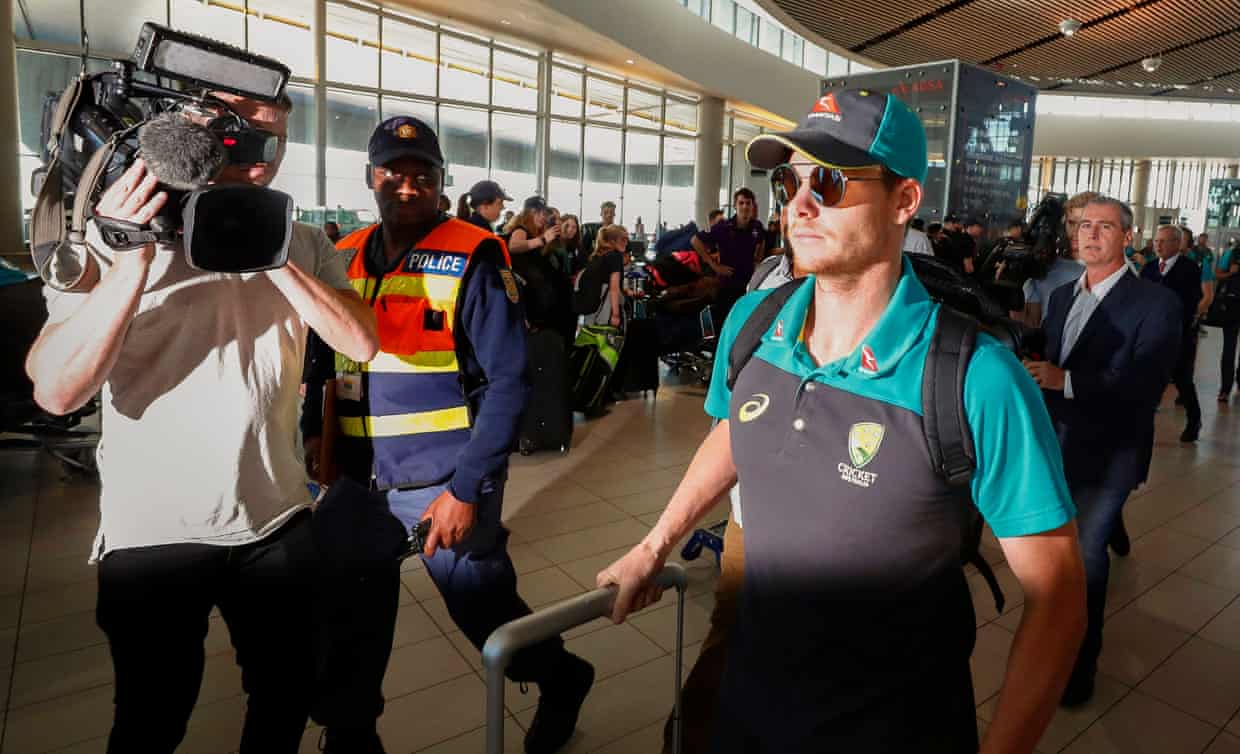
Australia’s prime minister weighed in. Steve Smith and Warner were stripped of the captaincy and vice-captaincy and banned for a year. Cameron Bancroft, the 25-year-old who many believed was press-ganged into the act, received nine months. Lehmann resigned. Smith was marched through Johannesburg airport surrounded by police and cameras before breaking down in tears at a press conference in Sydney, his father standing behind him.
To Australians, this was a national disgrace. A sign of how far the team, perhaps even the country, had fallen. To many South Africans, the response was surreal.
“We thought it would be a big news story and then blow over,” says Faf du Plessis, who was South Africa’s captain in 2018.
Du Plessis is uniquely qualified to weigh in. Between making his Test debut in 2012 and the series in 2018, Du Plessis was twice found guilty of ball tampering. First, against Pakistan in 2013, he was caught rubbing the ball on his zipper. Then, in 2016 in Australia, he was seen applying saliva to the ball while sucking a mint in a brief but inflammatory furore known as “mintgate”.
His response to the 2018 scandal was therefore not outrage but recognition. “It’s a pressure cooker, isn’t it?” Du Plessis says. “You’re under so much pressure that eventually the lid blows off.”
There is an obvious temptation to draw a moral distinction between Australian and South African cricket, to present the tourists as villains and the hosts as innocents. That would be too neat and also inaccurate.
The treatment of Warner’s wife, Candice, was disgraceful. Two Cricket South Africa (CSA) officials were photographed smiling alongside supporters wearing Sonny Bill Williams masks designed to humiliate her. Kagiso Rabada, South Africa’s leading wicket-taker across the series, was initially suspended after making contact with Smith while celebrating his dismissal. CSA responded by roping in one of the country’s leading advocates, who successfully argued on appeal for the charge to be downgraded. South Africa were not above the muck. They were knee-deep in it.
But perhaps that is precisely why the Australian reaction seemed so extraordinary from across the Indian Ocean. South Africa’s Vernon Philander, who played all four Tests, still believes the punishment handed to Smith and Warner was “a little bit outrageous”. He was even more perplexed by the political intervention. “For a prime minister to get involved … I don’t think there was a need for that,” he says.
South Africans may have been less inclined to regard ball tampering as an existential offence. Michael Atherton, Sachin Tendulkar and Shahid Afridi are among the cricketers who have been handed sanctions over the condition of the ball. None prompted anything resembling the crisis that engulfed Australia in 2018.
This is not to minimise what Australia did. Sandpaper was a particularly brazen means of altering the ball and the attempts to conceal what happened compounded the offence. Yet the scale of the humiliation troubled Du Plessis. He had particular sympathy for Bancroft in only his eighth Test. “That’s not on him,” Du Plessis says. “He’s not the guy that instigated this.”
There was another reason South Africans experienced the whole episode differently. While Australia were undergoing a national crisis, the hosts were achieving something they had waited 48 years for.
They had beaten Australia away three times in succession but, since readmission, never at home. For Du Plessis’s generation, Australia were the benchmark and the antagonist – the opponent he describes as South Africa’s “Ashes”. And this was no ordinary victory. Rabada took 23 wickets. Aiden Markram scored two centuries. AB de Villiers produced a masterpiece in Gqeberha. Du Plessis made a hundred in Johannesburg with a broken finger before Philander took six wickets as Australia were crushed by 492 runs. South Africa won the series 3-1.
It should have been remembered as one of the crowning achievements in South African cricket. Instead, eight years later, the series has a one-word shorthand: “Sandpapergate.”
Australia return to South Africa this week for their first Test series in the country since. Pat Cummins now leads a team that presents a markedly different face to the one that arrived in 2018. South Africa have changed too. Having triumphed in the World Test Championship final last year, they are no longer burdened by the same insecurities against Australia.
But the demons and difficult conversations from 2018 still loom large. Australia looked at that act of sporting dishonesty and saw something much larger reflected back. South Africa looked at the same piece of sandpaper and watched one of their greatest victories disappear behind it.
Explore more on these topicsReuse this content

