

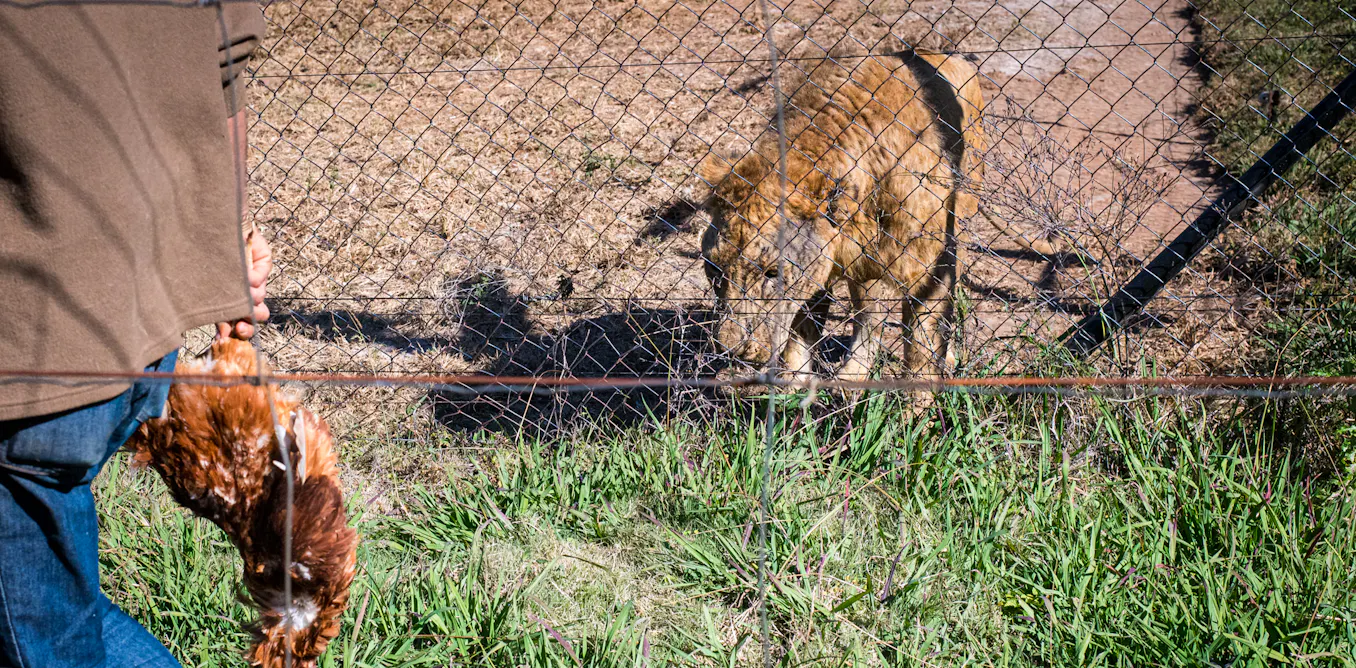
An estimated 8,000 lions are held in captivity in South Africa in about 350 places, ranging from zoos to tourism venues where people can interact up close with the big cats. Lions are also bred for live trade, trade in body parts and captive hunts.
Along with other predators, captive lions are held in conditions that vary from small enclosures of 250 square metres to larger enclosures of 5,000 square metres with more naturalistic features. Cubs, however, are often kept in crates or small pens.
South Africa’s commercial captive predator industry has been contentious for many years. The main concerns are the animals’ welfare, regulation, links to the international wildlife trade, health and safety risks to staff and tourists, and potential implications for the country’s tourism and conservation reputation.
We are researchers studying conservation, wildlife trade and animal welfare. In our latest study, using covert observation, we investigated commercial tourism venues for three years with a team of wildlife and animal welfare experts from the NGOs Blood Lions and World Animal Protection, and visited 34 commercial captive lion venues in South Africa’s Gauteng, Limpopo, North West and Free State provinces. Our aim was to understand what kind of living conditions exist in this sector of the commercial captive predator industry.
Different provincial and national laws apply to the captive lion sector. This results in a lack of coordination of legislation and policy. Provincial nature conservation authorities also don’t have the capacity to visit each facility to see if they are complying with the terms of their permits. We believed that many captive facilities weren’t complying with the laws around keeping lions, and that’s why we investigated these commercial venues.
We focused only on commercial venues open to the public for tourism activities, including viewing animals in captivity, petting and bottle-feeding cubs, and walking with young adult lions.
We also observed 607 individuals of other mammal species and found that tigers, leopards, servals and caracals were among the species most commonly kept for the same purposes. We observed 69 tiger cubs being used for interactions.
We scored the living conditions based on enclosure sizes, shelter, anything done to prevent boredom, quality of food, animal care and management, the frequency and intensity of tourist activities, social interaction with other lions, cleanliness of the enclosures, noise levels and naturalness of the lions’ immediate environment.
Our research found that not one venue scored highly. Overall, they only met basic animal needs and didn’t provide a high quality life for the lions. The quality of animal management, interactive activities and the natural environment received the lowest scores. Small enclosure sizes, inadequate shelter and bare enclosures, with little to explore or keep them occupied, were common.
These findings provide important evidence to inform policy and regulation for South Africa’s captive lion tourism industry. Even though the industry is big, there is limited scientific information on the welfare conditions of captive lions and other predators.
Our research fills an important knowledge gap by providing systematic data across a large number of commercial tourist venues.
Animal welfare conditions reveal systemic concerns
We found a range of different practices at commercial captive lion facilities. These included unsupervised viewing of lions, guided tours and direct contact with animals.
Restricted mobility: Lions in the wild have ranges of hundreds of square kilometres. In the venues we visited, they were confined to spaces as small as 250 square metres. Restricted environments limit opportunities for natural movement and behaviour and lead to problems like poor muscle development and chronic stress for lions.
Separating cubs from their mothers too soon: Bottle-feeding and cub-petting are common in the captive lion industry. Cubs are separated from their mothers at a very young age. Early maternal separation can have consequences for development and behaviour and can leave them without proper nutrition and expose them to stressful handling and surroundings.
Artificial social groupings: Cubs of different ages were housed together and, in some cases, lions were grouped with other species. This can contribute to aggression and social instability due to the incompatible nature of the animals kept together.
Animal-visitor interactions: Lion petting facilities had the worst welfare conditions. In some cases we found that lions were being handled and disturbed by humans for up to eight hours a day. Cubs were desensitised to humans and restricted from sleeping, resting and playing with siblings – a known problem.
An unexpected finding emerged: venues with higher welfare condition scores for lions tended to hold fewer individuals of other big cat species. More research is needed to find out why this is the case.
The other animals we observed were often held in much smaller enclosures than the lions. For example, three leopards were kept in an enclosure measuring 140 square metres, while a jaguar was kept in an enclosure measuring just 15 square metres. In some cases, the provincial enclosure requirements for these species are weaker than those for lions.
As with the lions, many of the other big cats had poor shelters and surroundings with little to explore or keep them occupied. Some animals displayed repetitive behaviours such as pacing, which can be an indicator of stress.
What needs to happen next
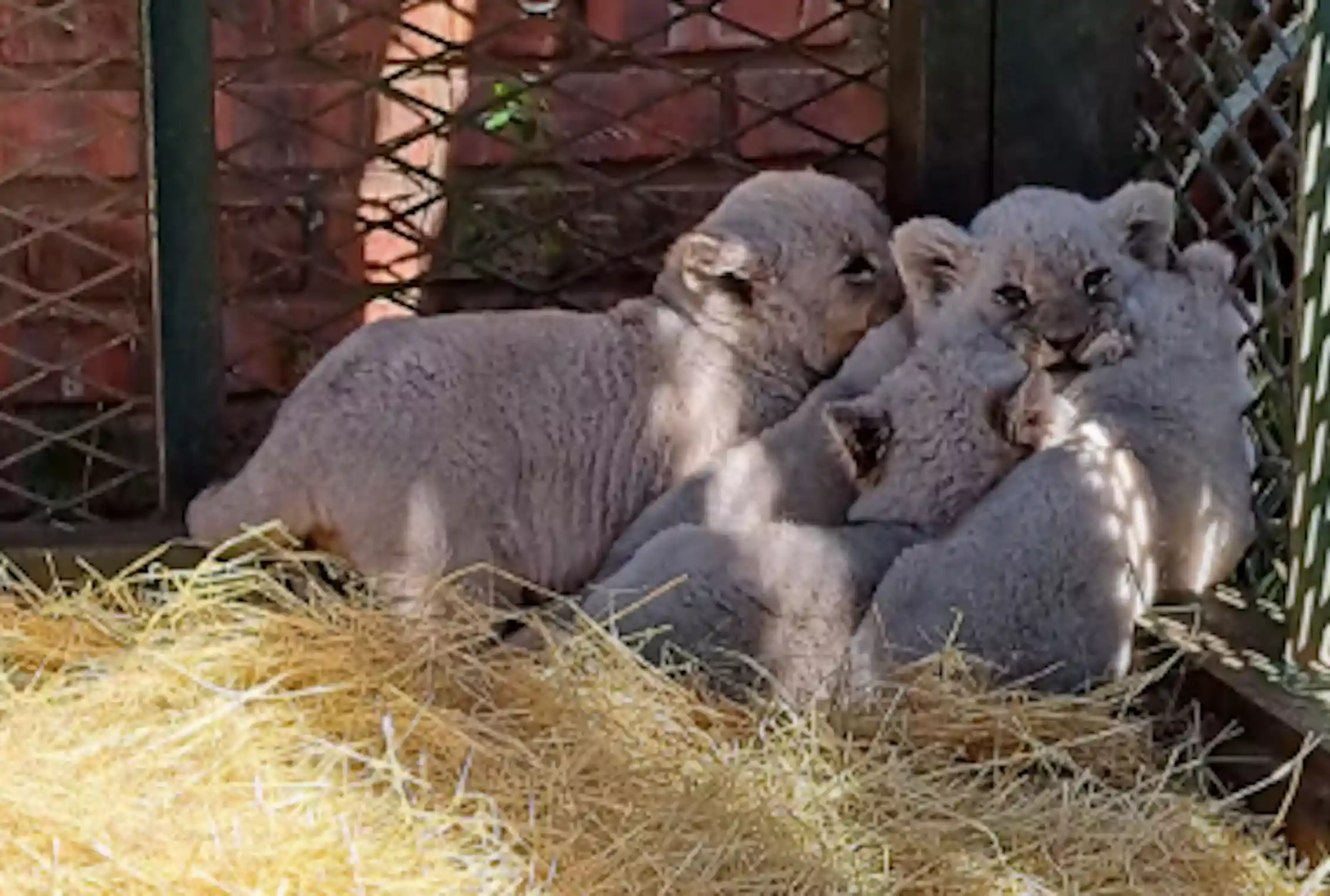
Courtesy Blood Lions.
Our research found that most provincial policies and legislation focus mainly on enclosure design, with much less attention to overall quality of life of the lion. Some include basic water and shelter requirements.
Our findings support the 2021 decision by the government to phase out the captive lion industry. But even if the government kept a closer eye on the industry and intervened to protect lions where necessary, our research suggests that the welfare problems are so widespread that only a total end to the industry will help the lions.
Because other big cats have similar problems, plans to phase out commercial lion breeding must include other captive predators. If not, businesses could simply switch to exploiting other species.
Captive animals need more than food and shelter: they need a good quality of life. Tourism should focus on seeing wild predators in their natural habitats, where they can live freely.

