

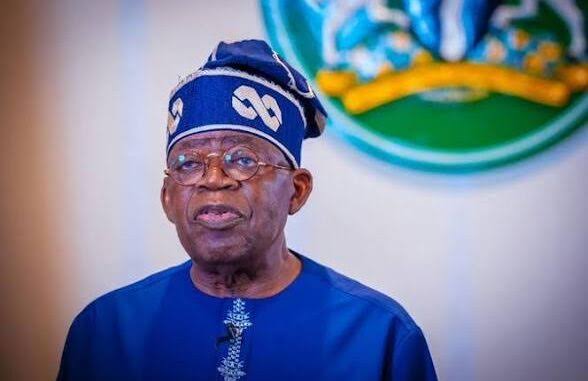
Tinubu: Nigeria breaking free from fuel import dependence
• Says 67m litres of petrol consumed daily before subsidy removal
ByAdewale SanyaoluandIsaac Anumihe,Abuja
PresidentBola Tinubu has said Nigeria’s ongoing reforms in the oil and gas industry are repositioning the country from dependence on imported petroleum products towards domestic refining, increased energy production and export opportunities.
The President stated this at the 20th edition of the OTL Africa Downstream Energy Week in Lagos, yesterday.
Tinubu, who was represented by the Permanent Secretary, Federal Ministry of Petroleum Reortunities for private investment, improving market efficiency and strengthening Nigeria’s capacity to process its natural re
The President described the milestone event as an important platform for bringing together policymakers, regulators, investors and industry operators to address the challenges and opportunities shaping Africa’s downstream energy sector.
He said Nigeria was moving away from a system characterised by heavy reliance on imported petroleum products towards one increasingly driven by domestic refining capacity, private-sector participation and a more competitive market.
According to him, the transformation reflects the government’s determination to establish a commerciallyng economic growth, industrialisation and job creation
Tinubu noted that the expansion of domestic refining capacity represented a significant development for Nigeria, with the potential to reduce pressure on foreign exchange, strengthen energy security and create new opportunities for exports.
He, however, stressed that sustaining the gains would require continued investment in infrastructure, efficient regulation, reliable energy supply and a business environment that encourages long-term capital commitments.
The President also highlighted the strategic importance of natural gas to Nigeria’s energy future, describing it as a critical reransition towards a more diversified energy economy
He said the government remained committed to developing the country’s gas res necessary to attract investments across the gas value chain
Meanwhile, President Bola Tinubu has said Nigeria consumed about 67 million litres of petrol daily before the removal of fuel subsidy, citing the figure as part of the justification for the government’s decision to end the policy.
Tinubu, represented by Vice President Kashim Shettima, spoke yesterday at the opening of the Nigerian Economic Summit Group (NESG) summit in Abuja, where he compared petrol prices in Nigeria with those of neighbouring African countries.
He said petrol sold for about $0.85 per litre in Niger Republic, equivalent to N1,148.36, while the price stood at $1.28, or N1,729.39, in Benin Republic.
In Cameroon, he said, a litre cost about $1.44, equivalent to N1,945.45, compared with N1,309 in Nigeria.
According to him, the price difference between Nigeria and its neighbours was no longer wide enough to justify the country continuing to subsidise petrol for domestic consumption.
“But 5, 6, 7 years ago, the only refinery in Cameroon was closed down because of the import of cheap Nigerian oil, unless we want to go back to the status quo of Nigeria being the godfather, or the Father Christmas of Africa, of Nigerian oil being a star.
“So, you have to make informed decision,” he said.
The President’s remarks came amid continuing debate over the effects of subsidy removal on households and businesses, particularly the increase in transport and production costs.
On the wider economy, Tinubu said the country was making progress, pointing to rising exports, a trade surplus and increased foreign investment as signs of improvement.
He disclosed that Nigeria exported goods worth N21.17 trillion in the first quarter of 2026, compared with imports valued at N13.62 trillion, resulting in a trade surplus of N7.55 trillion.
“In the first quarter of 2026, our exports of N21.17 trillion against imports of N13.62 trillion yielded a trade surplus of N7.55 trillion. Yet, crude oil accounted for 52.9 per cent of exports, while non-oil exports stood at N3.19 trillion.
“We must earn more from agricultural products, manufactured goods, processed minerals and digital services. We have put in place a system to connect with the grassroots. Our renewed homegrown development programme connects national priorities to community choices across 8,809 wards and 774 local government areas,” he said.
Tinubu said the government was working to diversify the economy by increasing earnings from agriculture, manufacturing, processed minerals and digital services instead of depending heavily on crude oil exports.
He also said capital importation rose to $10.37 billion in the first quarter of 2026, representing an 83.83 per cent increase over the corresponding period in 2025.
“Our development narrative is changing and investor confidence is returning. In the first quarter of 2026, our capital importation reached $10.37 billion, an increase of 83.83 per cent over the corresponding period in 2025. This comprises both portfolio and foreign direct investment,” he said.
The President added that the government would continue to reduce regulatory hurdles, improve transparency, make policies more predictable and expand access to finance for businesses.
He said the ongoing tax reforms were designed to establish a fairer and more modern system that could fund development while giving businesses greater certainty.
Tinubu also said the government was reforming the electricity market to improve power supply and attract investment in generation, transmission, distribution and alternative energy.
He disclosed that crude oil and condensate production reached 1.735 million barrels per day in June 2026, marking four consecutive months of growth, while food output reached its highest level in 74 months.
Earlier, NESG Chairman, Olaniyi Yusuf, warned that economic stabilisation alone would not guarantee prosperity, saying the next phase of reforms must focus on lowering production costs, improving infrastructure and increasing investment in productive activities.
“Stabilisation creates the conditions for progress; it does not automatically deliver it,” Yusuf said.
He noted that a more stable exchange rate would not automatically make Nigerian manufacturers competitive, stressing that businesses also needed reliable electricity, affordable financing, efficient transport infrastructure and predictable regulations to expand production and create jobs.
The summit, themed “Growth That Works: Delivering Jobs, Productivity and Shared Prosperity,” aims to strengthen cooperation between government and businesses to ensure that economic reforms translate into better living conditions for Nigerians.

