

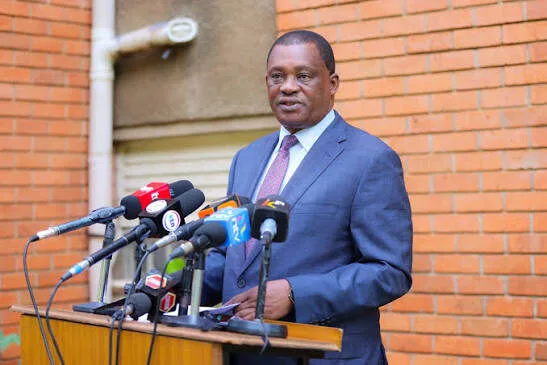
Kenya, Nov 2 – Democratic Party leader Justin Muturi has accused former Deputy President Rigathi Gachagua of political bullying and undermining efforts to unite the opposition ahead of the 2027 General Election, as rivalry between their parties over political influence in the Mt Kenya region intensifies
Muturi said Gachagua’s push for a tripartite political arrangement within the United Opposition risked fragmenting the coalition and weakening its chances of defeating President William Ruto.
The latest exchange also exposes the growing competition between Gachagua’s Democracy for the Citizens Party (DCP) and Muturi’s Democratic Party (DP) to consolidate their political bases in Mt Kenya, a region whose voting strength is expected to play a significant role in determining the outcome of the 2027 presidential contest.
Both leaders have been positioning themselves as influential voices in the region’s political future, with the contest for regional support adding another layer of complexity to negotiations within the opposition.
In a strongly worded statement, Muturi questioned Gachagua’s commitment to the collective presidential ambition of the opposition’s Wantam movement, warning that individual political interests should not take precedence over the broader goal of capturing State House.
“Gachagua must stop the political bullying, double-speak and self-sabotage,” Muturi said.
He argued that Kenya’s presidency could not be won through the support of one community, insisting that successful presidential campaigns required national consensus, strategic alliances and the ability to unite voters across ethnic and regional boundaries.
Muturi questioned whether the push for separate political formations was intended to strengthen the opposition’s presidential bid or give individual leaders greater control over parliamentary seats, legislators and devolved units.
“Is the objective to win the presidency or to control MPs, legislators and devolved units while sacrificing the bigger national ambition?” he posed.
The DP leader warned that insisting on a tripartite arrangement could create divisions within the opposition at a time when its leaders should be working towards a common political strategy.
His remarks come amid the contest for political dominance in Mt Kenya, where Gachagua has been seeking to consolidate his influence through DCP, while Muturi is also positioning the Democratic Party as a vehicle for political mobilisation in the region.
The rivalry raises questions about whether the two parties can work together in building a united opposition coalition or whether competition for the same political constituency could complicate efforts to agree on a common presidential candidate.
Muturi maintained that coalition-building required compromise, maturity and strategic thinking, arguing that having three separate political formations would not automatically guarantee victory in the presidential election.
He further cautioned Gachagua against treating political partnerships as contests for supremacy, saying no individual or community had a monopoly on the United Opposition.
“No individual owns the United Opposition, and no community has a monopoly on Kenya’s presidency. Political partnerships must be built on mutual respect, not ultimatums, political bullying or supremacy contests,” he said.
Muturi also invoked the political history of Gachagua’s family, recalling how his late brother, former Nyeri Governor Nderitu Gachagua, won the gubernatorial contest against TNA, the political vehicle that produced former President Uhuru Kenyatta, despite GNU supporting Uhuru.
He said the outcome demonstrated the complexities of political alliances and the fact that no political formation could claim ownership of the country’s political landscape.
Muturi warned that reducing presidential politics to ethnic arithmetic, regional strongholds and individual bargaining power could undermine the aspirations of Kenyans seeking political change.
He challenged opposition leaders to clarify whether they were building one national movement with a shared presidential ambition or establishing separate political kingdoms whose leaders would negotiate individual interests after the elections.
Muturi described the Komboa Kenya initiative as a national undertaking that required sacrifice, discipline, strategic thinking and genuine commitment to a common objective.
He said the Democratic Party remained open to dialogue with leaders committed to constructive negotiations but would not accept intimidation or attempts to undermine its principles.
“Kenya is bigger than any one politician. State House is the national prize. Unity must not be sacrificed at the altar of individual political survival,” Muturi said.

