

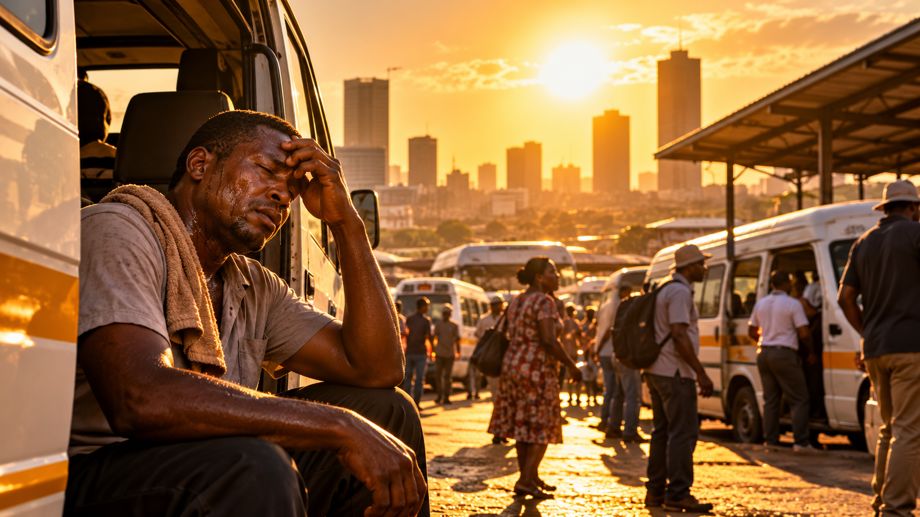
<a href="https://absafricatv.com/donald-trump-to-remove-rwanda-and-south-africa-from-us-trade-deal/" title="Donald Trump to remove Rwanda and South Africa from US trade deal”>South Africa’s Taxi Heat Crisis Exposes Major Gaps in Worker Safety and Climate Adaptation Plans
A WHO study warns that extreme heat threatens the health and livelihoods of South Africa’s informal taxi drivers and commuters, exposing gaps in transport infrastructure and affordable cooling solutions. The report urges stronger government action, community participation and equitable climate adaptation measures to protect vulnerable workers without increasing costs for low-income passengers.
The World Health Organization (WHO) and the South African Medical Research Council (SAMRC) have warned that rising temperatures are creating serious health and economic challenges for South Africa’s informal transport workers. A 2026 WHO case study, prepared by SAMRC researchers Caradee Y Wright, Thandi Kapwata, Candice Nkambule and Natasha Naidoo, examines how extreme heat affects minibus taxi drivers and commuters in Tshwane and eThekwini. Based on research conducted during 2023 and 2024, the study highlights inadequate transport infrastructure, financial difficulties and ethical challenges that make climate adaptation difficult. It emphasizes that protecting vulnerable workers requires affordable solutions, stronger government support and meaningful participation from communities most affected by climate change.
Rising Temperatures Put Millions of Commuters and Workers at Risk
Extreme heat is becoming a growing public health concern across African cities, particularly for people working outdoors or travelling in poorly ventilated vehicles. Approximately 80% of Africa’s urban population depends on public transport, exposing large numbers of commuters to potentially dangerous temperatures. Prolonged heat exposure can cause dehydration, headaches, dizziness, exhaustion and, in severe cases, life-threatening health complications.
South Africa’s minibus taxi industry is particularly vulnerable because it transports millions of passengers daily while operating under difficult economic conditions. Estimates suggest that approximately 130,000 to more than 200,000 licensed taxis operate across the country, generating tens of billions of rand annually.
Many taxi ranks have paved surfaces, metal roofing and limited vegetation, creating environments that absorb and retain heat. Drivers, marshals and passengers frequently spend long periods without adequate shade, drinking water or cooling facilities.
Researchers worked with taxi associations and municipal authorities in Tshwane and eThekwini, which include Pretoria and Durban. They interviewed drivers, installed temperature sensors inside vehicles and examined possible measures to reduce heat exposure.
Why Affordable Cooling Solutions Remain Difficult to Implement
One of the study’s most important findings is the gap between internationally recommended cooling technologies and the financial realities of informal transport operators.
Although air-conditioning and cooling centres are recognized methods of reducing heat exposure, drivers did not independently suggest these solutions during interviews. Instead, they relied on opening windows, drinking water and seeking shade.
Air-conditioning was considered too expensive because of installation costs, increased fuel consumption and narrow operating margins. Solar-powered cooling systems also presented financial challenges because of the initial investment required for panels and batteries.
Even basic protective measures proved difficult. Encouraging drivers to drink more water depends on reliable access to water points and sanitation facilities, which are often unavailable at taxi ranks.
Researchers proposed planting trees to provide natural shade, but municipal authorities rejected the suggestion because of concerns that tree roots could damage sidewalks.
An alternative awareness campaign involving stickers, calendars, brochures and other materials was planned. However, factional unrest within the taxi industry disrupted its implementation in Tshwane, forcing researchers to redirect prepared materials to primary health-care facilities.
Climate Adaptation Raises Questions of Fairness and Responsibility
Beyond physical health risks, the report highlights difficult ethical questions about protecting economically vulnerable workers without increasing their financial burdens.
Many taxi drivers must pay fuel expenses and fixed daily amounts to vehicle owners, regardless of passenger income. Introducing expensive cooling technologies could therefore increase operating costs and threaten already limited earnings.
Compensation also became controversial when some vehicle owners argued that they deserved payment because their vehicles were involved in the research, even though drivers were the formal participants.
Researchers faced another dilemma when selecting study locations. For safety and logistical reasons, they chose comparatively better-reties where heat exposure may be more severe
Fieldworkers also experienced emotional stress after witnessing poverty, difficult working conditions and limited access to essential services. The report recommends psychological support, regular debriefing and clear professional boundaries to protect research teams.
The study further warns that poorly communicated findings could damage public confidence in informal transport or encourage costly improvements that lead to higher passenger fares. Low-income commuters would face the greatest financial burden.
Stronger Government Action Needed to Protect Vulnerable Communities
Despite implementation challenges, the research strengthened cooperation between scientists, taxi associations and municipal authorities. Drivers became more aware of heat-related symptoms, while local governments received scientific evidence that could support future transport planning and public health policies.
The report emphasizes that successful climate adaptation requires community participation, affordable infrastructure and realistic financial arrangements. Authorities should consider practical improvements such as shade, drinking water facilities and better-designed waiting areas while ensuring that adaptation costs do not fall disproportionately on vulnerable workers and passengers.
Researchers also stress the importance of involving taxi drivers and industry representatives in decision-making rather than treating them merely as research participants.
Ultimately, the WHO study concludes that extreme heat is not simply an environmental problem but a growing challenge for public health, economic security and social justice. Protecting South Africa’s informal transport sector will require sustained cooperation between governments, researchers, transport operators and communities to ensure that climate resilience measures are practical, affordable and fair.
- FIRST PUBLISHED IN:
- Devdiscourse

