

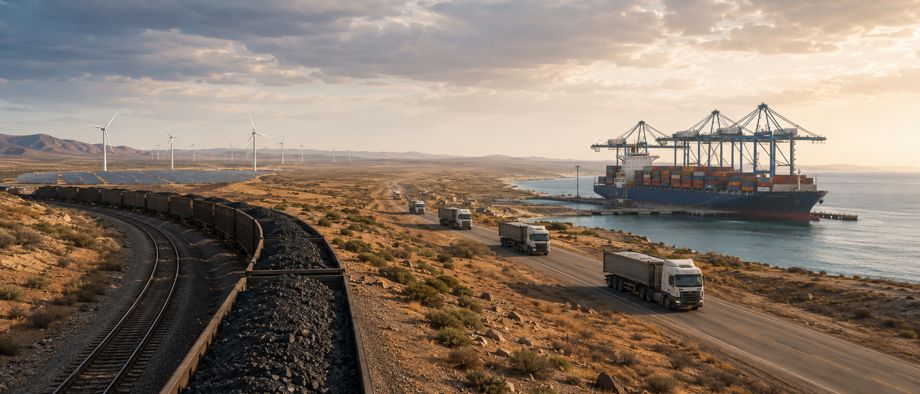
The Rules of Globalisation Are Working Against SACU’s Sustainability Goals

- Country:
- South Africa
Southern Africa’s oldest customs union was built to deepen trade, expand markets and strengthen regional economic cooperation. However, new research suggests that integration has not automatically translated into more efficient use of natural ree reinforcing the very production structures that hold the region back
This is the key finding of Global Integration and Sustainability Transitions in Southern Africa: The Effect of Economic Globalisation on Reed by Jacques de Jongh of North-West University’s TRADE Research Unit, the study examines Botswana, Eswatini, Lesotho, Namibia and South Africa over the period 1996–2023
The benefits of globalisation depend not simply on how much countries trade or invest, but on the institutional terms under which integration occurs. For SACU, deeper economic integration has been associated with lower reomic value from each unit of material it consumes
The study does not argue that trade itself is inherently damaging. Rather, it shows that global integration can become a sustainability liability when countries remain locked into commodity dependence, weak industrial diversification and unequal access to technology.
Integration is expanding faster than industrial upgrading
The research measures reestic material consumption. Higher productivity means an economy creates more output from the same quantity of raw materials; lower productivity suggests continued dependence on material-intensive activities
Across SACU, the average level of rewhile performance differed sharply among members. South Africa maintained a broadly upward trajectory, but several smaller economies stagnated or deteriorated. Lesotho’s decline became particularly visible after 2015, following the weakening of its textile sector and growing fiscal pressure
SACU is economically integrated but structurally unequal. South Africa dominates the bloc’s output, industrial base and negotiating weight, while Botswana, Lesotho, Namibia and Eswatini remain more exposed to narrow export structures, external demand shocks and limited domestic productive capacity.
The study also identifies a broader pattern of premature deindustrialisation. Manufacturing’s share of output declined across much of the bloc, especially in South Africa and Eswatini, while member states struggled to move into more advanced production systems. This helps explain why integration has failed to produce an efficiency dividend. Globalisation can improve resource use when economies absorb new technologies, enter higher-value stages of production and reorganise industry around more productive activities. However, where countries remain concentrated in mining, low-value agriculture or basic manufacturing, integration may simply expand the scale of material extraction and processing.
In other words, SACU appears to be integrating into the global economy faster than it is modernising its productive base. Export growth alone does not indicate structural progress. A country can sell more minerals, agricultural commodities or low-value manufactured goods while remaining dependent on large quantities of material inputs and retaining only a limited share of the final value.
The findings challenge a familiar policy assumption: that openness will eventually force efficiency. Without industrial upgrading, skills development and stronger domestic firms, openness may instead deepen existing specialisation.
The real drag comes from the rules, not the trade
The study separates economic globalisation into two dimensions:
- de facto globalisation:actual trade, financial flows, foreign investment, debt exposure and the diversity of trading partners.
- de jure globalisation:the policy and regulatory framework governing those flows, including trade agreements, tariffs, investment treaties, capital-account openness and WTO membership.
The study finds no statistically significant relationship between de facto globalisation and rejure integration. In other words, the problem does not appear to be the mere movement of goods and capital across borders. It lies more in the formal arrangements that shape those movements
Across the study’s models, a one-unit increase in the de jure globalisation index was associated with a decline of between 2.1% and 4.8% in reion rise in formal integration could correspond to an approximately 20% decline relative to the sample mean
These are associations rather than definitive causal estimates, but the pattern is still striking. The paper suggests several possible mechanisms. Trade and investment agreements may narrow the policy space available for domestic industrial development. Common tariff structures can reinforce existing comparative advantages in primary commodities. Strong intellectual-property protections can limit access to green technologies. Regulatory competition may also encourage countries to accept resource-intensive investment rather than risk losing capital to neighbouring markets.
Actual trade and investment flows can, in principle, spread technology and reorganise production more efficiently. Formal integration, however, can also produce regulatory arbitrage, comparative-advantage lock-in and unequal access to technology. This is not an argument against rules-based integration, but about whose development priorities those rules serve.
For economies on the periphery of global value chains, market access agreements may expand exports without enabling technological upgrading. If trade rules open markets but do not secure technology transfer, local value addition or environmental standards, they can consolidate an unequal division of labour: raw materials leave the region, while higher-value goods and technologies return at a premium.
SACU’s internal design magnifies the shock
The negative relationship between integration and renternal architecture. The customs union combines a common external tariff, free movement of goods and a revenue-sharing formula that redistributes customs and excise income. These mechanisms provide fiscal stability and support regional trade, particularly for smaller members, but the study argues that they may also weaken incentives for domestic diversification
The revenue-sharing system is especially important. For some smaller economies, transfers from the common revenue pool represent a majorty, it can reduce pressure to build a broader productive base. When public revenue depends more on regional customs receipts than on domestic industrial expansion, reforms that would improve re
The common external tariff creates another constraint. Individual members cannot always adjust tariffs independently to support green technologies, clean machinery or emerging industries. A tariff structure designed for regional coherence may therefore limit national experimentation.
The internal power imbalance further complicates the picture. South Africa accounts for roughly 90% of SACU’s combined GDP and plays the dominant role in shaping external agreements. Smaller members share the resulting obligations but do not possess the same industrial capacity, bargaining leverage or access to technology. This creates an internal core–periphery relationship layered on top of SACU’s peripheral position in the global economy.
South Africa may have greater capacity to absorb shocks, invest in efficiency and negotiate from a position of relative strength. Smaller members, by contrast, can face the same regulatory commitments without equivalent tools to adapt. The study suggests that they may therefore experience the negative effects of integration more intensely.
Natural-restently negative relationship between natural-remmodity dependence can weaken incentives for diversification and efficient allocation
The study also identifies strong path dependency. Past levels of reduction structures tend to reproduce themselves. Existing infrastructure, capital, skills and political interests remain tied to mining, agriculture, garments and other established sectors
Once such systems become entrenched, change becomes harder and more expensive. This is why trade reform alone cannot deliver a sustainability transition. The problem is not simply a bad tariff or an unfavourable treaty. It is a whole economic structure built around re
Green integration requires rewriting the regional bargain
SACU does not need less integration; it needs a different form of integration. Trade and investment agreements should be evaluated not only by their impact on market access, but also by whether they increase resource efficiency, enable technology transfer and support higher-value production. The author recommends using agreements with the European Union and the African Continental Free Trade Area to negotiate stronger environmental provisions, binding efficiency standards and green-technology commitments.
The common revenue pool could also be used more strategically. Rather than functioning mainly as a redistributive mechanism, part of it could finance a regional green-transition fund supporting cleaner infrastructure, industrial retrofitting and skills development. Such a fund would be especially valuable for smaller SACU members that lack the fiscal space to absorb the costs of technological upgrading.
The study also proposes lowering tariffs on clean-energy technologies and green industrial equipment. Revising the common external tariff in this way could reduce the cost of renewable-energy systems, efficient machinery and low-carbon production technologies across the bloc.
Industrial policy must accompany these trade reforms. SACU members need to move beyond exporting raw materials toward processing, manufacturing and regional value-chain participation. Opportunities may exist in mineral beneficiation, renewable-energy components, circular production, agro-processing and re
Yet policy must also address governance. The research finds that rether, while rehat weak institutions are not merely an external obstacle; they can become part of a self-reinforcing system in which reour
A regional environmental framework could help prevent a race to the bottom, align standards and give smaller members greater protection against unequal bargaining outcomes.
Notably, the study covers only five countries, reducing statistical precision and limiting the extent to which its findings can be generalised to other regional blocs. Its econometric approach accounts for shared shocks and country differences, but it does not fully eliminate reverse causality or structural endogeneity. The author therefore advises interpreting the findings as conditional associations rather than definitive causal estimates.
Future research should extend the analysis to the Southern African Development Community, examine individual countries in greater detail and identify which sectors transmit the strongest effects. More evidence is also needed on the role of global value chains and whether green clauses in trade agreements lead to measurable productivity improvements.
- FIRST PUBLISHED IN:
- Devdiscourse
