

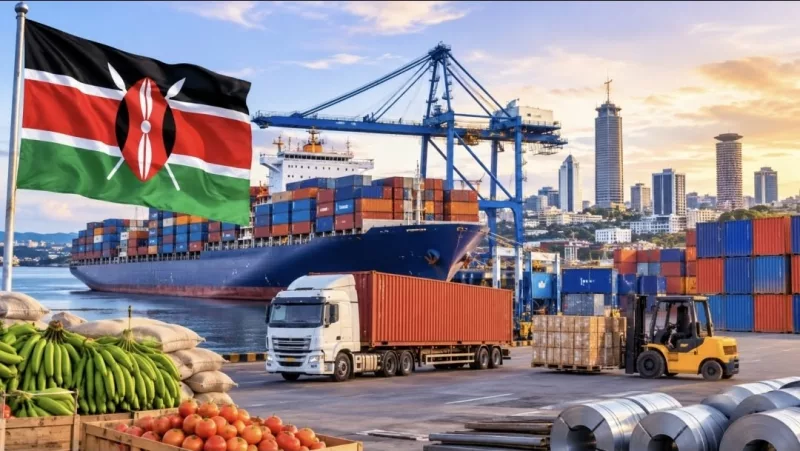
Kenya’s economic debate has for too long concentrated on attracting foreign investment, borrowing more money and increasing exports. While these are important, there is another question we must confront: how much of the foreign exchange we earn do we unnecessarily send back out of the country?
A sustainable economy is not just about earning dollars. It is equally about retaining more of those dollars within our domestic economy.
Kenya needs a deliberate strategy to increase exports, reduce dependence on imported finished products, develop local manufacturing, expand tourism and mineral exports, and accelerate renewable energy and electric mobility.
The objective is simple: earn more foreign currency, spend less unnecessarily abroad and keep more money circulating at home.
The foreign exchange leakage
Kenya’s merchandise imports reached approximately KSh2.7 trillion in 2024, against exports of approximately KSh1.1 trillion Our export earnings therefore covered only about 41 per cent of our merchandise import bill
Petroleum products alone accounted for approximately KSh552.5 billion in imports during 2024.
Consider the fuel question. Every time Kenya imports petroleum, we send billions of shillings’ worth of foreign exchange outside our economy, much of it towards international suppliers and trading hubs in the Middle East and other oil-producing markets.
The more fuel we buy, the more money we send out. We then pay again through higher transport costs, manufacturing expenses, agricultural distribution costs and ultimately more expensive commodities.
We are importing not just fuel, but a cost structure that makes almost every other sector more expensive.
Electric mobility and renewable energy
Kenya should view electric vehicles (EVs) as an economic opportunity, not merely an environmental initiative.
EVs have fewer moving mechanical components than conventional vehicles, require less routine mechanical servicing and eliminate several conventional replacement items. More importantly, they can run on locally generated electricity, reducing dependence on imported petroleum.
Kenya has substantial geothermal, hydro, wind and solar potential. Expanding renewable energy in factories, commercial buildings, farms and hotels can further reduce energy costs.
However, importing EVs and solar equipment alone is not enough. We must develop local vehicle assembly, battery servicing, charging infrastructure, electrical components and technical skills.
Agriculture, tourism and minerals
Agriculture must evolve from exporting raw produce to exporting value-added products. Tea, coffee, flowers, vegetables, fruits, meat, honey and processed foods offer opportunities to earn more foreign exchange.
We should deliberately open new markets in the Middle East, Asia, <a href="https://absafricatv.com/made-in-europe/” title=”Made in Europe”>Europe and Africa.
Tourism must go beyond traditional safaris and beach holidays. Medical tourism, conference tourism, sports tourism and specialised hospitality can attract higher-value international visitors.
Our mineral reer opportunity. Local processing means more jobs, industrial capacity and export value
A practical national policy action plan
Kenya needs a National Foreign Exchange Retention and Production Strategy, built around six interventions:
Import substitution: Identify the top 50 commerciallyfer time-bound tax incentives, affordable industrial financing and technology partnerships to competitive manufacturers
Export expansion: Establish an export development programme targeting new markets in Africa, Asia and the Middle East. Strengthen export financing, certification, market intelligence and trade facilitation for farmers and manufacturers.
Energy transition: Accelerate EV adoption through incentives for local assembly, electric buses, motorcycles and commercial fleets. Expand solar installations, geothermal generation and renewable-powered industrial parks.
Agricultural and mineral value addition: Invest in agro-processing, cold-chain infrastructure, storage, packaging and mineral processing zones near production areas. Encourage private-sector investment and farmer cooperatives.
Strategic government procurement: Within Kenya’s trade obligations, prioritise competitive locally manufactured products in public procurement, creating predictable demand for domestic industries.
Foreign exchange accountability: Require relevant ministries and agencies to publish an annual import-substitution and export-performance scorecard. Track fuel import expenditure, local manufacturing growth, export earnings and foreign exchange savings.
These measures must be coordinated across the National Treasury, Trade, Energy, Agriculture, Transport and Investment Promotion agencies, with clear timelines and measurable outcomes.
A different measure of economic success
Reducing imports does not mean closing our borders or violating trade agreements. It means distinguishing between imports that build productive capacity and finished products we can competitively manufacture ourselves.
A stronger shilling requires a stronger productive economy, reduced dependence on imported fuel, competitive industries and diversified export earnings.
This is not economic isolation. It is economic intelligence.
We must continue trading with the world, but become more deliberate about what we buy, manufacture, process and sell.
The question is not simply how Kenya can earn more foreign exchange. It is how we can stop sending so much of what we earn back out of the economy and instead use it to build industries, create jobs and secure our economic future.
Mulumi Mwangi is an entrepreneur, marketing consultant and business strategist with experience across agribusiness, real estate, technology, advertising and enterprise development.

