


Beyond connection: The challenge of expanding electricity access in Sub-Saharan Africa
- Tony Fujs
- Haruna Kashiwase

Electricity access is often measured by a simple question: is a household connected with power? But a connection does not necessarily mean that power is reliable, affordable, or sufficient for everyday needs.
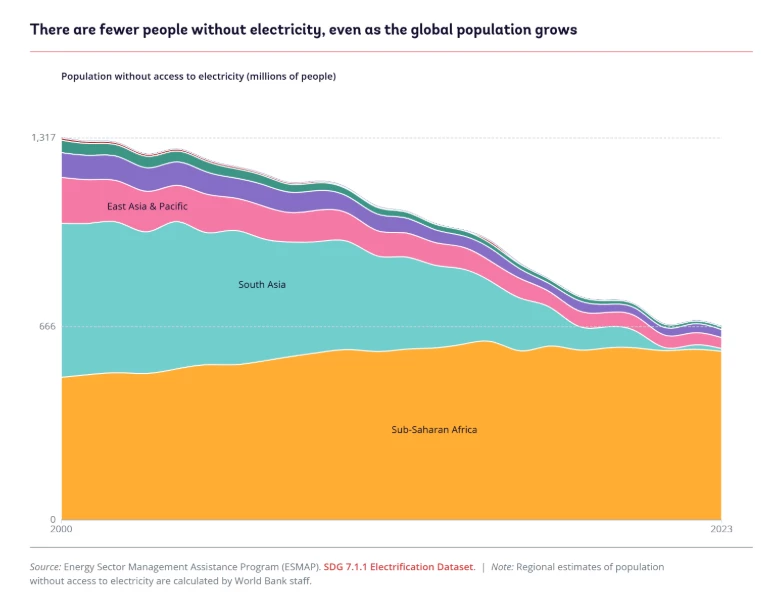
The World Bank Group’s Atlas of Global Developmenthighlights both the progress made and the scale of the remaining challenge. In 2023, 666 million people worldwide still lacked any connection to electricity. The shortfall was concentrated in Sub-Saharan Africa, where 581 million people remained without access.
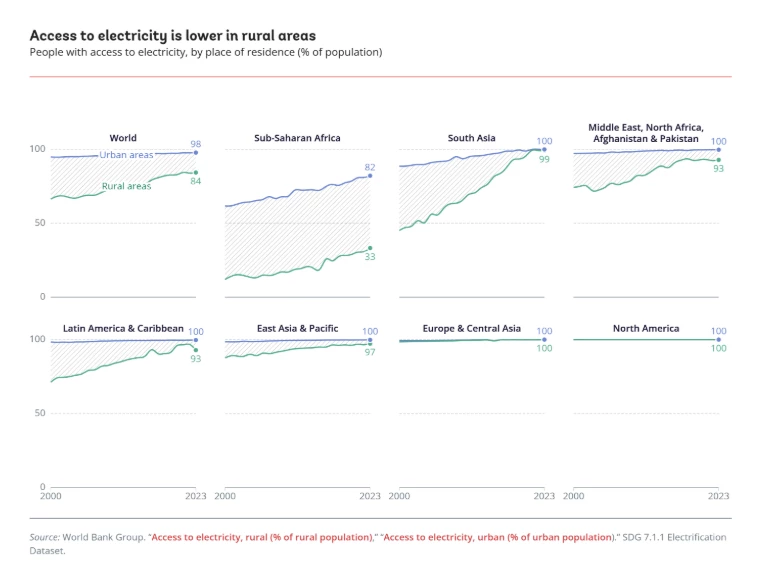
Within Sub-Saharan Africa, the urban-rural divide remains particularly pronounced. Across the world, rural electricity access has improved over time, but in Sub-Saharan Africa only about one in three rural residents still had electricity in 2023, compared with more than four in five urban residents. The gap reflects the difficulty of extending conventional grids to remote and sparsely populated communities, where high infrastructure costs and limited electricity demand make investments less economically viable. This highlights the need for solutions that fit local conditions.
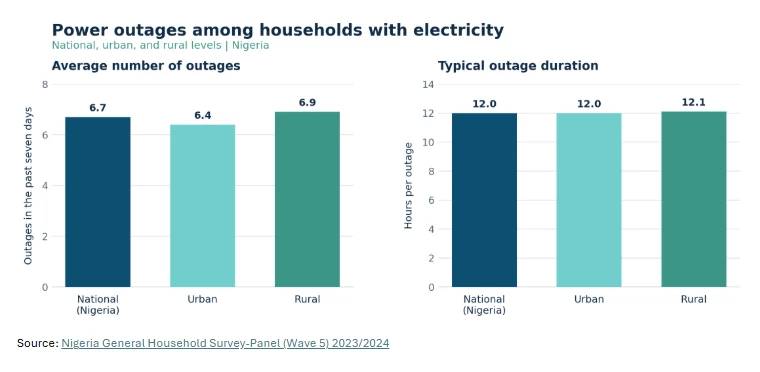
Even where households have a connection, service can fall short. In Nigeria, households report an average of nearly seven power outages in a seven-day period, with each outage typically lasting about 12 hours. Despite the large urban- rural divide in access, reliability is similarly poor in both areas, with households experiencing frequent and prolonged outages.
Many turn to diesel or petrol generators to keep essential services running, bringing additional costs and pollution. The example points to a broader lesson: counting connections alone can obscure the quality of the service people receive.
Expanding the grid remains important, particularly where it is the most practical and cost-effective option. But for remote communities, mini-grids and solar home systems can offer alternatives. Stronger utilities and more reliable supply matter too: access should mean more than a light that works some of the time.
Mission 300, launched by the World Bank Group and the African Development Bank, aims to extend electricity access to 300 million people in Africa by 2030. Meeting that ambition will require a focus not only on how many people gain a connection, but also on whether the electricity they receive is dependable and useful in daily life.
The central message is simple: a connection is the first milestone, but further steps include bringing reliable and affordable access. Measuring access alongside reliability and service quality gives a fuller picture of whether electricity is helping households and businesses thrive.
Note: This blog draws on the electricity access data and analysis presented in the Atlas of Global Development 2026, released in May 2026. More recent estimates are available in the World Development Indicators and may differ from the figures presented here.
Tony Fujs
Haruna Kashiwase
Statistician, Development Data Group, World Bank

