

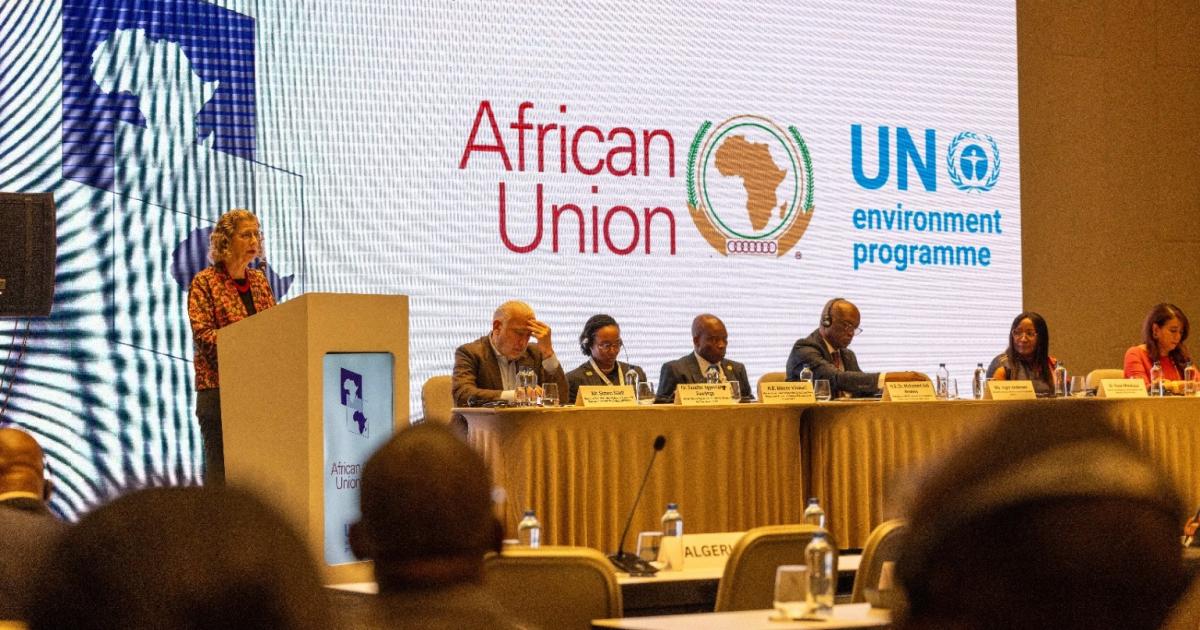

Speech Delivered By
Inger Andersen
Event Name
AMCEN Ministerial
Location
Antalya, Türkiye
Published on
15 Nov 2026
Body
Colleagues and friends.
It is a pleasure to be here in beautiful Antalya during these crucial climate negotiations.
My thanks to Your Excellency Dr Mohamed Sidi Ibrahim for your leadership of the African Ministerial Conference on the Environment (AMCEN). Your focus on AMCEN’s strategic direction, including preparations for the 21st Ordinary Session next March in Addis Ababa, and your message of solidarity with the African Group of Negotiators, is crucial for the work ahead.
My thanks also to the African Union Commission, through Your Excellency Mr Moses Vilakati, for the continued and helpful collaboration with UNEP as the host of the AMCEN Secretariat.
I commend African nations for putting forward a common, clear and consistent position at COP31. Decisions taken here in Antalya will shape the road to COP32 in Addis Ababa in November 2027, so your engagement is crucial.
You have rightly highlighted that the international community must do far more on adaptation finance, loss and damage, and the means of implementation. This is particularly important as we enter a period of overshoot of 1.5°C.
UNEP’s Emissions Gap Report 2026: The Point of Return shows that we can come back from overshoot through a ‘lowest possible’ 1.5°C overshoot scenario, in which peak warming is limited to 1.7-1.8°C by around the middle of the century. There would also be a need for increasing use of Carbon Dioxide Removal – the process of removing carbon from the air and storing it through afforestation or other means – to assist in a return to 1.5°C.
To make this scenario a reality, nations, particularly those most responsible for the climate crisis, must go far beyond current Nationally Determined Contributions (NDCs) and slash greenhouse gas emissions.
But even if the world succeeds in this task, we will face more-frequent and more-intense climate impacts. Droughts. Floods. Shifting seasons. And we will likely face irreversible losses and changed conditions even if we return to 1.5°C. These losses and changes will hit least-developed countries and small island developing states the hardest.
So, effective and well-financed climate adaptation is essential to reduce risks, strengthen resilience, protect development and save lives. UNEP’s Adaptation Gap Report 2026: Ready? Not. tells us that we are nowhere near having sufficient adaptation in place for the countries and communities that that need it most.
International public adaptation finance flows from developed to developing countries did grow by US$1 billion between 2023 and 2024. But the pace of growth is slowing when it should be accelerating to reach the needs of around US$305 billion per year in the coming decade.
We also face the issue of losses and damages, responses to which remain insufficient. The initial funding round envelope of the Fund for responding to Loss and Damage was US$342 million, but developing countries submitted requests totalling around eight times that value.
Africa is home to the highest number of least developed countries, half of the world’s landlocked developing countries, and a significant share of small island developing states. You face heightened climatic vulnerability that continues to imperil lives, livelihoods and infrastructure. And you bear the least responsibility for this climate crisis.
So, the findings of UNEP’s reports reinforce Africa’s justified call for scaled-up, accessible and predominantly grant-based support for adaptation and losses and damages. They reinforce the need to intensify efforts to achieve the COP30 Global Mutirão call for efforts to triple adaptation finance by 2035. And they reinforce the need for a just transition that expands energy access, creates jobs and protects development space.
But Africa is not only calling for action. Africa is acting itself, particularly in the renewable energy space.
Since 2020, Africa has added more than 20 GW of renewable energy capacity, bringing total installed renewable power capacity to approximately 82 GW by the end of 2025. This growth has been driven by investments in solar, wind and hydropower, demonstrating Africa’s growing leadership in clean energy development.
Africa’s private sector is also increasingly delivering solutions. Independent power producers are developing utility-scale solar and wind projects for national grids. Innovative companies are deploying solar home systems, mini-grids and distributed renewable energy solutions that are powering communities beyond the reach of conventional electricity networks.
African financial institutions are also stepping up. The African Development Bank has placed renewable energy and energy access at the centre of its investments and has established initiatives such as the Sustainable Energy Fund for Africa, the Africa Green Bank Initiative, Desert to Power and Mission 300 to mobilize public and private capital for renewable energy deployment across the continent.
Yet the expansion of renewable energy must ultimately be measured by its impact on people’s lives. Today, Sub-Saharan Africa remains home to more than 560 million people without access to electricity and around 970 million people without access to clean cooking. Closing these gaps is essential to advance economic development, public health, jobs and human well-being across the continent.
There is ample opportunity for Africa to close these gaps, since the continent holds over 60 per cent of the world’s solar potential. The challenge is not one of renewable re
May your deliberations today strengthen Africa’s collective influence in climate negotiations and set a clear course toward a climate-resilient and prosperous future for the African continent.
Be assured that we at UNEP will continue our commitment to Africa. Support Ethiopia’s Presidency and wider African effort to make COP32 deliver for people and planet. Implement the priorities you set at AMCEN 20 last year, including the pathway toward the joint AMCEN21 and Conference of Ministers of Finance in Addis Ababa in March 2027. And continue to deliver projects that build resilience, restore ecosystems, expand clean energy access and create decent green jobs.
Category
Speech
Topics
Climate action
SDG tags
Image
Goal 13: Climate Action
(opens in a new tab)Goal 13: Take urgent action to combat climate change and its impacts
Image
Goal 3: Good Health and Well-Being
(opens in a new tab)Ensure healthy lives and promote well-being for all at all ages
Image
Goal 15: Life on Land
(opens in a new tab)Sustainably manage forests, combat desertification, halt and reverse land degradation, halt biodiversity loss

